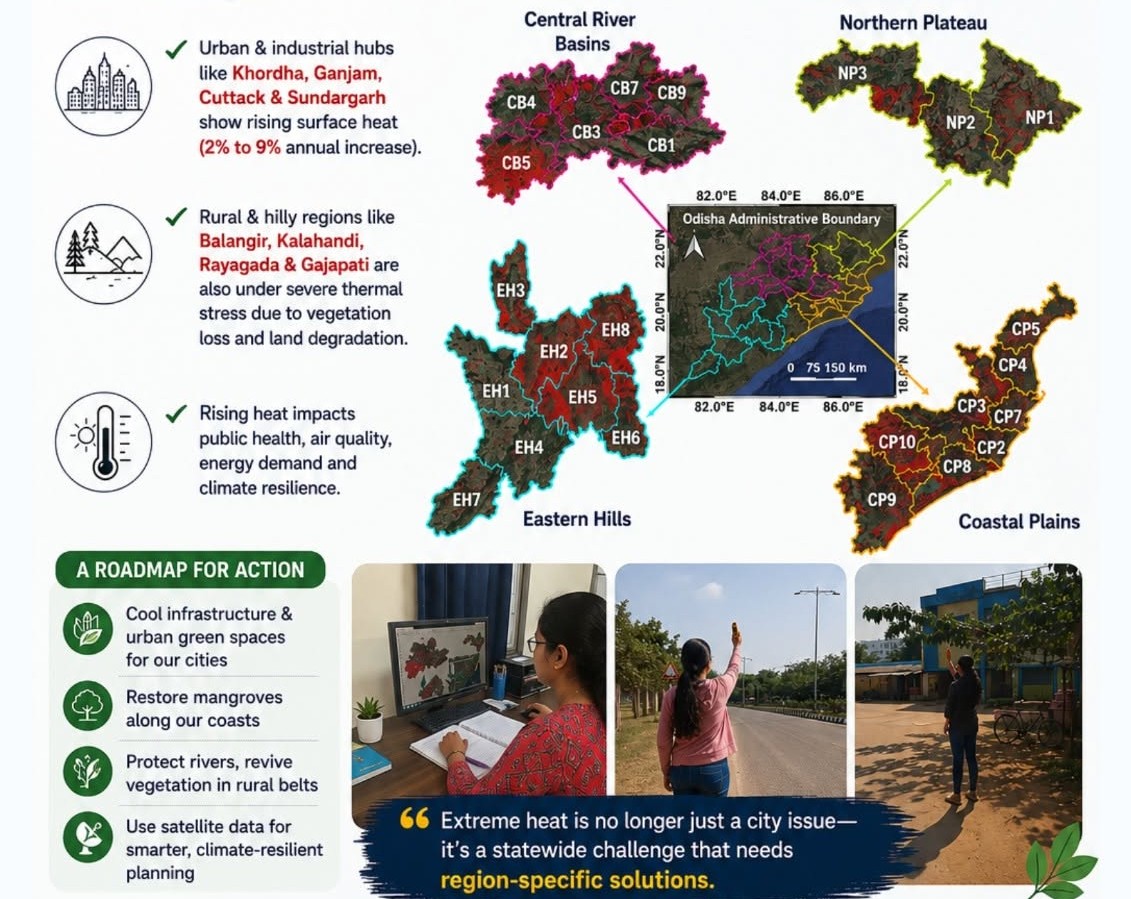
Bhubaneswar: Thermal hotspots are expanding rapidly across Odisha, with both urban centres and ecologically sensitive regions experiencing rising land surface temperatures due to urbanisation, industrial growth and changing land-use patterns, according to a new study by researchers from the Indian Institute of Technology (IIT) Bhubaneswar.
The research, carried out by Dikshika Mahapatra and Dr. Debadatta Swain of the School of Earth, Ocean and Climate Sciences, has been published in the Royal Society of Chemistry’s journal Environmental Science: Advances. The study examined two decades of satellite data to track the evolution of land surface thermal hotspots across all 30 districts of the state.
The analysis showed that rapidly urbanising districts such as Khordha, Ganjam, Cuttack and Sundargarh have recorded a consistent rise in extreme surface temperatures. In several coastal districts, thermal hotspot coverage has expanded by 2 to 9 per cent annually, indicating the growing influence of urban expansion and industrial activity.
The researchers also found that the phenomenon is spreading beyond cities. Districts such as Balangir, Kalahandi, Rayagada and Gajapati are witnessing persistent thermal stress, largely driven by forest degradation, vegetation loss and the increasing extent of barren land.
According to the study, the expansion of thermal hotspots could have significant implications for public health, energy demand and environmental sustainability, as prolonged exposure to high surface temperatures can intensify heat-related risks and place additional pressure on infrastructure and natural ecosystems.
To mitigate the impacts, the researchers have recommended region-specific measures, including increasing urban green cover, developing heat-resilient infrastructure, restoring mangroves and riverbank vegetation, and incorporating high-resolution satellite data into urban planning and environmental management.
The study highlights the importance of adopting climate-responsive planning and sustainable land management practices to address the growing heat challenge and build resilience against the impacts of climate change in Odisha.
Bhubaneswar: Recognising their gold medal-winning performances at the 2026 Asian Games in Japan, Odisha Chief…
Bhubaneswar: Two school-going sisters from Odisha have used a multiplication table to deliver a social…
Bhubaneswar: The Satwalipi Committee on Mahaprabhu Lingaraj Temple has submitted its third interim report to…
Bhubaneswar: Odisha will organise a state-level summit to finalise priorities and accelerate the implementation of…
Bhubaneswar: The Housing and Urban Development Department has asked Urban Local Bodies (ULBs) across Odisha…
Bhubaneswar: From exploring ancient temples and the story of Odisha’s capital city to discovering local…