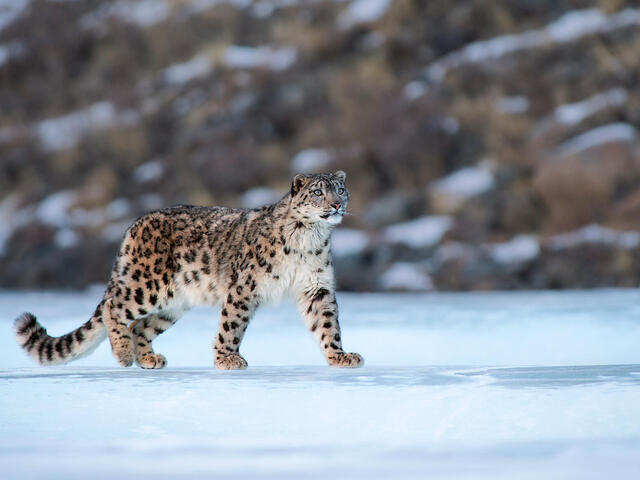
Snow Leopard Population Assessment: 718 Individuals Identified in India (PC: WWF)
New Delhi: Bhupender Yadav, the Union Minister of Environment, Forest, and Climate Change, unveiled the report on the Status of Snow Leopards in India during the National Board for Wildlife meeting in New Delhi. The groundbreaking Snow Leopard Population Assessment in India (SPAI) Program, led by the Wildlife Institute of India (WII), reported a snow leopard population of 718 individuals in the country.
The SPAI Program, conducted from 2019 to 2023, systematically covered over 70% of the potential snow leopard range in India. This scientific exercise involved collaboration with snow leopard range states and two conservation partners, the Nature Conservation Foundation, Mysuru, and WWF-India. The study covered approximately 120,000 km2 of crucial snow leopard habitat across the trans-Himalayan region, including Union Territories of Ladakh and Jammu & Kashmir, and states such as Himachal Pradesh, Uttarakhand, Sikkim, and Arunachal Pradesh.
The two-step framework of the SPAI involved evaluating snow leopard spatial distribution using an occupancy-based sampling approach, followed by estimating snow leopard abundance through camera traps in each identified stratified region. During the SPAI exercise, 13,450 km of trails were surveyed, and camera traps were deployed at 1,971 locations for 180,000 trap nights. The study recorded snow leopard occupancy in 93,392 km2, with an estimated presence in 100,841 km2. A total of 241 unique snow leopards were photographed.
The estimated snow leopard population in different states is as follows: Ladakh (477), Uttarakhand (124), Himachal Pradesh (51), Arunachal Pradesh (36), Sikkim (21), and Jammu and Kashmir (9).
Before 2016, around one-third of the snow leopard range in India received minimal research attention. However, recent status surveys have significantly increased understanding, providing preliminary information for 80% of the range compared to 56% in 2016. The report emphasizes the need for consistent monitoring to ensure the long-term survival of snow leopards and proposes establishing a dedicated Snow Leopard Cell at WII under the Ministry of Environment, Forest, and Climate Change. Regular population estimation every fourth year is recommended for effective conservation strategies.
Bhubaneswar: The inaugural edition of the National Indoor Athletics Championships is set to begin on…
Bhubaneswar: In a bid to enhance urban safety and emergency readiness, the Housing & Urban…
Bhubaneswar: The Kala Bhoomi museum celebrated its 8th Foundation Day on Sunday at Gandamunda with…
Bhubaneswar: Amid growing concerns over safety in healthcare facilities, Health & Family Welfare Minister Dr.…
Bhubaneswar: Marking the World Water Day celebrations, Chief Minister Mohan Charan Majhi on Sunday inaugurated…
Bhubaneswar: The Higher Education Department, Government of Odisha has released the admission schedule for two-year…