Mohali: In a groundbreaking discovery, researchers have identified common metabolites across different cancer types, including pancreatic cancer and glioma, suggesting their potential as universal cancer biomarkers. This finding offers a promising non-invasive method for early cancer diagnosis and could pave the way for more effective therapeutic strategies.
Aggressive cancers like pancreatic cancer and glioma, which develops in the glial cells of the brain and spinal cord, are often diagnosed at an advanced stage, leading to poor prognoses. The lack of reliable early detection methods makes it crucial to develop new biomarkers that can aid in timely diagnosis and intervention.
Researchers from the Institute of Nano Science and Technology (INST), Mohali, an autonomous institute under the Department of Science and Technology (DST), have focused on exosomes, which act as nano messengers carrying tumor-derived metabolites. These tiny extracellular vesicles provide insights into the tumor microenvironment (TME) and can serve as potential biomarkers for cancer detection.
The study, conducted by Ms. Nandini Bajaj and Dr. Deepika Sharma, analyzed exosomes derived from pancreatic cancer, lung cancer, and glioma cell lines. Their findings revealed common metabolites that could serve as universal cancer biomarkers, improving clinical applicability and leading to more precise, targeted therapies.
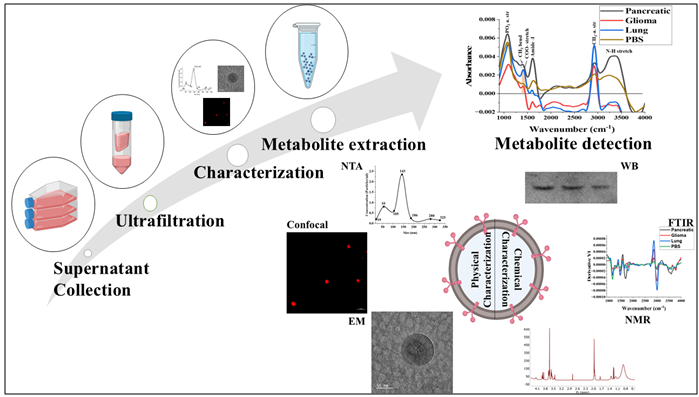
The researchers employed a multi-technique approach to characterize exosomes comprehensively, surpassing conventional single-method studies. Their methodology included:
- Nanoparticle Tracking Analysis (NTA)
- Electron Microscopy (EM)
- Western Blot (WB)
- Fourier Transformed Infrared Spectroscopy (FTIR)
- Untargeted Liquid Chromatography-Tandem Mass Spectrometry (LC-MS/MS)
- Nuclear Magnetic Resonance (NMR)
This in-depth analysis provided a clearer understanding of metabolic interactions within tumors, advancing research in cancer diagnostics, personalized medicine, and treatment strategies.
The identified metabolites shed light on dysregulated pathways in the tumor microenvironment, revealing how cancer progresses. These insights not only enhance early detection methods but also offer avenues for targeted therapies that can disrupt abnormal metabolic pathways, improving treatment outcomes and reducing side effects.
Published in the journal Nanoscale, this research could revolutionize cancer diagnostics and treatment, especially through personalized precision medicine approaches. With further advancements, these findings hold the potential to significantly improve patient survival rates and quality of life.