New Delhi: The ancient Buddhist site of Sarnath in Uttar Pradesh has been inscribed on the UNESCO World Heritage List, becoming India’s 45th World Heritage property after the decision was taken at the 48th Session of the World Heritage Committee in Busan, South Korea.
The recognition came after the World Heritage Committee approved India’s nomination for the 2025–26 cycle. Prime Minister Narendra Modi, Union Culture Minister Gajendra Singh Shekhawat and Uttar Pradesh Chief Minister Yogi Adityanath hailed the achievement, describing it as a proud moment for the country and its rich cultural heritage.
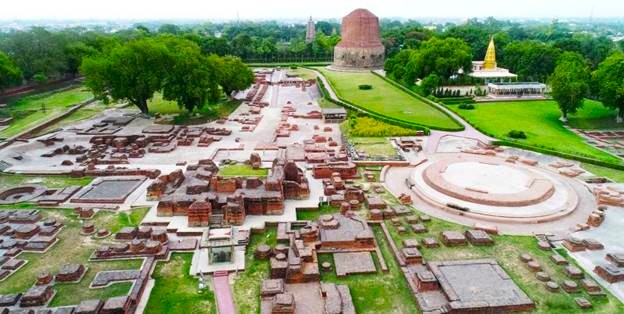
The inscription covers two components—the Chaukhandi Stupa and the Archaeological Remains of Sarnath, which include the Dhamekh Stupa, Dharmarajika Stupa, Mulagandhakuti Vihara and the Ashokan Pillar. Located near Varanasi, Sarnath is revered in Buddhism as the place where Gautama Buddha delivered his first sermon, known as the Dharmachakra Pravartana or “Turning of the Wheel of the Law,” marking the beginning of the Buddhist Sangha.
Recognised under UNESCO criteria (iii) and (vi), the site was acknowledged for its outstanding testimony to Buddhist traditions and its direct association with events of exceptional religious significance. Over the centuries, Sarnath evolved into one of Buddhism’s most important pilgrimage centres, with monasteries, temples and stupas built through royal and monastic patronage before its decline in the 12th century.
The Archaeological Survey of India (ASI), which has been excavating and conserving Sarnath for over 150 years, played a key role in preparing the successful nomination. The proposal, first placed on UNESCO’s Tentative List in 1998, was formally submitted in January 2025 and underwent an 18-month evaluation process, including technical reviews by UNESCO’s advisory body ICOMOS.
The excavations at Sarnath led to the discovery of the famed Ashokan Lion Capital, later adopted as India’s National Emblem, and the Dharmachakrapravartana Buddha image, considered a masterpiece of Gupta art. The artefacts are preserved at India’s earliest site museum, established at Sarnath in 1904.
With Sarnath’s inclusion, three of the four principal Buddhist pilgrimage sites—Lumbini in Nepal, the Mahabodhi Temple at Bodh Gaya and Sarnath—are now on the UNESCO World Heritage List. The inscription is also expected to strengthen India’s cultural diplomacy with Buddhist-majority countries, including Japan, Sri Lanka, Thailand, Myanmar, Cambodia, Vietnam, South Korea and Mongolia.
India now ranks sixth globally and second in the Asia-Pacific region in terms of the number of UNESCO World Heritage Sites. The country currently has 69 properties on UNESCO’s Tentative List, from which one site can be nominated each year for World Heritage consideration.