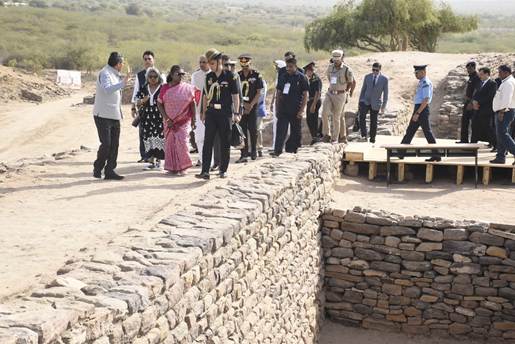
Dholavira: President of India, Droupadi Murmu, visited the UNESCO World Heritage Site of Dholavira in Kachchh district, Gujarat, today, appreciating the meticulous conservation efforts undertaken by the Archaeological Survey of India (ASI) to preserve this ancient Harappan city.
Accompanied by the Governor of Gujarat and other dignitaries, the President expressed deep admiration for the architectural and engineering brilliance of the Harappan civilization. She remarked that Dholavira’s sheer scale and complexity would require at least three to four days to explore and fully comprehend its significance.
President Murmu was particularly impressed by the technological advancements of the Harappans, noting that in many aspects, their urban planning, water management, and engineering skills surpassed even modern standards. She highlighted the importance of such sites in understanding India’s rich and sophisticated past.
The Director General of ASI, Y. S. Rawat, along with senior officials, guided the President through the key discoveries at the site, explaining the ongoing conservation and upgradation initiatives aimed at preserving this historical treasure.
Dholavira is among the most well-preserved and significant archaeological sites in the Indian subcontinent, offering a glimpse into the urban planning, water conservation systems, and social structures of the Harappan people. The site showcases an advanced town planning system, featuring well-structured reservoirs, drainage systems, and large urban settlements that demonstrate the ingenuity of one of the world’s earliest civilizations.
With its inclusion in the UNESCO World Heritage Site list in 2021, Dholavira has gained international recognition, attracting scholars, archaeologists, and history enthusiasts from around the world.
President Murmu’s visit underscores the importance of preserving India’s rich archaeological heritage and creating public awareness about its historical treasures. She reaffirmed the commitment of the government to protect and promote India’s ancient legacies for future generations.
Dholavira was excavated by the Archaeological Survey of India between 1990 and 2005, under the supervision of Dr. Ravindra Singh Bisht. The excavations revealed seven cultural phases of habitation, dating from 3000-1500 BCE, providing new insights into the Harappan Civilization’s connections with other Bronze Age civilizations of the 3rd Millennium BCE.
New Delhi: Odisha is moving towards the next phase of the Pradhan Mantri Awas Yojana…
Bhubaneswar: Odisha’s traditional handloom and handicraft products are set to reach a wider national market…
New Delhi: The Aircraft Accident Investigation Bureau (AAIB) has launched a detailed investigation into an…
New Delhi: The Centre has introduced a monthly Direct Benefit Transfer (DBT) mechanism for scholarships…
Bhubaneswar: The Centre and Odisha have discussed an integrated roadmap to leverage the state’s rich…
Bhubaneswar: The Odisha government held a workshop to explore opportunities for ex-servicemen to establish agricultural…