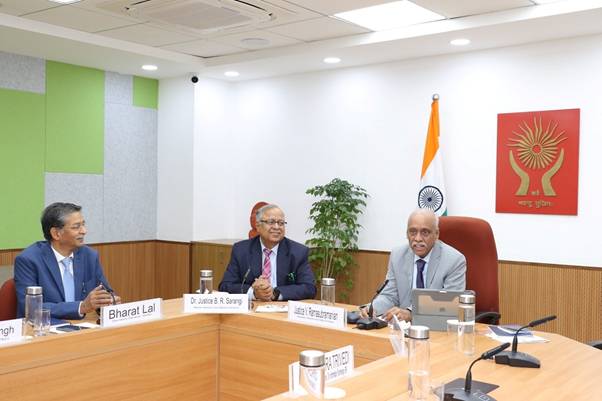
New Delhi: The National Human Rights Commission (NHRC), India, organized an open house discussion on ‘Ensuring Privacy and Human Rights in the Digital Era: A Focus on Corporate Digital Responsibility’ at its premises. The session, held in hybrid mode, was chaired by NHRC Chairperson, Justice V. Ramasubramanian, in the presence of Justice (Dr) Bidyut Ranjan Sarangi, Secretary General Bharat Lal, and other senior officials, domain experts, and industry representatives.
Addressing the participants, Justice V. Ramasubramanian underscored the importance of protecting privacy as a fundamental human right in the digital world. He emphasized that technological advancements must align with human rights and data protection principles. Stressing individual responsibility, he urged citizens to maintain digital hygiene and be mindful of their data security. He also highlighted the declining value systems and warned about the long-term consequences of neglecting privacy concerns.
NHRC Member, Justice (Dr) Bidyut Ranjan Sarangi, expressed concern over the lack of digital literacy, which leaves many individuals vulnerable to fraud and data misuse. He stressed the need to simplify digital processes to maximize safe usage for all citizens.
Setting the agenda for the discussion, NHRC Secretary General, Shri Bharat Lal, outlined the session’s key focus areas:
Citing 2023 data, he noted that India generates over 20% of global data but has only 3% of the world’s data storage capacity, making corporate involvement crucial. While regulations like the Digital Personal Data Protection Act, 2023 exist, data breaches and privacy concerns continue to rise. He emphasized that entities collecting and storing personal data must act as trustees, and any breach of this trust is unacceptable.
Participants raised concerns over the dominance of global technology companies, which complicates regulatory enforcement. Law enforcement agencies struggle to access critical data, as many firms store information offshore, posing jurisdictional challenges.
Discussions also covered gaps in India’s data protection regulations, particularly in enforcing timely reporting of data breaches (within 72 hours) and holding research institutions accountable for handling personal data. Government representatives highlighted ongoing consultations to strengthen data privacy laws and introduce the Right to Nomination to further protect user data.
Industry representatives shared best practices in data protection and digital well-being while also addressing challenges in adapting to evolving regulations. Companies transitioning from low digital penetration to structured data protection frameworks stressed the need for regulatory flexibility to comply with global standards like the EU’s General Data Protection Regulation (GDPR).
Corporate stakeholders also recommended that the Draft Digital Personal Data Protection Rules, 2025 include explicit penal provisions for non-compliance and clear guidelines for obtaining verifiable parental consent for minors.
The discussion also highlighted consumer concerns, with many users having little choice but to consent to data collection due to mandatory data-sharing models in digital services. Participants pointed out the ineffectiveness of TRAI’s Do-Not-Disturb (DND) mechanism, calling for more robust consumer protection policies.
The event witnessed participation from key representatives, including:
The discussions underscored the need for joint efforts between individuals, corporations, and the government to safeguard privacy, promote digital security, and ensure responsible corporate practices in the evolving digital landscape.
With data privacy concerns intensifying, the NHRC’s initiative sets the stage for stronger legal frameworks, corporate accountability, and greater public awareness in India’s digital age.
Bhubaneswar: The inaugural edition of the National Indoor Athletics Championships concluded on a high note…
Bhubaneswar: The Higher Education Department, Government of Odisha has announced that the Common PG Entrance…
Bhubaneswar: The Government of Odisha has nearly concluded paddy procurement for the 2025–26 Kharif season,…
Bhubaneswar: Strengthening its efforts to stabilise farm incomes and streamline agricultural marketing, the Odisha Rural…
Bhubaneswar: With a growing focus on sustainable agriculture and income diversification, the Agricultural Promotion and…
Bhubaneswar: In a major push towards clean energy adoption, the Housing & Urban Development Department,…