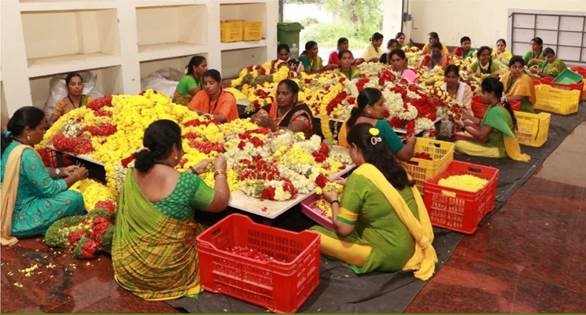
New Delhi: As India strides towards sustainability and a circular economy, the innovative concept of “waste to wealth” is gaining traction. By implementing composting pits in temples and involving temple trusts and Self-Help Groups (SHGs) in recycling efforts, significant employment opportunities can be created. Outreach programs educating priests and devotees about not dumping floral waste in rivers are also encouraging waste reduction. The “Green Temples” initiative, promoting eco-friendly practices, is being integrated into policies to transform temples into sustainable spaces.
Promoting digital offerings or biodegradable materials instead of traditional flowers can help reduce floral waste. The National Horticulture Board is also being involved in tracking and managing floral waste in green spaces like parks.
Growth in the Floral Waste Sector
The floral waste sector in India is witnessing significant growth, providing employment opportunities for women and diverting waste from landfills, thus contributing to environmental preservation. Floral waste from spiritual sites, mostly biodegradable, often ends up in landfills or water bodies, causing health hazards and harming aquatic life. According to a UN Climate Change report, the river Ganga alone absorbs over 8 million metric tons of flower waste annually. Under the Swachh Bharat Mission-Urban 2.0, several Indian cities are bringing innovative solutions to recycle flowers into valuable products like organic compost, soaps, candles, and incense sticks.
The Swachh Bharat Mission is leading a transformative journey towards sustainability, embracing the circular economy and waste-to-wealth ethos. Floral waste is a significant contributor to carbon footprints, prompting collaborative efforts among cities and startups to address this challenge.
Success Stories in Floral Waste Management
Ujjain’s Mahakaleshwar Temple: With 75,000 to 100,000 daily visitors, the temple produces around 5-6 tonnes of floral waste daily. Specialized ‘Pushpanjali Econirmit’ vehicles collect this waste, which is then processed at a 3 TPD plant into eco-friendly products. Sixteen women from the Shiv Arpan Self-Help Group create various high-quality items from the floral waste. The waste is also converted into briquettes and compost for local farmers and used as biofuel. According to the Ujjain Smart City 2022 report, 2,200 tons of floral waste have been treated, producing 30,250,000 incense sticks.
Siddhivinayak Temple: This temple sees 40,000 to 50,000 devotees daily, peaking at 100,000 on some days, offering 120 to 200 kilograms of floral waste. Mumbai-based designer house ‘Adiv Pure Nature’ turns the temple’s discarded blooms into natural dyes for textiles, including fabric yardage, garments, scarves, table linens, and tote bags. They collect 1,000 to 1,500 kilograms of floral waste weekly. A team of artisans transforms the dried flowers into natural dyes, using coconut husks for textured prints.
Tirupati Municipal Corporation: Handling over 6 tons of floral waste daily, the city upcycles this waste into valuable products. 150 women from SHGs are employed through this initiative. The recycling is done at the Tirumala Tirupati Devasthanam Agarbatti 15-ton capacity manufacturing plant, with products packaged using recycled and plantable paper embedded with Tulsi seeds for a zero-carbon footprint.
Phool: Based in Kanpur, Phool tackles the massive temple-waste problem by collecting nearly 21 MT of floral waste weekly across five prominent temple towns: Ayodhya, Varanasi, Bodh Gaya, Kanpur, and Badrinath. This waste is upcycled into items like incense sticks, incense cones, and bamboo-less incense. The women employed by Phool enjoy a safe working space, fixed salaries, and benefits like provident fund, transportation, and healthcare. Phool has developed ‘Fleather,’ a viable alternative to animal leather, recently awarded PETA’s best innovation in the Vegan World.
HolyWaste: Founded in 2018 in Hyderabad, HolyWaste collects floral waste from 40 temples, two flower vendors, and a market area to create eco-friendly products like fertilizers, incense sticks, scented cones, and soaps. They prevent 1,000 kilograms of floral waste per week from polluting water bodies or landfills.
Aaruhi: Poonam Sehrawat’s startup in Delhi-NCR collects floral waste from over 15 temples, recycling 1,000 kilograms of waste and earning over Rs 2 lakh monthly. Sehrawat has trained more than 3,000 women to create products from floral waste.
New Delhi: Veteran actor Anant Nag was conferred the Dadasaheb Phalke Award for 2024 by…
New Delhi/Bhubaneswar: Odisha is showcasing its integrated approach to water management, climate-resilient agriculture and efficient…
Bhubaneswar: As many as 775 senior citizens from eight districts of Odisha embarked on a…
Bhubaneswar: Odisha is working on a coordinated action plan to tackle urban heatwaves and flooding,…
Kolkata: Rugby India has named a 13-member Senior Women’s Rugby Sevens squad for the Aichi-Nagoya…
Kakamigahara, Japan: India continued their dominant run at the Asian Games 2026, crushing Indonesia 17-1…