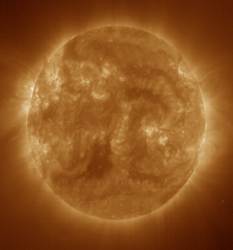
Bengaluru: In a significant breakthrough, astronomers from the Indian Institute of Astrophysics (IIA) have accurately estimated the thermal and magnetic field structures of solar coronal holes, which play a crucial role in influencing space weather and the Indian summer monsoon rainfall. The findings provide valuable insights into the Sun’s dynamic processes and their far-reaching effects on Earth.
Coronal holes, first discovered in the 1970s by X-ray satellites, are dark regions in X-ray and extreme ultraviolet (EUV) images of the Sun. These regions have open magnetic field lines, allowing charged particles to escape more easily, generating high-speed solar winds that can travel at speeds between 450 and 800 km/sec. Such solar winds interact with Earth’s magnetic field, potentially causing geomagnetic storms that disrupt satellite operations and communication systems.
The study, published in the journal Astronomy and Astrophysics, provides a comprehensive analysis of coronal holes, particularly their latitude-dependent temperature and magnetic field strength. By examining eight years of full-disk calibrated images captured by the Solar and Heliospheric Observatory (SOHO) space probe, the researchers were able to precisely estimate the physical parameters of these solar features.
Coronal holes have long been linked to geomagnetic disturbances on Earth. However, this new study goes further, suggesting that their radiative effects play a crucial role in Indian monsoon variability. While the influence of sunspots on the Earth’s atmosphere has been well-documented, the study establishes that the thermal and magnetic properties of coronal holes also significantly affect the climate.
These findings highlight how coronal holes can lead to ionospheric disturbances, impacting radio wave propagation and causing communication disruptions. As these solar phenomena are closely linked to space weather effects, their study is essential for predicting geomagnetic storms and mitigating their impacts on technology-dependent infrastructure.
Lead author Dr. Manjunath Hegde from IIA emphasized that the study not only provides precise estimates of the physical parameters of coronal holes but also reveals two key discoveries.
“We found that there is no latitudinal variation in the temperature structure of coronal holes, suggesting that they likely originate from the deep solar interior,” said Dr. Hegde.
Co-author Dr. K.M. Hiremath added that their research showed a latitudinal variation in the strength of magnetic field structures, which increases from the solar equator towards the poles. “This suggests that coronal holes might have formed due to the superposition of Alfvén wave perturbations,” he explained.
Understanding the thermal energy and radiative flux of coronal holes is crucial for estimating their influence on the interplanetary medium and their evolution during different solar cycles. With the ability to map their depth of origin and magnetic field structures, scientists can now better predict how these solar phenomena impact Earth’s climate and space weather events.
The study’s findings reinforce the importance of continuous solar observation and research, particularly as space weather increasingly affects satellite communication, power grids, and aviation systems. With the growing reliance on space-based technologies, such studies play a crucial role in enhancing predictive models and ensuring preparedness for solar-induced disruptions.