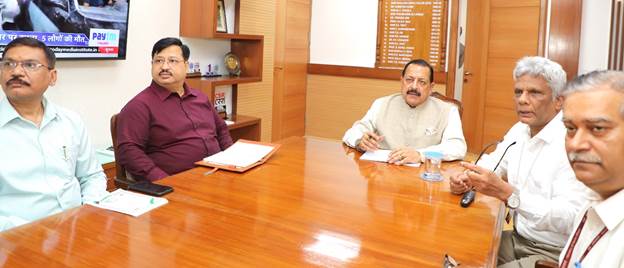
New Delhi: India is set to significantly increase its nuclear power generation capacity by approximately 70% over the next five years, according to Union Minister Dr. Jitendra Singh. This announcement came during a high-level meeting to review the 100-day Action Plan of the Department of Atomic Energy (DAE), marking Dr. Singh’s first atomic energy-related meeting since reassuming his ministerial role in the Modi Government 3.0.
Dr. Jitendra Singh, Union Minister of State (Independent Charge) for Science and Technology, Earth Sciences, and other key portfolios, highlighted India’s strides in nuclear and renewable energy. He revealed that the installed nuclear power capacity, currently at 7.48 GWe, is projected to rise to 13.08 GWe by 2029. This ambitious expansion will be achieved through the addition of seven new reactors, representing over a 70% increase in capacity.
Emphasizing the importance of self-reliance, Dr. Singh directed the DAE to prioritize the indigenous development of technology and to enhance energy security. He underscored the necessity of integrating and collaborating to harness the full potential of India’s nuclear capabilities through capacity building, knowledge sharing, and expertise exchange. He noted the government’s support for joint ventures with public sector units, increased budgets through collaboration, and the adoption of next-generation technologies.
To facilitate research and scale-up activities, Dr. Singh highlighted the initiative to provide single-point approvals, which will promote the ease of scientific research and enhance the application of nuclear technology for the benefit of citizens.
Dr. Singh shared details about the department’s work on the 220 MW Pressurized Heavy Water Reactor (PHWR) designed to use the Bharat Small Reactor (BSR) for captive nuclear power generation. He also mentioned the development of the Bharat Small Modular Reactor (BSMR), a 220 MW light water-based reactor that replaces the Calandria with a pressure vessel.
He also provided an update on BHAVINI, a public sector undertaking that is progressing towards completing the initial fuel loading of the Prototype Fast Breeder Reactor. The reactor’s first approach to criticality is expected in the coming months. This fast breeder reactor is notable for its ability to produce more fuel than it consumes.
Dr. Singh stressed the broader applications of nuclear technology, including energy security, health and food security, radiopharmaceuticals and nuclear medicine, and the preservation of agriculture and food. He highlighted the economic and societal benefits that advancements in radiation technology can bring, promoting ease of living and fostering research in basic, applied, and translational sciences using subatomic particles.
Bhubaneswar: From a proposed international airport to the restoration of historic religious sites, Odisha Chief…
Bhubaneswar, October 12: Students across Odisha have showcased their ideas for a developed India through…
Bhubaneswar: More than 170 students and vocational lecturers from Government Vocational Higher Secondary Schools across…
Bhubaneswar: East Coast Railway (ECoR) is expanding its technology-driven security network, with plans to increase…
Bhubaneswar: Odisha’s traditional handloom and handicraft heritage took centre stage at Bhubaneswar Times Fashion Week…
Bhubaneswar: With physical tests for the recruitment of Foresters, Forest Guards and Excise Constables set…