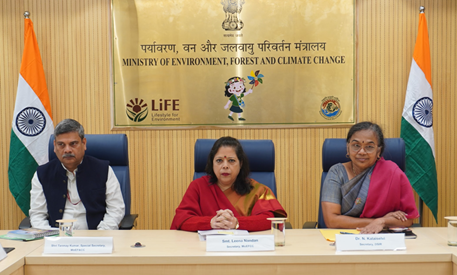
New Delhi: In a significant step toward fostering a circular economy, the Ministry of Environment, Forest and Climate Change (MoEFCC) facilitated key agreements, including a Memorandum of Understanding (MoU) between the Government of Telangana and the Council of Scientific and Industrial Research (CSIR) and agreements between CSIR and prominent recyclers. These initiatives aim to revolutionize waste management practices in India, emphasizing sustainability and innovation.
The MoU between Telangana and CSIR focuses on developing a skilled workforce in recycling and waste management. Under this collaboration, CSIR’s laboratories and institutions will provide technical expertise to support training programs in Telangana. By utilizing CSIR-developed waste management technologies, the partnership will encourage adopting circular economy principles and foster green employment opportunities.
Simultaneously, MoEFCC facilitated agreements between eight CSIR national laboratories and recyclers, addressing 15 innovative recycling and waste management technologies. The CSIR labs involved include CSIR-NIIST, CSIR-IICT, CSIR-NML, CSIR-IMMT, CSIR-CEERI, CSIR-IIP, and CSIR-CECRI. These agreements aim to establish advanced recycling infrastructure, enhance domestic waste recycling capacities, and secure critical mineral supplies through sophisticated recycling processes. They also promote innovation by fostering the development of new recycling technologies and offering technical support to recyclers for enhancing their operations.
The formalization of these agreements was attended by prominent officials, including Leena Nandan, Secretary of MoEFCC; Dr. N. Kalaiselvi, Director General of CSIR; A. Santhi Kumari, Chief Secretary of Telangana; and Jayesh Ranjan, Special Chief Secretary of Telangana. Senior scientists and officials from CSIR, MoEFCC, and the Telangana government also participated in the event, underscoring a collaborative commitment to sustainable development.
These efforts align with Prime Minister Narendra Modi’s Mission Circular Economy, which emphasizes minimizing waste, recovering valuable resources, and reducing dependency on virgin materials. By implementing Extended Producer Responsibility (EPR) frameworks, the government is incentivizing recyclers, integrating the informal sector, and establishing recycling units.
Bhubaneswar: The Department of Mission Shakti has launched a state-level capacity-building programme to strengthen women-led…
Bhubaneswar: Odisha is planning to modernise its land and property registration system through the National…
Bhubaneswar: Odisha has stepped up its cyclone preparedness, with the India Meteorological Department (IMD) forecasting…
Bhubaneswar: Odisha has stepped up its cyclone preparedness, with the India Meteorological Department (IMD) forecasting…
Bhubaneswar: The Odisha Rural Development and Marketing Society (ORMAS) has won the BIRC Global Excellence…
Bhubaneswar: Odisha has earmarked ₹1,615 crore over five years under its PMAY-Urban BANDHU initiative to…
