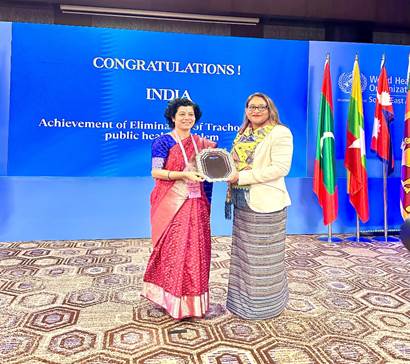
New Delhi: The World Health Organization (WHO) has officially declared that India has eliminated Trachoma as a public health problem, making it the third country in the WHO South-East Asia Region to reach this milestone. The official certification was presented to Smt. Aradhana Patnaik, Additional Secretary and Mission Director of the National Health Mission, Ministry of Health and Family Welfare, by Ms. Saima Wazed, Regional Director of WHO South-East Asia, during a regional committee meeting in New Delhi today.
Trachoma is a highly contagious bacterial infection caused by Chlamydia trachomatis, which affects the eyes. It is a leading cause of preventable blindness, particularly in underprivileged communities living in poor environmental conditions. If left untreated, Trachoma can cause irreversible blindness. WHO estimates suggest that 150 million people worldwide are affected by the disease, with 6 million at risk of visual impairment or blindness.
In the 1950s and 1960s, Trachoma was a major cause of blindness in India. To combat this, the Government of India launched the National Trachoma Control Program in 1963, which later became part of the National Program for Control of Blindness (NPCB). Over the years, efforts to control and eliminate Trachoma have intensified, leading to a significant reduction in cases. In 1971, Trachoma-related blindness was at 5%, but today, thanks to interventions under the National Program for Control of Blindness & Visual Impairment (NPCBVI), it has dropped to less than 1%.
India’s success can largely be attributed to the implementation of WHO’s SAFE strategy, which emphasizes Surgery, Antibiotics, Facial hygiene, and Environmental cleanliness. In 2017, India was declared free of infective Trachoma, but surveillance continued to ensure that the disease did not resurface. From 2019 to 2024, rigorous monitoring was conducted across all districts in the country.
The final step in India’s journey towards Trachoma elimination involved the National Trachomatous Trichiasis (TT only) Survey, conducted in 200 endemic districts from 2021 to 2024, as mandated by WHO. Following the compilation and submission of the survey reports, WHO officially declared that India had eliminated Trachoma as a public health problem.
Kolkata: Rugby India has named a 13-member Senior Women’s Rugby Sevens squad for the Aichi-Nagoya…
Kakamigahara, Japan: India continued their dominant run at the Asian Games 2026, crushing Indonesia 17-1…
Kakamigahara, Japan: India goalkeeper Savita Punia has become the most-capped player in the history of…
Dhenkanal: A trail through the hills of Dhenkanal took heritage enthusiasts to Tapoban, a site…
Bhubaneswar: Six southern Odisha districts are set to get a new platform for rural development…
Bhubaneswar: Hospitals and health facilities across Odisha are being readied to handle emergencies and maintain…