New Delhi: In a landmark move toward sustainable aviation and technological self-reliance, India has officially begun the development of Electric Hansa (E-Hansa), a next-generation two-seater electric trainer aircraft. The project is being undertaken by the Council of Scientific and Industrial Research–National Aerospace Laboratories (CSIR-NAL), Bengaluru.
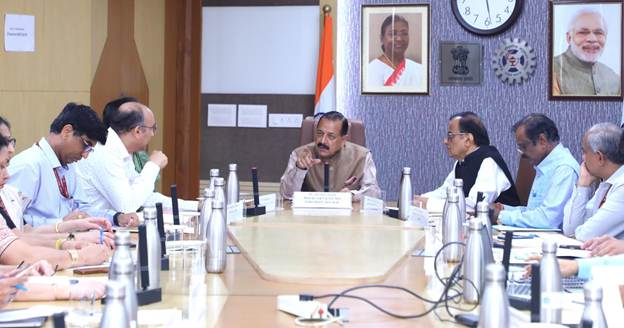
Union Minister of State (Independent Charge) for Science & Technology, Dr. Jitendra Singh, announced the initiative while chairing a high-level review meeting with senior officials of all major science departments at the Science Centre in New Delhi. Dr. Singh, who also serves as Vice President of CSIR, hailed the initiative as a proud moment for India and a key step in realizing the country’s green aviation ambitions.
The E-Hansa is a part of the larger HANSA-3 (NG) trainer program aimed at providing cost-effective and environmentally friendly solutions for pilot training in India. The aircraft is expected to cost approximately Rs 2 crore, nearly half the price of comparable imported models, making it an affordable and viable option for flight schools and aviation institutions.
Dr. Singh emphasized that the electric aircraft project reflects India’s commitment to clean energy and technological innovation. He also stressed the urgent need to commercialize indigenous technologies, calling for robust public-private partnerships. He urged the National Research Development Corporation (NRDC) to adopt successful collaboration models such as DBT-BIRAC and IN-SPACe, and directed the creation of AI-powered technology exchange platforms along with regional National Technology Transfer Offices (NTTOs) to ensure wide-reaching impact.
Highlighting the importance of private sector involvement, Dr. Singh said private players should serve not only as knowledge partners but also as investment partners. He proposed a hub-and-spoke model of partnership to drive science and technology-based development at both national and regional levels.
The Minister also reviewed recent achievements in India’s space sector, praising ISRO for its successful SPADEX mission, which demonstrated critical docking and undocking capabilities essential for the country’s upcoming human spaceflight mission, Gaganyaan. He expressed national pride in ISRO’s contributions to Operation Sindoor and revealed that ISRO is currently working in collaboration with 40 Union Ministries and 28 State Governments.
Further strengthening India’s position in global space research, Dr. Singh confirmed that Group Captain Subhash Shukla will soon travel to the International Space Station (ISS) as part of the Axiom Space Mission, where he will conduct seven microgravity experiments, further enhancing India’s reputation in space science.
In keeping with Prime Minister Narendra Modi’s vision of ‘Viksit Bharat’, Dr. Singh called for a “Whole-of-Science and Whole-of-Government” approach to innovation. He instructed departments to organize regional “Chintan Shivirs” across the country, involving entities like DST, DBT, CSIR, ISRO, Earth Sciences, and Atomic Energy, to promote integrated and collaborative planning.
Dr. Singh also proposed the creation of a “Global Science Talent Bridge” to attract top researchers from around the world and noted the rising international interest in setting up joint science centers with India. Countries like Switzerland and Italy are exploring partnerships modeled on the Indo-French and Indo-German Science Centres.
Addressing the enthusiastic response to the government’s initiative to open all 37 CSIR labs to students, Dr. Singh acknowledged that the program had to be temporarily paused due to security concerns, but confirmed that it will resume soon.
The meeting was attended by top officials from India’s science establishment, including Principal Scientific Advisor Prof. Ajay Kumar Sood, CSIR Director General Dr. N. Kalaiselvi, ISRO Chairman Dr. V. Narayanan, DST Secretary Dr. Abhay Karandikar, DBT Secretary Dr. Rajesh Gokhale, Earth Sciences Secretary Dr. M. Ravichandran, IMD Director General Dr. M. Mohapatra, and NRDC CMD Commodore Amit Rastogi (Retd.), along with senior representatives from the Department of Atomic Energy.
Bhubaneswar: With temperatures rising across the state, the Odisha government has directed all schools to…
Bhubaneswar: In a major move to streamline the supply of LPG and petroleum products, the…
Bhubaneswar: Odisha has rolled out a week-long statewide capacity-building initiative, “SĀDHANA Saptah – 2026,” aimed…
Bhubaneswar: In a major push to enhance early childhood care infrastructure, Odisha inaugurated 1,889 newly…
Bhubaneswar: People across Odisha came together in large numbers to celebrate “Ama Poshak Ama Parichaya”…
Bhubaneswar: In a major step towards improving international travel access for residents of Odisha, Chief…