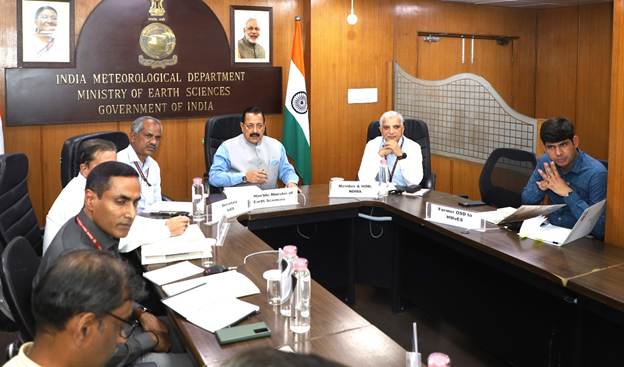
New Delhi: In a major push to bolster India’s weather forecasting and disaster preparedness capabilities, Union Minister Dr. Jitendra Singh chaired a high-level review meeting with officials of the India Meteorological Department (IMD) and key ministries on Thursday. The meeting laid out an ambitious roadmap to modernize the country’s meteorological infrastructure and expand radar coverage to ensure timely and precise weather alerts nationwide.
Dr. Singh, who holds multiple key portfolios including Science and Technology, Earth Sciences, and the Department of Space, emphasized the critical need for accurate, real-time, and impact-based weather forecasting, especially in the face of increasingly frequent and severe weather events triggered by climate change.
“No weather hazard should go undetected or unpredicted,” the Minister said, as he called for rapid implementation of key measures under the government’s “Mission Mausam” initiative. The program, launched under the leadership of Prime Minister Narendra Modi, is designed to revolutionize India’s weather monitoring systems and strengthen the nation’s climate resilience.
Among the top priorities discussed was the expansion of the Doppler Weather Radar (DWR) network, which currently comprises 37 radars. The network is set to nearly double to 73 by 2025-26 and reach 126 installations by 2026. The new radars are being strategically placed in high-priority and weather-vulnerable regions, including Bengaluru, Raipur, Ahmedabad, Ranchi, Guwahati, and Port Blair.
The Minister also focused attention on the modernization of Delhi’s weather monitoring infrastructure. Currently supported by 18 Automatic Weather Stations (AWS), the capital will see the installation of 50 more systems in the immediate term, with a long-term goal of reaching 100. These AWS units will provide hyperlocal, accurate, and timely weather data, aligning Delhi’s systems with international standards.
Senior officials briefed the Minister on the selection process for new radar sites and the progress of satellite meteorology upgrades and numerical prediction models. Dr. Singh underlined the direct benefits of enhanced forecasting for key sectors such as agriculture, aviation, fisheries, and disaster management.
“The ability to track extreme weather events with greater precision will not only aid in disaster management but also support livelihoods and economic stability,” Dr. Singh said.
He also urged all involved ministries to fast-track financial clearances and decision-making processes for critical weather-related infrastructure projects. A review of pending allocations and approvals was conducted to ensure that implementation timelines are met.
The meeting was attended by Dr. M. Ravichandran, Secretary of Earth Sciences, Dr. Mrutyunjay Mohapatra, Director General of IMD, and other senior officials. Ministry insiders called the meeting a significant turning point in India’s strategy to become a global leader in climate preparedness and disaster risk reduction.
Bhubaneswar: With temperatures rising across the state, the Odisha government has directed all schools to…
Bhubaneswar: In a major move to streamline the supply of LPG and petroleum products, the…
Bhubaneswar: Odisha has rolled out a week-long statewide capacity-building initiative, “SĀDHANA Saptah – 2026,” aimed…
Bhubaneswar: In a major push to enhance early childhood care infrastructure, Odisha inaugurated 1,889 newly…
Bhubaneswar: People across Odisha came together in large numbers to celebrate “Ama Poshak Ama Parichaya”…
Bhubaneswar: In a major step towards improving international travel access for residents of Odisha, Chief…
