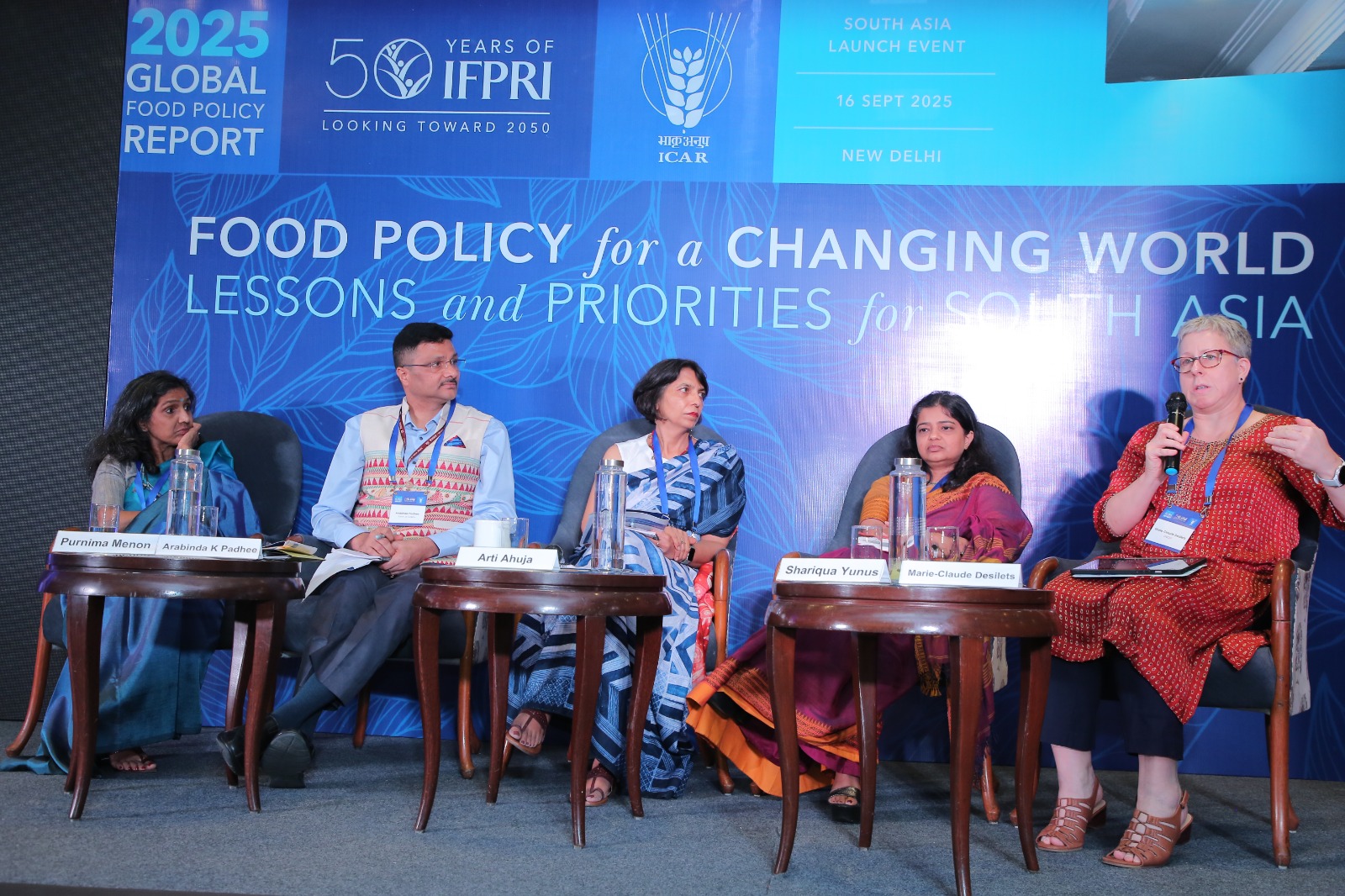
Bhubaneswar: The International Food Policy Research Institute (IFPRI), in collaboration with the Indian Council of Agricultural Research (ICAR), convened a high-level regional dialogue titled “Food Policy for a Changing World: Lessons and Priorities for South Asia” in New Delhi on September 16. The event also marked the South Asia launch of IFPRI’s 2025 Global Food Policy Report (GFPR).
The dialogue brought together senior policymakers, researchers, and development partners to deliberate on how South Asia can strengthen food systems to withstand the pressures of climate change, malnutrition, and demographic shifts, while ensuring resilience, equity, and nutrition.
Delivering the keynote, Prof. S. Mahendra Dev, Chairman of the Economic Advisory Council to the Prime Minister of India (EAC-PM), stressed the need for collective action. “The food systems agenda cannot lose sight of traditional priorities. Governments and the private sector must work together to reshape food systems that deliver affordable, healthy, and diversified diets,” he said.
Nutrition remained a central theme, with Dr. Vinod K. Paul, Member of NITI Aayog, highlighting the urgency of early action. “If we truly want to break the intergenerational cycle of malnutrition, we must act before pregnancy,” he emphasized.
Odisha’s innovations in food security and resilience drew attention at the dialogue. Anu Garg, Development Commissioner-cum-ACS, Government of Odisha, recalled the state’s transformation. “Odisha’s journey from districts once infamous for starvation deaths to becoming the fifth-largest rice producer in India shows what determined institution-building and investment in irrigation can achieve. Today, our focus is on embedding climate resilience into agriculture so that this progress endures,” she said.
Adding to this, Dr. Arabinda Kumar Padhee, Principal Secretary, Department of Agriculture and Farmers’ Empowerment, Government of Odisha, underscored the state’s integrated approach. “Odisha is perhaps one of the few states where we have both a Climate Resilience Cell and a forthcoming Gender Responsive Cell. Through CRC and GRC we want to embed the gender and climate lens right from the design stage,” he noted. He also pointed to regional collaborations such as Seeds Without Borders as examples of how cross-country cooperation can fast-track the spread of climate-resilient varieties.
From the development community, Dr. Angela Lusigi, UNDP India Representative, emphasized the importance of blending innovation with traditional knowledge for inclusive solutions. Meanwhile, Dr. Purnima Menon, Senior Director, Food and Nutrition Policy, IFPRI, reaffirmed IFPRI’s role as a global connector of policy evidence.
Dr. Shahidur Rashid, Director, IFPRI-South Asia, closed the session by situating the discussions within a broader context. “This year’s Global Food Policy Report is special—it not only marks IFPRI’s 50-year journey but also reflects on the future policy challenges that will shape food and agriculture in the decades ahead,” he said.
The South Asia Dialogue, co-hosted by IFPRI and ICAR, underscored the region’s shared responsibility and opportunity to lead. With evidence-driven insights, state-level innovations, and global collaboration, the discussions set the stage for food systems transformation that prioritizes resilience, nutrition, and equity for all.
Bhubaneswar: The Bhubaneswar Development Authority (BDA) has reviewed the proposed redevelopment of its City Centre,…
Puri: Elderly and differently-abled devotees visiting the Shree Jagannath Temple in Puri will be able…
Bhubaneswar: Timely completion of water supply and sewerage projects, effective use of funds and improved…
Bhubaneswar: Financial planning, physical wellness and stronger family bonds were at the centre of Odisha’s…
Bhubaneswar: From Pattachitra and palm leaf engraving to stone and wood carving, 144 trainees have…
Bhubaneswar: Odisha is set to host the seventh edition of the Odisha Travel Bazaar (OTB)…