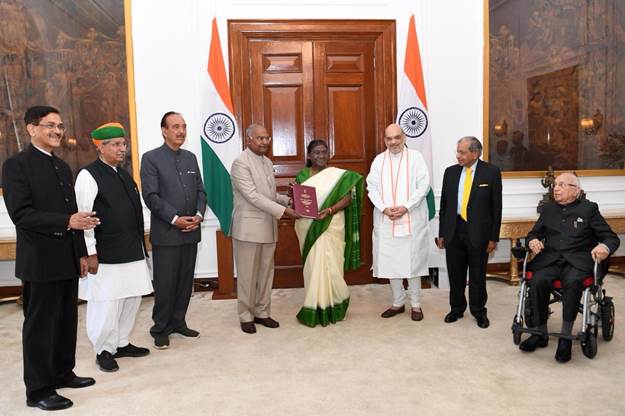
Historic Report on Simultaneous Elections Submitted to President Murmu
New Delhi: The High-Level Committee on Simultaneous Elections, chaired by former President Ram Nath Kovind, has presented its comprehensive report to the President of India, Droupadi Murmu. This extensive report, spanning a staggering 18,626 pages, is the culmination of 191 days of rigorous consultations, marking a pivotal moment in Indian democratic discourse.
Comprising a distinguished panel including Union Minister Amit Shah, former Leader of Opposition Ghulam Nabi Azad, and legal luminary Harish Salve, among others, the committee embarked on an exhaustive journey to engage with stakeholders and experts. From political parties to apex business organizations, from legal luminaries to eminent economists, a plethora of voices were heard, opinions gathered, and perspectives analyzed.
The committee’s efforts bore fruit with 32 out of 47 political parties lending their support to the concept of simultaneous elections. Moreover, an overwhelming 80% of the 21,558 respondents from across the nation echoed this sentiment in response to a public notice, underscoring the widespread consensus for this reform.
Crucially, the economic ramifications of asynchronous elections were highlighted by leading business organizations and economists. The detrimental impact on economic growth, inflation, public expenditure, and social harmony necessitated urgent attention, as emphasized in the committee’s deliberations.
In a landmark move, the committee proposed a two-step approach to transition towards simultaneous elections. Initially focusing on synchronizing elections for the House of the People and State Legislative Assemblies, the second phase aims to align Municipalities and Panchayats elections within a hundred days of the former. This meticulously crafted strategy, along with the recommendation for a single electoral roll and Electoral Photo Identity Cards (EPIC) for all tiers of government, underscores the committee’s commitment to enhancing electoral efficiency and transparency.
Importantly, the committee’s recommendations adhere to the spirit of the Constitution, requiring minimal amendments while upholding the core principles of democratic governance.
In its conclusive reflections, the committee foresees its recommendations as a catalyst for enhancing voter confidence, promoting inclusivity, and fostering national development. By streamlining the electoral process, India can embark on a transformative journey towards realizing the aspirations of its diverse populace, thereby strengthening the foundations of its democratic ethos.
As this historic report now rests in the hands of the President, the nation awaits with bated breath for the next chapter in India’s democratic evolution.
Bhubaneswar: Chief Minister Mohan Charan Majhi on Sunday inaugurated two affordable housing projects in Bhubaneswar,…
Bhubaneswar: Odisha has received the prestigious ‘Wind India 2026: Leadership in Wind Energy De-risking’ award…
Bhubaneswar: The Police Commissionerate, Bhubaneswar-Cuttack, has announced traffic restrictions across Bhubaneswar from October 16 to…
Bhubaneswar: To manage the expected rise in passenger traffic during the upcoming Durga Puja and…
Greater Noida: Odisha’s traditional handlooms and handicrafts are attracting buyers and visitors from India and…
Bhubaneswar: Food vendors at this year's Bali Jatra in Cuttack will be encouraged to use…