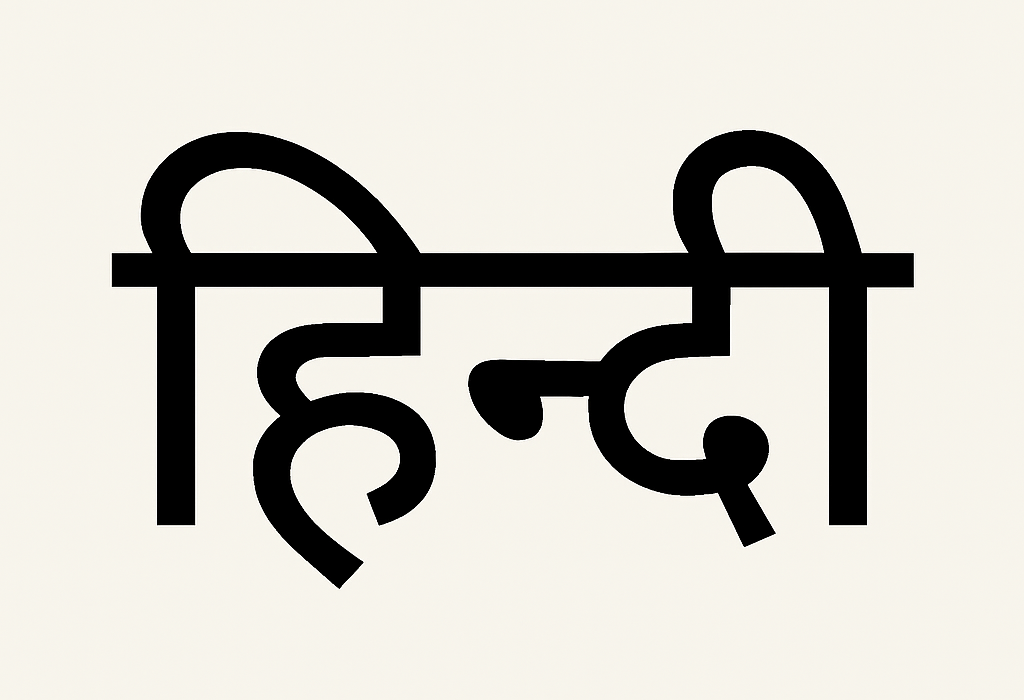
The push to crown Hindi as India’s “national language” is no longer a background hum—it’s becoming a drumbeat. From Union government advisories prioritizing Hindi in official communication to its growing dominance in entrance exams, parliamentary proceedings, and even language-learning platforms, the pattern is deliberate. What’s framed as “promotion” often amounts to imposition, and it risks tearing at the linguistic federalism that underpins India’s unity.
India has never been, and was never meant to be, a monolingual nation. With over 19,500 languages and dialects—and 22 scheduled languages recognized in the Constitution—our linguistic diversity is fundamental to our democratic and federal character. In the Constituent Assembly debates, language was among the most heated issues. Hindi found its place only as an “official language,” not the “national language,” after firm resistance from non-Hindi-speaking states, especially in the South. The settlement was clear: India would be bound together by pluralism, not linguistic dominance.
Having worked on elections in Tamil Nadu, Telangana, Karnataka, Maharashtra, and Delhi over the past five years, I’ve seen how language is more than culture—it’s about political trust, dignity, and equitable access. In Tamil Nadu, for example, the language question is far from dormant. Central policies increasingly tilt toward Hindi, whether in recruitment, broadcasting, or education. The New Education Policy (NEP) 2020, despite its multilingual facade, nudges Hindi forward in central institutions. Proposals for Hindi-medium instruction in technical education under AICTE may look inclusive, but they carry the unspoken premise that inclusion revolves around Hindi.
This is not just cultural erosion—it’s structural inequality. Language determines who gets access to opportunity. When central exams, services, and official documents are predominantly in Hindi and English, millions of youth from Tamil, Kannada, Bengali, Marathi, Odia, and other linguistic backgrounds are left at a disadvantage. In such cases, “promotion” becomes exclusion by design.
The numbers lay bare this imbalance. RTI data shows that between 2014–15 and 2024–25, the Centre allocated ₹2,532.59 crore to Sanskrit—a language natively spoken by less than 0.002% of Indians. By contrast, five South Indian classical languages—Tamil, Telugu, Kannada, Malayalam, and Odia—together received just ₹147.56 crore. Even combined, Hindi, Urdu, and Sindhi got ₹1,317.96 crore—barely half of what Sanskrit alone received.
Federalism—one of the Constitution’s defining features—rests on mutual respect between the Union and the States, and language is central to that balance. Hindi imposition is more than overreach; it’s a breach of cooperative federalism. The resistance is already visible: Tamil Nadu stands firm on its two-language policy, Karnataka rejects the three-language formula, and civil society in the Northeast sees Hindi expansion as an existential threat to indigenous identities. During election campaigns, I have seen how such disparities harden political divides and deepen cultural mistrust.
A balanced language policy must rest on four pillars. First, abandon the idea of Hindi as a unifying instrument—unity can flourish without uniformity. Second, revisit the three-language formula through genuine state-level consultations, not central diktats. Third, make central exams, public services, and government communication truly multilingual, covering all scheduled languages and relevant non-scheduled ones. Fourth, reform institutions like the Commission for Scientific and Technical Terminology (CSTT) to ensure linguistic representation beyond the Hindi belt.
Promoting Hindi is not the problem—elevating it at the expense of others is. When one language is given disproportionate power, the damage isn’t just to vocabulary—it strikes at identity, dignity, and democracy. In a republic as multilingual as ours, the dominance of a single language is not just flawed governance—it is dangerous politics.
This is not a fight over words; it is a struggle over power. If federalism is to endure, linguistic equity must be non-negotiable. India doesn’t need a national language—it needs national respect for all languages.
Mumbai: Legendary playback singer Asha Bhosle passed away at the age of 93 in Mumbai…
Bhubaneswar: Amid concerns over global geo-political developments and their potential impact on energy supplies, the…
Bhubaneswar: In a seasonal conservation measure, the Odisha government has imposed a ban on sea…
Baripada: A vast deposit of prehistoric marine fossils along the Budha Balanga river near Baripada…
Bhubaneswar: The Odisha Cabinet, chaired by Chief Minister Mohan Charan Majhi, on Friday approved a…
Bhubaneswar: In a focused effort to create livelihood opportunities in forest regions, the Odisha government…
