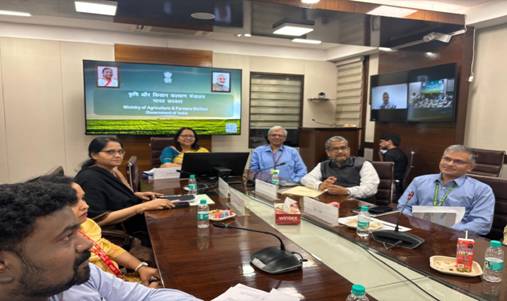
New Delhi: The Department of Animal Husbandry & Dairying convened a high-level brainstorming session on Avian Influenza at Krishi Bhawan, focusing on surveillance and vaccination under the One Health approach. The session, held yesterday, was chaired by Secretary of the Department of Animal Husbandry & Dairying, Alka Upadhyaya, and attended by a diverse group of officers and experts.
Dr. Rajiv Bahl, Secretary of the Department of Health Research and Director General of the Indian Council of Medical Research (ICMR), set the context for the One Health Mission. Participants included senior experts from ICMR Headquarters, ICMR-NIV Pune, CSIR-Centre for Cell and Molecular Biology (CCMB), the National Centre for Disease Control, ICAR-NIHSAD Bhopal, ICAR-NIVEDI Bangalore, and representatives from the Ministry of Environment, Forest and Climate Change, Department of Biotechnology, DM Cell, Ministry of Health & Family Welfare, and the Department of Animal Husbandry & Dairying (DAHD).
The poultry sector in India plays a crucial role in food security by providing a reliable source of high-quality protein. It significantly contributes to nutritional security and supports livelihoods, particularly in rural areas. The sector, which has grown steadily at a rate of 7-10% over the past decade, also boosts trade and exports, contributing to the country’s economic growth. However, recurrent Highly Pathogenic Avian Influenza (HPAI) outbreaks hinder its potential and impact exports.
The highly pathogenic avian influenza (HPAI) H5 subtype virus is evolving biologically and expanding geographically, with the emergence of well-established genetic lineages. The recent HPAI outbreak in dairy cattle in the USA, with spillover to other mammals, underscores the pandemic potential of HPAI. Addressing this threat requires the One Health approach, integrating human, animal, and environmental health with enhanced coordination and comprehensive strategies.
The session featured comprehensive presentations from the Human Health, Animal Husbandry, and Wildlife sectors, highlighting current surveillance protocols and response mechanisms for Avian Influenza outbreaks. The need for enhanced environmental surveillance and updating existing protocols was emphasized. Experts concurred on the necessity of proactive One Health Coordination to prepare for exotic and emergent zoonotic diseases like Avian Influenza. Discussions focused on strengthening surveillance at the interface areas between humans, animals, and wildlife, augmenting active surveillance, and deploying cross-sectoral Joint Response Teams (RRTs).
The Influenza A/H5 virus is spreading through poultry and wild birds along well-defined migratory routes. Given India’s position along the migratory bird flyway, developing an effective strategy for migratory bird surveillance at water bodies during the winter season is emphasized for early warnings and disease control. Special emphasis is placed on developing SOPs for environmental surveillance using low-cost methods at sites like wet markets, water bodies, wastewater, slaughterhouses, and poultry farms. Following the lead from wastewater screening for COVID and poliovirus, CCMB, ICMR, and NIV have initiated research in this area, yielding significant and promising results.
The globally available HPAI vaccines typically neither provide sterile immunity nor are 100% effective against all strains. Vaccines offer partial immunity, reducing disease severity and viral shedding but not entirely preventing infection. Vaccinated birds can still carry and transmit the virus without exhibiting symptoms, complicating surveillance and outbreak detection. This partial immunity can lead to the emergence of vaccine-resistant strains. Considering these scenarios and the difficulties in ensuring stringent biosecurity and movement restrictions, particularly in the backyard poultry sectors, experts advocate continuing the present strategy of surveillance and culling with no vaccination. However, the need for advanced research for vaccines for both humans and poultry birds is emphasized. ICAR-NIHSAD, Bhopal, which has already commercialized the vaccine technology against Low-Pathogenic Avian Influenza (LPAI-H9N2), has taken a significant lead in developing an indigenous vaccine against HPAI. ICMR is also planning to initiate cell-culture-based vaccines against Avian flu for human use.
Bhubaneswar: The Housing and Urban Development Department has asked Urban Local Bodies (ULBs) across Odisha…
Bhubaneswar: From exploring ancient temples and the story of Odisha’s capital city to discovering local…
Bhubaneswar: Odisha will prepare a dedicated lightning safety action plan for 2027 and a roadmap…
Bhubaneswar: The Women and Child Development (WCD) Department of the Odisha government has signed a…
Baripada: Wildlife enthusiasts and nature lovers can return to Similipal Tiger Reserve in Odisha’s Mayurbhanj…
Bhubaneswar: Applicants who secure flats under the Bhubaneswar Development Authority’s (BDA) Ekamra Residency housing project…