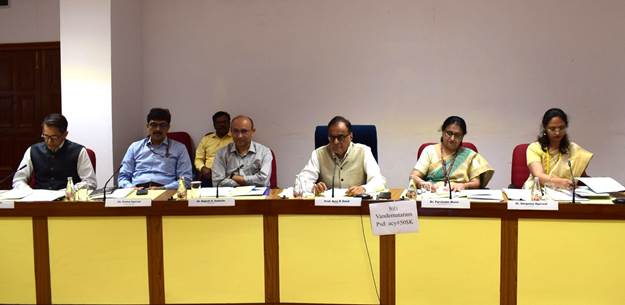
New Delhi: Professor Ajay Kumar Sood, the Principal Scientific Adviser (PSA) to the Government of India, spearheaded the inaugural meeting to deliberate on biomass cultivation on degraded land for green biohydrogen production and bioenergy generation. The gathering, held at Vigyan Bhawan Annexe on May 14, 2024, convened key stakeholders from government ministries, knowledge partners, and research institutes to explore avenues for utilizing barren and uncultivated lands for biomass cultivation.
The meeting aimed to kickstart a comprehensive discussion series to formulate an action plan for enhancing green hydrogen production from biomass. In his opening address, Prof. Ajay Kumar Sood highlighted the significance of the National Green Hydrogen Mission and stressed the importance of focused pilots for biomass-based green biohydrogen production. He underscored the need to understand the biomass cultivation ecosystem, identify challenges, and strategize a roadmap for leveraging degraded land for green hydrogen production.
The session witnessed presentations from eminent experts representing various domains. Dr. Rajesh Gokhale, Secretary of the Department of Biotechnology (DBT), outlined prospects for seaweed cultivation as biomass for bioenergy production, aligning with India’s Deep Ocean Mission. Dr. A. Velmurugan from the Indian Council of Agricultural Research (ICAR) discussed biomass production for green energy using diverse plants, including algae, molasses, and sugarcane.
Dr. Sangita M Kature from the Ministry of New & Renewable Energy (MNRE) shed light on the ministry’s programs for bioenergy and highlighted the National Biomass Atlas for agri-residue surplus data. Dr. G. Sridhar from the Sardar Swaran Singh National Institute of Bio-Energy (SSS NIBE) emphasized the role of agri-residual biomass in green hydrogen production.
Dr. Prakash Chauhan from the Indian Space Research Organisation (ISRO) presented on the Bhuvan portal for data on biomass availability and degraded land mapping, underlining the need for comprehensive data characterization. Government officials from various ministries also provided insights into schemes and initiatives aimed at biomass cultivation and hydrogen production.
Summarizing the meeting’s outcomes, Dr. Parvinder Maini highlighted the imperative for biomass cultivation in both land and marine ecosystems. Prof. Ajay Kumar Sood reiterated the importance of identifying biomass sources and utilizing both public and private lands for sustainable cultivation to meet the country’s energy demands.
Mumbai: Legendary playback singer Asha Bhosle passed away at the age of 93 in Mumbai…
Bhubaneswar: Amid concerns over global geo-political developments and their potential impact on energy supplies, the…
Bhubaneswar: In a seasonal conservation measure, the Odisha government has imposed a ban on sea…
Baripada: A vast deposit of prehistoric marine fossils along the Budha Balanga river near Baripada…
Bhubaneswar: The Odisha Cabinet, chaired by Chief Minister Mohan Charan Majhi, on Friday approved a…
Bhubaneswar: In a focused effort to create livelihood opportunities in forest regions, the Odisha government…