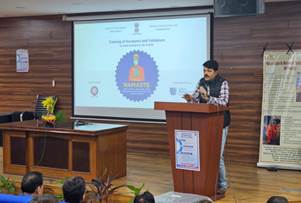
New Delhi: The Indian government has launched the National Action for Mechanized Sanitation Ecosystem (NAMASTE) Scheme, a groundbreaking initiative that aims to eliminate the manual engagement of sanitation workers in hazardous tasks such as sewer and septic tank cleaning. This human-centric approach, jointly initiated by the Ministry of Social Justice and Empowerment and the Ministry of Housing and Urban Affairs, was virtually inaugurated by Dr. Virendra Kumar, the Union Minister for Social Justice and Empowerment.
The NAMASTE Scheme, implemented by the National Safai Karamcharis Finance and Development Corporation (NSKFDC), spans a three-year period from FY 2023-24 to FY 2025-26, with a budget allocation of 349.73 crores.
Geographical Distribution of New District Disability Rehabilitation Centers:
Madhya Pradesh: 13 centers
Andhra Pradesh: 7 centers
Odisha: 6 centers
Tripura: 4 centers
Maharashtra: 2 centers
Assam, Nagaland, Manipur: 1 center each
During the inauguration, Dr. Virendra Kumar highlighted the remarkable achievements of persons with disabilities, both nationally and internationally, and reiterated the government’s commitment to providing the best possible services to divyangjan. He emphasized recent changes in the Central Scheme Guidelines to enhance the functioning of District Disability Rehabilitation Centers (DDRCs).
The Minister praised the adoption of new technologies by the DDRCs, such as telemedicine services and assistance in Unique Disability ID (UDID) card registration, aiming to improve accessibility and efficiency in service delivery. Dr. Virendra Kumar urged non-governmental organizations (NGOs) to strive for excellence in rehabilitation services.
Minister of State for Social Justice and Empowerment Ms. Pratima Bhowmik highlighted that the establishment of new DDRCs exemplifies Prime Minister Narendra Modi’s commitment to Divyangjan. She emphasized that DDRCs serve as crucial channels for delivering rehabilitation services directly to persons with disabilities at the grassroots level.
Key Components of NAMASTE Scheme:
Profiling of Sewer and Septic Tank Workers (SSWs) in Urban Local Bodies (ULBs) through digital tools (~ 1 lakh SSWs to be identified).
Health Insurance coverage for SSWs under PM-JAY.
Occupational safety training of SSWs and Sanitation Response Units for NAMASTE.
Capital Subsidy up to Rs. 5.00 lakh for the procurement of Sanitation Related Vehicles/Equipment.
Distribution of Personal Protective Equipment (PPE) to SSWs.
Distribution of safety devices to Emergency Response Sanitation Units (ERSU).
Information, Education, and Communication (IEC) Campaign for awareness on SSW safety and dignity.
Capacity building of ULB Nodal Officers and Surveyors on the Profiling Process and NAMASTE Mobile Application.
Profiling of Sewer and Septic Tank Workers:
The first component of NAMASTE is profiling of SSWs, aiming to create a national database for the identification of Sewer and Septic Tank Workers (SSW). A unique NAMASTE ID shall be given to all such SSWs.
An online training on the profiling process and the demonstration of the NAMASTE Mobile Application has been conducted for 30 States/UTs across all five zones. A total of 2367 ULBs attended the training, and the VC training was given to participants, including the Executive Officers, Executive Engineers, Senior Public Health Inspector, and Chief Officers nominated by the State government as the ULB Nodal Officer for NAMASTE.
Training of Trainers on the Usage of NAMASTE Mobile Application:
Training of Trainers programs were conducted in four states to ensure officers have a clear understanding of the app and scheme in their regional language when the training happens.
After successful completion of training on profiling and the usage of NAMASTE App/portal, profiling has started in 28 states, along with a proper Information Education Communication (IEC) campaign conducted by states through the usage of print, electronic, and mass media. As of March 6, 2024, a total of 28,732 SSWs have been surveyed, and 21,760 SSWs have been validated.
The NAMASTE Scheme represents a significant leap towards the welfare of sanitation workers, ensuring their safety, dignity, and a transition towards mechanized sanitation practices. The government’s commitment to empowering these workers and providing them with better livelihood opportunities is a commendable step towards a cleaner and safer India.
Bhubaneswar: The Kala Bhoomi museum celebrated its 8th Foundation Day on Sunday at Gandamunda with…
Bhubaneswar: Amid growing concerns over safety in healthcare facilities, Health & Family Welfare Minister Dr.…
Bhubaneswar: Marking the World Water Day celebrations, Chief Minister Mohan Charan Majhi on Sunday inaugurated…
Bhubaneswar: The Higher Education Department, Government of Odisha has released the admission schedule for two-year…
Bhubaneswar: Taking stock of the state’s environmental management efforts, Chief Secretary Anu Garg on Friday…
Bhubaneswar: Reiterating the importance of forests in sustainable development, Chief Minister Mohan Charan Majhi on…
