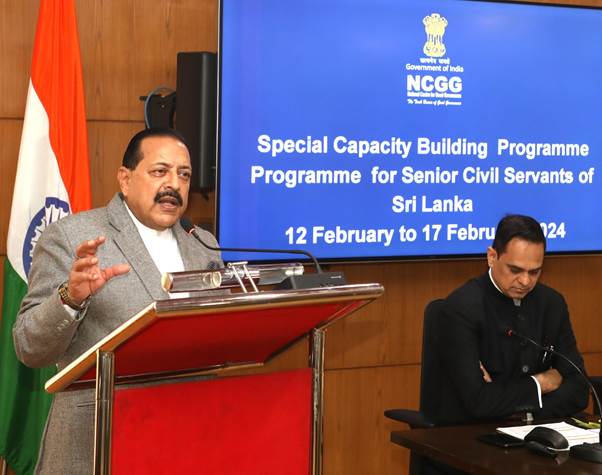
New Delhi: Union Minister of State (Independent Charge) Science & Technology, Dr Jitendra Singh, highlighted the profound impact of governance reforms under Prime Minister Narendra Modi, stating that these initiatives have led to substantial economic savings for India. Addressing participants in the ‘Special Capacity Building Programme for Senior Civil Servants of Sri Lanka’ in New Delhi, Dr Jitendra Singh emphasized the role of technology in delivering services efficiently.
Dr Jitendra Singh underscored the successful adoption of Direct Benefit Transfer (DBT), leading to savings of Rs. 1 lakh crore by eliminating middlemen. During the Covid-19 pandemic, DBT played a crucial role in preventing starvation among millions of poor households. Additionally, the Government E-Marketplace (GeM) portal facilitated savings of Rs. 65,000 crore.
Quoting Prime Minister Modi’s recent emphasis on governance as the top priority, Dr Jitendra Singh discussed the far-reaching socio-economic benefits resulting from the last decade’s governance reforms. The principles of transparency, accountability, and time-bound service delivery, guided by technology, have been the hallmarks of this transformation.
Dr Jitendra Singh highlighted PM Modi’s ‘Neighbours First’ policy, emphasizing cultural and people-to-people ties between India and Sri Lanka. The minister reiterated PM Modi’s vision of ‘Minimum Government, Maximum Governance,’ emphasizing women-centric initiatives such as maternity leave in case of stillbirth. The recent amendment to the Prevention of Corruption Act showcased the government’s zero tolerance for corruption and terrorism.
The Department of Administrative Reforms and Public Grievances (DARPG) emerged as a pivotal department during these reforms. The minister discussed the success of the Centralized Public Grievance Redressal and Monitoring System (CPGRAMS), with over 95% grievance redressal. The introduction of Human Interface for public feedback, leveraging technology to reduce litigations, and the use of Face Recognition Technology for issuing Digital Life Certificates were also highlighted.
Secretary of DARPG and Director-General of NCGG, Shri V. Srinivas, emphasized the significant capacity-building initiatives, including the current program for senior civil servants of Sri Lanka. The head of the Sri Lankan delegation, Mr Anura Dissanayake, Secretary to the Prime Minister of Sri Lanka, expressed interest in learning from India’s best practices to revitalize Sri Lanka’s public sector and appreciated India’s progress in digital services and anti-corruption institutions.
This exchange of experiences and knowledge reflects the commitment to fostering international cooperation and sharing successful governance models.
Bhubaneswar: Odisha government has rolled out the Atal Bus Stand Scheme to develop modern, passenger-friendly…
Bhubaneswar: Strengthening women’s safety and empowerment mechanisms took centre stage at a high-level review meeting…
Bhubaneswar: The 8th edition of Poshan Pakhya 2026 was formally inaugurated by Union Minister Annapurna…
Bhubaneswar: In a major step towards strengthening women’s safety and confidence, Deputy Chief Minister Pravati…
Bhubaneswar: The Odisha government has intensified efforts to strengthen irrigation infrastructure, with a high-level review…
Bhubaneswar: The Under-14 boys’ and girls’ competitions of the 69th National School Games Federation of…