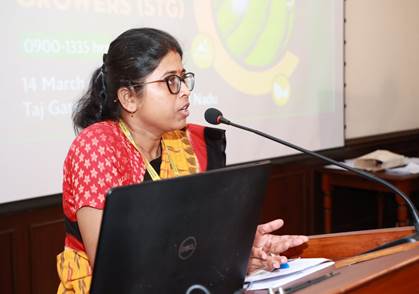
Coonoor: The Food Safety & Standards Authority of India (FSSAI) recently organized an interactive session for Small Tea Growers (STGs) in Coonoor, aimed at promoting safe and hygienic production practices in the tea industry. Supported by the Tea Board and Confederation of Indian Industry Food and Agriculture Centre of Excellence (CII FACE), the session focused on educating STGs about Integrated Pest Management (IPM) and Good Agricultural Practices (GAP) for tea cultivation.
During the session, participants engaged in discussions covering various topics, including FSSAI notifications on Maximum Residue Levels (MRLs) for pesticides. Emphasis was placed on the importance of adhering to recommended time gaps between pesticide spraying and tea leaf plucking to ensure compliance with FSSAI norms on MRLs.
Thiru. R. Lalvena, Health Secretary & Commissioner Food Safety, Tamil Nadu, commended the Capacity Building programme and pledged support for initiatives aimed at assisting STGs in improving their cultivation practices.
Inoshi Sharma, Executive Director, FSSAI, stressed the need for continuous guidance and support for STGs to enhance their adoption of Good Agricultural Practices.
M. Muthukumar, Executive Director, Tea Board (South-India Zonal Office), underscored the importance of traceability in the tea value chain and highlighted the significance of supporting STGs, who contribute significantly to tea production in the country.
The interactive session witnessed the participation of over 70 STGs, followed by a training session focused on raising awareness and ensuring compliance with FSSAI-recommended MRLs in tea. Expert-led sessions were conducted by CII FACE and other industry partners.
Looking ahead, FSSAI, in collaboration with CII FACE and industry partners, aims to roll out a comprehensive capacity building initiative across various tea-growing regions in Tamil Nadu, Kerala, Assam, and West Bengal. This initiative seeks to enhance the quality and safety of tea production, thereby contributing to the growth and sustainability of the tea industry in India.
India, the second-largest tea producer globally, contributes approximately 900,000 tonnes of tea annually, with key production hubs in Darjeeling, Nilgiris, and Assam. Tea remains one of the world’s most consumed beverages, with significant consumption in countries such as China, India, Turkey, and Pakistan.
Bhubaneswar: East Coast Railway (ECoR) is expanding its technology-driven security network, with plans to increase…
Bhubaneswar: Odisha’s traditional handloom and handicraft heritage took centre stage at Bhubaneswar Times Fashion Week…
Bhubaneswar: With physical tests for the recruitment of Foresters, Forest Guards and Excise Constables set…
Bhubaneswar: Adapting government communication to the rapidly evolving digital and artificial intelligence (AI) landscape while…
Bhubaneswar: Olympian hockey player and East Coast Railway (ECoR) Sports Officer Amit Rohidas was felicitated…
Bhubaneswar: In a major push to expand egg production and attract investment in the poultry…