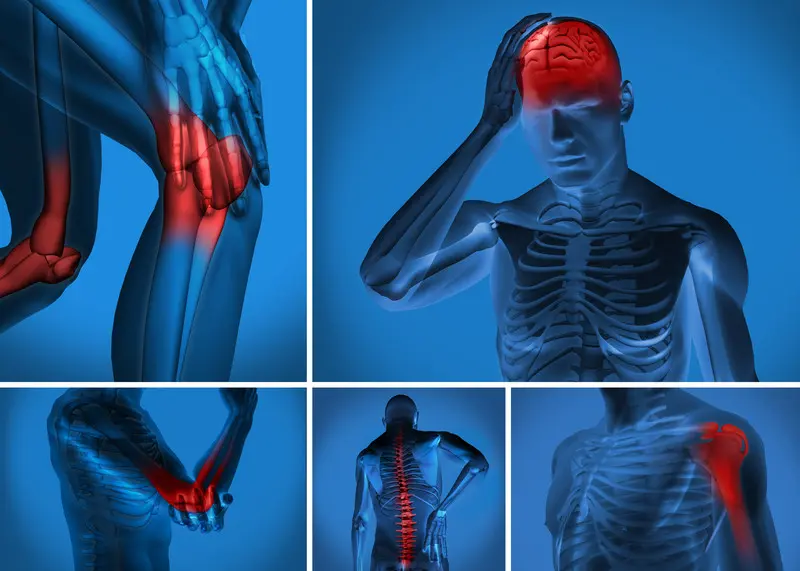
If your story sounds like this—pain all over the body, crushing fatigue, disturbed sleep, brain fog, and a stack of “normal” test reports—you are not alone, and your pain is real. Many people, especially women, spend years going from doctor to doctor trying to explain symptoms that don’t fit into one neat diagnosis. When nothing shows up in the blood test or X-ray, they are often told, “It’s just stress,” or worse, “It’s all in your head.”
But this pattern is the hallmark of a very real, recognised condition: Fibromyalgia.
The Faulty Volume Knob: What Exactly Is Fibromyalgia?
Fibromyalgia is not about damaged joints or weak muscles. It is a neurological condition caused by a disturbance in how the brain and spinal cord process pain signals. Doctors call this Central Sensitisation—an exaggerated, amplified pain response coming from the nervous system.
Think of your body’s pain system as having a volume knob. In fibromyalgia, this knob is stuck on high.
A light touch may feel like pressure.
Mild discomfort may feel unbearable.
Everyday sensations—sound, temperature, crowds—feel overwhelming.
This is not imagination. This is pain amplification, driven by changes in the nervous system.
More Than Just Pain: A Whole Constellation of Symptoms
Fibromyalgia affects far more than the muscles and joints. Many patients finally feel understood when they see the full picture:
If you recognise many of these symptoms, this may be the explanation you’ve been searching for.
The Diagnosis: When Tests Are Normal but the Pain Isn’t
One of the most frustrating parts of fibromyalgia is that there is no single test—no blood report, no scan—that can confirm it. Diagnosis is based on:
Hearing “your tests are normal” does not mean “nothing is wrong.” It simply means that fibromyalgia is a functional neurological disorder, not a structural one.
Reclaiming Control: The Three-Legged Stool of Fibromyalgia Management
There is no magic cure—but there is a highly effective, science-backed way to live well. Think of treatment as a three-legged stool. All three legs matter.
Pain often makes people avoid activity, but gentle, regular movement helps “turn down” the pain volume.
Helpful options include:
Over time, movement retrains the nervous system and improves energy.
Stress significantly worsens central sensitisation. Mind-body strategies help calm the overactive pain pathways:
These are not psychological treatments for imaginary pain—they are neurological retraining techniques for real, amplified pain.
Certain medicines can help reduce the intensity of the signals travelling through the nervous system:
These don’t cure the condition, but they significantly reduce symptoms and restore function.
A Final Message of Validation and Hope
If you have been dismissed, ignored, or told “it’s nothing,” please know this:
Fibromyalgia is a real, chronic, invisible illness—and it is manageable.
With a knowledgeable doctor (often a rheumatologist) and a multi-pronged approach, you can reclaim energy, reduce pain, and improve quality of life.
You are not imagining your symptoms.
You are not weak.
And you are not alone.
Fibromyalgia has a name. It has science. And it has a path forward filled with understanding, strength, and hope.
Bhubaneswar: With temperatures rising across the state, the Odisha government has directed all schools to…
Bhubaneswar: In a major move to streamline the supply of LPG and petroleum products, the…
Bhubaneswar: Odisha has rolled out a week-long statewide capacity-building initiative, “SĀDHANA Saptah – 2026,” aimed…
Bhubaneswar: In a major push to enhance early childhood care infrastructure, Odisha inaugurated 1,889 newly…
Bhubaneswar: People across Odisha came together in large numbers to celebrate “Ama Poshak Ama Parichaya”…
Bhubaneswar: In a major step towards improving international travel access for residents of Odisha, Chief…