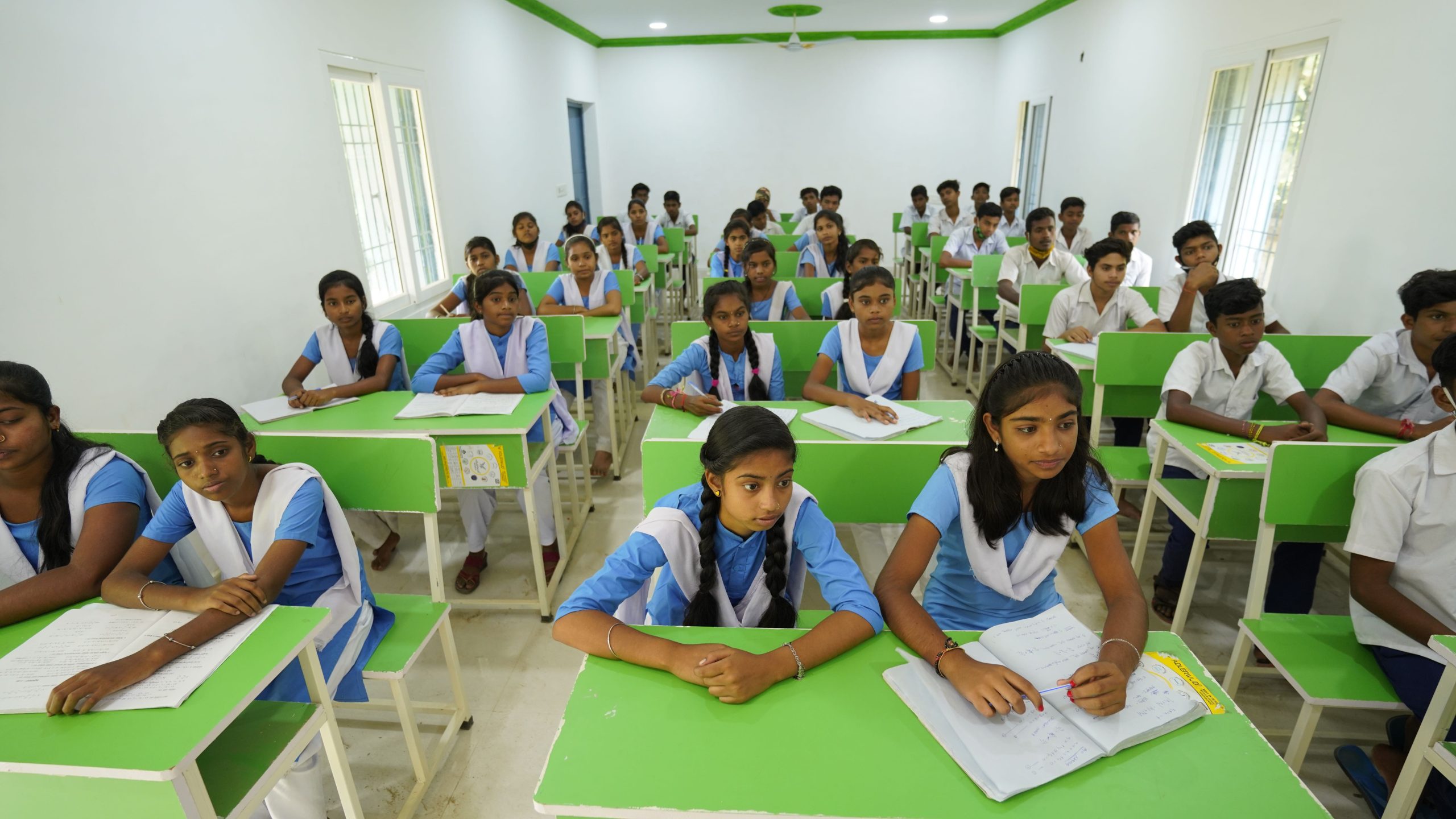
New Delhi: Union Minister for Finance and Corporate Affairs Nirmala Sitharaman tabled the Economic Survey 2024-25 in Parliament today, highlighting the role of education and human capital development as foundational pillars of national progress. The Survey underscored the transformative impact of the National Education Policy (NEP) 2020 in reshaping India’s education landscape, with significant improvements in school and higher education, digital learning, and inclusive education for children with special needs.
The Survey reported that India’s school education system serves 24.8 crore students across 14.72 lakh schools, supported by 98 lakh teachers. Government schools constitute 69% of total schools, enrolling 50% of students, while private schools account for 22.5% of institutions, catering to 32.6% of students. The NEP 2020 aims for a 100% Gross Enrolment Ratio (GER) by 2030, with current figures indicating near-universal enrolment at the primary level (93%). Efforts are underway to bridge enrolment gaps at the secondary (77.4%) and higher secondary levels (56.2%). The Survey also noted a decline in school dropout rates, which now stand at 1.9% at the primary level, 5.2% at upper primary, and 14.1% at the secondary stage.
Infrastructure development in schools has seen notable progress, particularly in digital access. As per the UDISE+ 2023-24 Report, the percentage of schools equipped with computers has risen from 38.5% in 2019-20 to 57.2% in 2023-24, while internet-enabled schools have increased from 22.3% to 53.9% in the same period. Various government schemes, including the Samagra Shiksha Abhiyan and its sub-schemes such as NISHTHA, Vidya Pravesh, and Kasturba Gandhi Balika Vidyalaya (KGBV), along with initiatives like DIKSHA, STARS, and PM POSHAN, have been instrumental in achieving NEP 2020 objectives.
In the early childhood education sector, the government launched two major frameworks in April 2024: Aadharshila, which promotes play-based learning with 130 activities for children aged 3-6 years, and Navchetana, which provides 140 age-specific activities for children from birth to three years. These initiatives aim to enhance foundational literacy, numeracy, and socio-emotional learning. The National Initiative for Proficiency in Reading with Understanding and Numeracy (NIPUN Bharat) was launched to ensure that every child attains foundational literacy and numeracy by the end of Grade 3 by 2026-27.
Digital literacy has emerged as a critical component of modern education, equipping students with skills in artificial intelligence, Internet of Things (IoT), big data, and robotics. The Survey highlighted the launch of TeacherApp, a digital platform aimed at enhancing educator capabilities and integrating AI-based tools into teaching methodologies. The incorporation of technology is expected to provide cost-effective solutions, making quality education more inclusive and accessible.
The Economic Survey also addressed inclusivity in education, stating that under Samagra Shiksha, dedicated funds have been allocated for children with special needs (CwSN). Infrastructure improvements, including ramps in 11.35 lakh schools, handrails in 7.7 lakh schools, and accessible toilets in 5.1 lakh schools, have been made to support inclusive education.
On higher education, the Survey noted that India’s higher education system ranks among the largest globally, with student enrolment increasing from 3.42 crore in 2014-15 to 4.33 crore in 2021-22, reflecting a 26.5% growth. The GER for the 18-23 age group has risen from 23.7% to 28.4% over the same period. The number of Higher Education Institutions (HEIs) has also grown, from 51,534 in 2014-15 to 58,643 in 2022-23. The expansion of premier institutions includes an increase in IITs from 16 to 23, IIMs from 13 to 20, and universities from 723 in 2014 to 1,213 in 2024. The number of medical colleges has more than doubled from 387 in 2013-14 to 780 in 2024-25.
The Survey outlined that by 2040, all higher education institutions will transition into multidisciplinary institutions. Strategies for achieving this include expanding public education opportunities, providing scholarships for disadvantaged students, and advancing online education and Open Distance Learning (ODL). The effective implementation of NEP 2020 will require collaboration between central and state governments, universities, and regulatory bodies.
Bhubaneswar: The Housing and Urban Development Department has asked Urban Local Bodies (ULBs) across Odisha…
Bhubaneswar: From exploring ancient temples and the story of Odisha’s capital city to discovering local…
Bhubaneswar: Odisha will prepare a dedicated lightning safety action plan for 2027 and a roadmap…
Bhubaneswar: The Women and Child Development (WCD) Department of the Odisha government has signed a…
Baripada: Wildlife enthusiasts and nature lovers can return to Similipal Tiger Reserve in Odisha’s Mayurbhanj…
Bhubaneswar: Applicants who secure flats under the Bhubaneswar Development Authority’s (BDA) Ekamra Residency housing project…