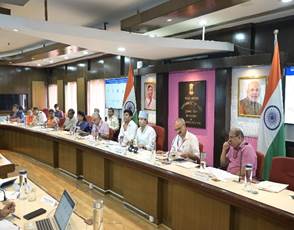
DoT Engages Stakeholders in Collaborative Policy Making
New Delhi: In line with Prime Minister Narendra Modi’s vision of fostering inclusive and collaborative policy decision-making, the Department of Telecommunications (DoT) under the leadership of Minister of Communications and Development of the North Eastern Region Jyotiraditya Scindia, along with Dr. Chandra Sekhar Pemmasani, Minister of State for Communications, has initiated the second round of meetings with the recently constituted Stakeholders Advisory Committees (SACs). The latest discussions focused on Satellite Communication and Internet Service Providers & Infrastructure Providers.
During the meeting on Internet Service Providers & Infrastructure Providers, the discussion revolved around current regulatory provisions and the seamless adoption and facilitation of Right of Way (RoW) for a digitally connected India. This initiative is critical for engaging industry leaders in expanding and shaping the future of India’s telecommunication ecosystem.
The Advisory Committee on Internet Service Providers & Infrastructure Providers commended the recent progress in Right of Way (RoW) processes but emphasized the ongoing need for integrated governance and enhanced cooperation from state governments and local municipal bodies.
The Secretary (Telecom) assured that the new rules under the New Telecom Act are designed to address many of the issues raised. The Minister of Communications also encouraged industry stakeholders to actively participate by providing their feedback on the RoW rules.
In parallel, the Advisory Committee on Satellite Communication presented their views on Indian space policy, spectrum allocation, and Spectrum Usage Charges (SUC). They suggested various measures to advance India’s position as a global hub for satellite communication.
The Advisory Committee on Satellite Communication commended the Ministry for including key provisions in the New Telecom Act. These changes are set to modernize India’s telecommunications framework by enabling more flexible, liberalized, and technologically neutral spectrum utilization, which will significantly benefit the advancement and efficiency of satellite communication services.
Aiming to facilitate a consistent two-way dialogue with the government on matters related to the telecommunication sector, Shri Jyotiraditya Scindia had constituted six distinct Stakeholders Advisory Committees (SACs) to provide valuable insights to the DoT on various matters.
This collaborative effort marks a significant step towards achieving a digitally empowered India by ensuring the inclusion of diverse perspectives and fostering a robust telecommunication infrastructure.
Bhubaneswar: Chief Minister Mohan Charan Majhi on Sunday inaugurated two affordable housing projects in Bhubaneswar,…
Bhubaneswar: Odisha has received the prestigious ‘Wind India 2026: Leadership in Wind Energy De-risking’ award…
Bhubaneswar: The Police Commissionerate, Bhubaneswar-Cuttack, has announced traffic restrictions across Bhubaneswar from October 16 to…
Bhubaneswar: To manage the expected rise in passenger traffic during the upcoming Durga Puja and…
Greater Noida: Odisha’s traditional handlooms and handicrafts are attracting buyers and visitors from India and…
Bhubaneswar: Food vendors at this year's Bali Jatra in Cuttack will be encouraged to use…