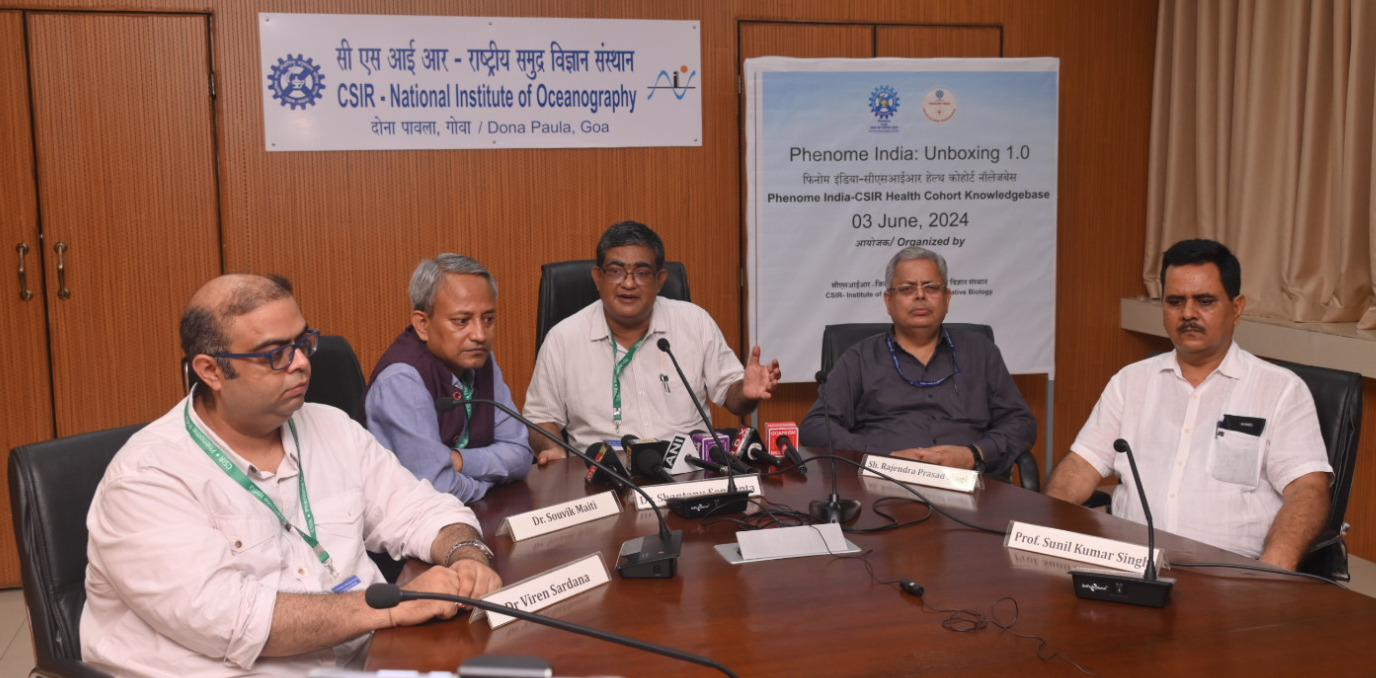
Goa: The Council of Scientific and Industrial Research (CSIR) celebrated the successful conclusion of the first phase of its pioneering longitudinal health monitoring project, the ‘Phenome India-CSIR Health Cohort Knowledgebase’ (PI-CheCK), with a special event titled ‘Phenome India Unboxing 1.0’ at the National Institute of Oceanography (NIO) in Goa. The event saw the presence of esteemed dignitaries including Dr. Souvik Maiti, Director of CSIR-Institute of Genomics and Integrative Biology (IGIB), Dr. Sunil Kumar Singh, Director of CSIR-National Institute of Oceanography (NIO), Dr. Shantanu Sengupta, Senior Principal Scientist at CSIR-IGIB, Dr. Rajendra Prasad Singh, Senior Principal Scientist at CSIR, and Dr. Viren Sardana, Senior Scientist at the Centre of Excellence for Intelligent Sensors and Systems.
Dr. Shantanu Sengupta addressed the media, describing the day as a significant milestone for Indian healthcare. He emphasized the need for a better understanding of the high incidence of cardio-metabolic diseases in the Indian population, which may have different risk factors compared to Western populations. “A one-size-fits-all concept has to go in our country,” he said, highlighting the necessity for personalized health strategies.
Dr. Sengupta elaborated on the project’s aim to develop an enhanced prediction model for cardio-metabolic diseases, including diabetes, liver diseases, and cardiac conditions. He noted the successful collection of over 10,000 samples, surpassing their initial target, and urged other organizations to conduct similar drives. “With more samples, we can redefine major health parameters in the country,” he explained, adding that CSIR has developed a cost-effective Standard Operating Procedure for sample collection.
Launched on December 7, 2023, the PI-CHeCK project focuses on identifying risk factors for non-communicable cardio-metabolic diseases among the Indian populace. Nearly 10,000 participants, including CSIR employees, pensioners, and their spouses from 17 states and 24 cities, have volunteered for the study, providing extensive health data. This data includes clinical questionnaires, lifestyle and dietary habits, anthropometric measurements, imaging/scanning data, and detailed biochemical and molecular information.
Dr. Sengupta stressed the importance of understanding the mechanisms underlying the increasing risk of cardio-metabolic disorders in the Indian population to develop new strategies for risk stratification, prevention, and management. He noted that current risk prediction algorithms, based on data from Caucasian populations, may not be accurate for Indians due to ethnic diversity, varied genetic make-up, and different lifestyle patterns.
Bhubaneswar: A new crowd-management mechanism could soon be introduced at the Shree Jagannath Temple in…
Bhubaneswar: Odisha is exploring the possibility of setting up a satellite launch centre in the…
Amstelveen: India’s campaign for a place in the FIH Hockey World Cup 2026 semi-finals came…
Bhubaneswar: The Odisha University of Agriculture and Technology (OUAT) marked its 65th Foundation Day on…
Bhubaneswar: Handmade Rakhis crafted from traditional and eco-friendly materials are drawing attention in Bhubaneswar this…
Bhubaneswar: The Odisha government has stepped up monitoring of the second phase of the JICA-assisted…