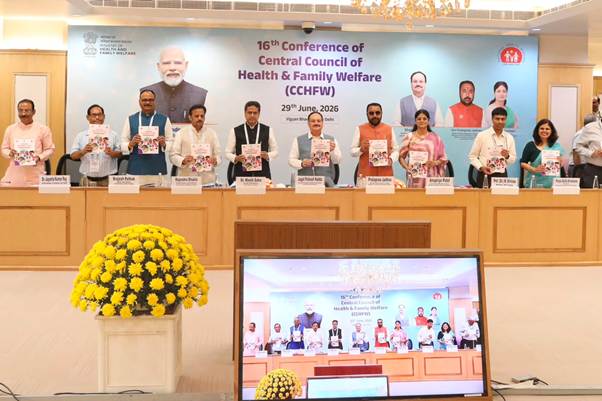
New Delhi: Seeking to accelerate improvements in maternal and newborn health outcomes, the Centre on Monday unveiled the SUMAN Roadmap 2030, a comprehensive national framework aimed at strengthening healthcare delivery systems and achieving sustainable development targets through focused interventions and improved maternal care.
Union Health and Family Welfare Minister Jagat Prakash Nadda launched the roadmap during the 16th Conference of the Central Council of Health and Family Welfare (CCHFW), attended by Ministers of State for Health, state health ministers, senior government officials and public health experts.
The roadmap has been developed in response to continuing regional disparities in maternal and newborn mortality despite notable gains achieved by India in recent years. Built on evidence-based planning, the strategy seeks to ensure equitable, quality healthcare services for mothers and newborns across the country.
Anchored under the RMNCHA+N framework, the initiative adopts an integrated approach covering the entire continuum of care—from pre-pregnancy and antenatal services to childbirth and postnatal support—while converging with programmes related to child health, nutrition, family planning and adolescent wellbeing.
A major focus of the roadmap is the early identification and management of high-risk pregnancies through systematic monitoring at four stages—antenatal care, third trimester, delivery and the postnatal period—to reduce complications and improve maternal and neonatal outcomes.
To address areas with higher healthcare burdens, the Centre has identified 130 districts across 13 states, including Odisha, Bihar, Uttar Pradesh, Madhya Pradesh and Rajasthan, for priority interventions. These measures include strengthened antenatal services, institutional delivery support, enhanced referral transport, regular ASHA outreach, and improved access to emergency obstetric care.
The roadmap also outlines nationwide reforms such as expanding nutrition support for pregnant women, institutionalising pre-pregnancy care, deploying digital monitoring tools through the JANANI Portal, introducing AI-enabled labour rooms and strengthening maternal death review mechanisms.
Community participation forms a central pillar of the strategy through initiatives like SUMAN Panchayats and locally driven maternal health awareness programmes, while dedicated Centres of Excellence and a proposed SUMAN Call Centre are expected to support implementation and accountability.
The Government aims to reduce the Maternal Mortality Ratio to below 70 per one lakh live births by 2030, lower neonatal and infant mortality rates and move towards eliminating preventable maternal and newborn deaths through universal access to quality healthcare.
Officials said the roadmap marks a strategic shift towards more targeted, technology-enabled and community-driven maternal healthcare delivery across India.
Bhubaneswar: Braj Mohan Ram on Sunday took oath as the new Governor of Odisha at…
Bhubaneswar: Recognising their gold medal-winning performances at the 2026 Asian Games in Japan, Odisha Chief…
Bhubaneswar: Two school-going sisters from Odisha have used a multiplication table to deliver a social…
Bhubaneswar: The Satwalipi Committee on Mahaprabhu Lingaraj Temple has submitted its third interim report to…
Bhubaneswar: Odisha will organise a state-level summit to finalise priorities and accelerate the implementation of…
Bhubaneswar: The Housing and Urban Development Department has asked Urban Local Bodies (ULBs) across Odisha…