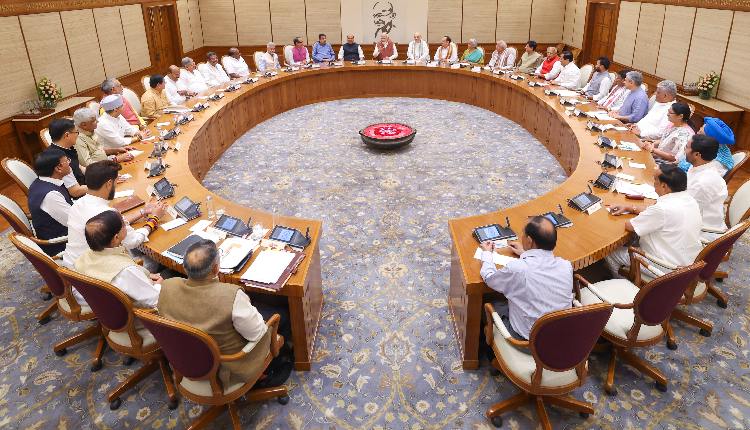
New Delhi: The Union Cabinet, chaired by Prime Minister Narendra Modi, on Friday approved the conduct of the Census of India 2027 with an estimated outlay of ₹11,718.24 crore, setting the stage for the country’s first fully digital census and one of the largest administrative exercises undertaken globally.
The decennial exercise will be carried out in two phases. The Houselisting and Housing Census will take place from April to September 2026, followed by Population Enumeration in February 2027. However, in the Union Territory of Ladakh and the snow-bound regions of Jammu & Kashmir, Himachal Pradesh and Uttarakhand, population enumeration will be conducted earlier, in September 2026, owing to climatic conditions.
For the first time, the census will rely entirely on digital technology. Nearly 30 lakh field functionaries, including enumerators, supervisors, master trainers and census officers, will be deployed. Data will be collected using mobile applications compatible with both Android and iOS platforms. To ensure effective supervision, a dedicated Census Management & Monitoring System (CMMS) portal has been developed for real-time tracking of field activities, while a new Houselisting Block Creator web-mapping tool will help officials digitally define enumeration areas.
In a significant expansion of scope, caste enumeration will be included in Census 2027. The Cabinet Committee on Political Affairs had approved this decision on April 30, 2025. Caste-related data will be captured electronically during the Population Enumeration phase, adding a critical dimension to India’s demographic database.
Another first for the census will be the option of self-enumeration. Citizens will be able to submit their details through a secure online platform, with the government assuring robust data security measures to safeguard personal information throughout the digital process.
The exercise is also expected to generate substantial employment and capacity-building opportunities. Census 2027 is projected to create around 1.02 crore man-days of work, with nearly 18,600 technical personnel engaged for about 550 days across local administrative units. The large-scale digital operation is expected to enhance data management and technological skills among personnel, improving their future employability.
With upgraded digital infrastructure, the government aims to release census data faster than in previous cycles. A new “Census-as-a-Service” platform will provide ministries and agencies with clean, machine-readable datasets, while advanced visualisation tools will enable public access to results down to the village and ward levels.
Census 2027 will be the 16th national census and the eighth since Independence. Conducted under the Census Act, 1948 and Census Rules, 1990, it remains India’s most comprehensive source of primary demographic, social and economic data, critical for policy planning and governance.
Bhubaneswar: Braj Mohan Ram on Sunday took oath as the new Governor of Odisha at…
Bhubaneswar: Recognising their gold medal-winning performances at the 2026 Asian Games in Japan, Odisha Chief…
Bhubaneswar: Two school-going sisters from Odisha have used a multiplication table to deliver a social…
Bhubaneswar: The Satwalipi Committee on Mahaprabhu Lingaraj Temple has submitted its third interim report to…
Bhubaneswar: Odisha will organise a state-level summit to finalise priorities and accelerate the implementation of…
Bhubaneswar: The Housing and Urban Development Department has asked Urban Local Bodies (ULBs) across Odisha…