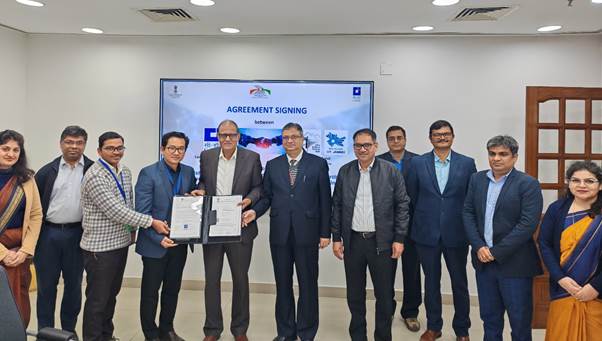
New Delhi: In a groundbreaking initiative to advance next-generation telecommunications technology, the Centre for Development of Telematics (C-DOT), the premier R&D arm of the Department of Telecommunications (DoT), has signed an agreement with the Indian Institute of Technology Mandi (IIT Mandi) and Indian Institute of Technology Jammu (IIT Jammu). The collaboration aims to develop a “Wideband Spectrum-Sensor ASIC-Chip for Enhancing Spectrum Utilization.”
The agreement was formalized under the Telecom Technology Development Fund (TTDF) scheme of the DoT, which supports Indian startups, academia, and R&D institutions in designing and commercializing telecommunication products. The scheme aims to bridge the digital divide by enabling affordable broadband and mobile services across rural and underserved areas in India.
The project focuses on developing reliable wideband spectrum sensing (WSS) algorithms and hardware solutions to improve spectrum efficiency. Spectrum sensing is a key enabler for cognitive radio networks, allowing them to detect underutilized frequency bands (spectrum holes) and deliver broadband services without interfering with primary networks.
Key objectives include:
The initiative will initially emulate these designs in a field-programmable gate-array (FPGA) environment before transitioning to an application-specific integrated circuit (ASIC) chip. This transition will lead to enhanced spectrum efficiency and pave the way for intellectual property creation in wideband spectrum sensing technology, a critical component for dynamic spectrum access.
The signing ceremony was attended by prominent figures, including Dr. Raj Kumar Upadhyay, CEO of C-DOT; Dr. Rahul Shrestha, Principal Investigator from IIT Mandi; Dr. Rohit B. Chaurasiya, Co-Investigator from IIT Jammu; and C-DOT Directors Dr. Pankaj Kumar Dalela and Shikha Srivastava.
Dr. Upadhyay emphasized the importance of indigenously developed spectrum sensing technologies in addressing India’s diverse communication needs, aligning with the government’s “Atmanirbhar Bharat” vision. He reiterated C-DOT’s commitment to fostering innovation and self-reliance in telecom technology.
Dr. Shrestha and Dr. Chaurasiya expressed gratitude for the opportunity to collaborate on this ambitious project. They highlighted the alignment of their work with the objectives of the Make-in-India initiative and the India Semiconductor Mission. They further emphasized the project’s potential to enhance India’s research capabilities and infrastructure in the telecom sector.
By targeting spectrum sensing and cognitive radio technologies, this collaboration aims to boost rural connectivity, improve spectrum utilization, and contribute to India’s broader digital and technological transformation. The project underscores the growing role of indigenous research in shaping the nation’s telecom infrastructure and advancing the global telecommunications landscape.
Bhubaneswar: Bhitarkanika National Park, known for its population of giant saltwater crocodiles, will remain closed…
Bhubaneswar: Implementation of key welfare and development programmes, digital governance tools, and service delivery mechanisms…
Bhubaneswar: Strengthening its push to improve healthcare access, the Odisha government on Wednesday entered into…
Bhubaneswar: The door-to-door enumeration phase of the country’s first fully digital Census 2026 began across…
Bhubaneswar: Eklavya Model Residential Schools (EMRS) in Odisha have registered a significant improvement in Class…
Bhubaneswar: Odisha Adarsha Vidyalayas (OAVs) have recorded an impressive performance in the CBSE Class X…