Bhubaneswar: The Odisha Government has signed a five-year Memorandum of Understanding (MoU) with the M.S. Swaminathan Research Foundation (MSSRF) to promote climate-resilient agriculture, strengthen nutrition security, conserve biodiversity and improve livelihoods, particularly among women and rural and tribal communities.
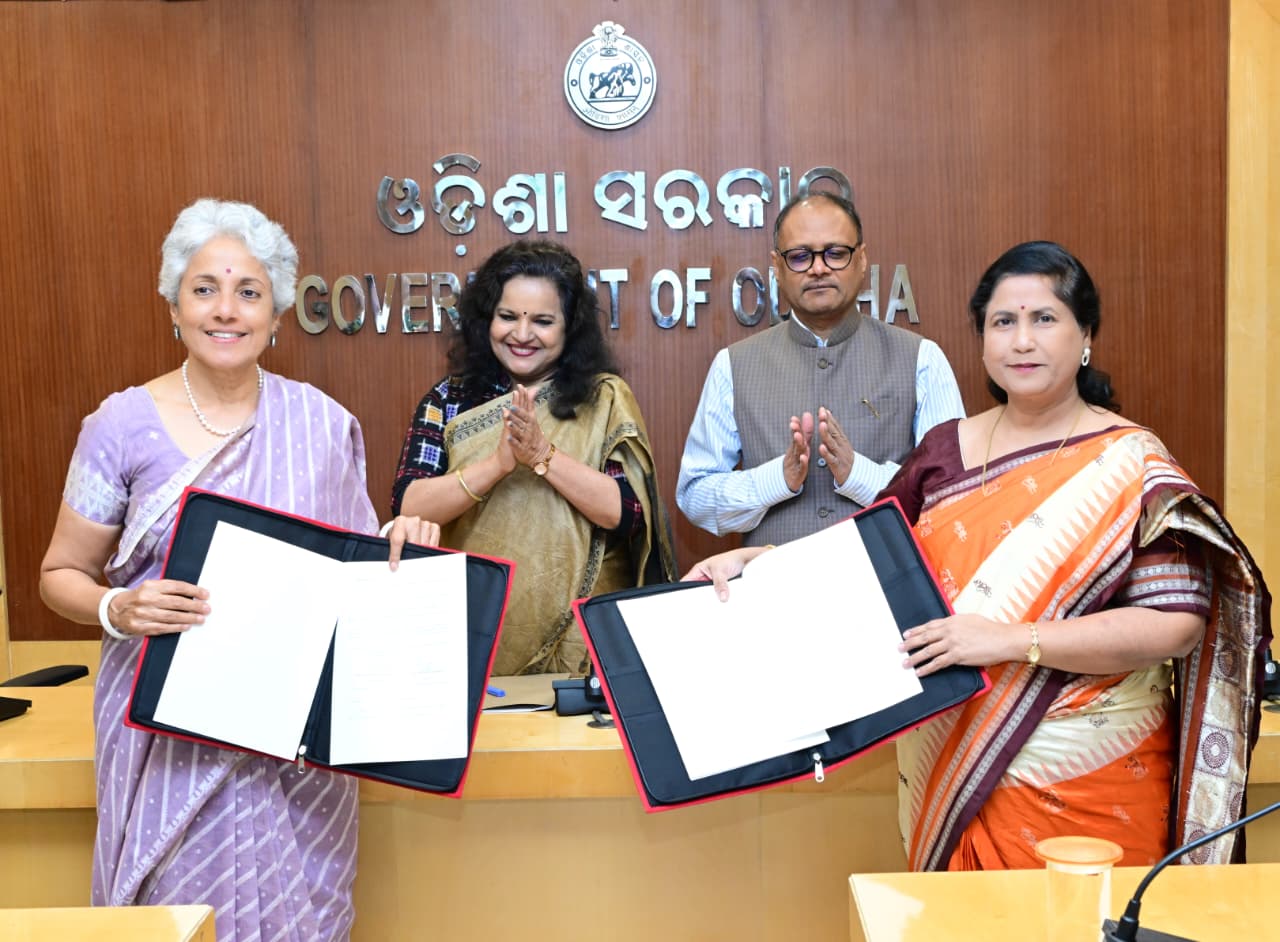
The agreement was signed at Lok Seva Bhavan in the presence of Chief Secretary Anu Garg, Development Commissioner-cum-Additional Chief Secretary Deoranjan Kumar Singh, senior officials of various departments and MSSRF Chairperson Dr Soumya Swaminathan.
Additional Chief Secretary of the Planning and Coordination Department Shubhashree Nanda signed the MoU on behalf of the state government, while Dr Swaminathan represented MSSRF.
Under the partnership, MSSRF will serve as a knowledge and technical partner to the state government, helping departments integrate scientific research, traditional knowledge and policy interventions in agriculture, nutrition, health, environment and livelihoods. The foundation will provide support in policy formulation, programme planning, research, skill development, innovation and scaling up of initiatives.
The collaboration will focus on climate-resilient agriculture, agro-ecological farming practices, promotion of millets and alternative crops, conservation of traditional seeds and agricultural biodiversity, and development of sustainable food systems. It will also prioritise women farmers’ participation, economic empowerment, enterprise development and stronger market linkages.
Under the ‘Subhadra Fast’ initiative, efforts will be made to connect women and socio-economically vulnerable families with livelihood opportunities. The partnership will also explore the establishment of Bio-Happiness Centres in agricultural universities to promote biodiversity management, environment-friendly agriculture and conservation of natural resources.
Special attention will be given to improving nutrition and health security, strengthening local food systems and creating livelihood opportunities in tribal-dominated and remote areas.
In the fisheries sector, the collaboration will support initiatives to strengthen the livelihoods and security of small-scale fishers in coastal areas. These will include developing the ‘Fisher Friend’ mobile application, expanding digital services, conserving fishery resources and promoting value-added fish products and entrepreneurship among women fishers.
Joint interventions will also be undertaken for the conservation and restoration of water bodies, wetlands, mangroves and coastal ecosystems.
In areas affected by migration, the partnership will focus on creating local employment opportunities through agriculture and allied activities, skill development, strengthening women’s Self-Help Groups and improving market access. The objective is to enhance household incomes and reduce livelihood-related vulnerabilities.
A steering committee headed by the Development Commissioner will be constituted to monitor the implementation of the action plan. It will include secretaries of the concerned departments and representatives of MSSRF and will meet regularly to review progress, outcomes and the effectiveness of various programmes.
Dr Swaminathan said the partnership would strengthen cooperation between Odisha and the foundation and enable joint efforts towards sustainable management of natural resources. She highlighted the scope for innovation in addressing development challenges through green technologies, gender equality, women’s empowerment, millet promotion and agricultural processing technologies.
Chief Secretary Anu Garg described the agreement as an important step towards science-based, inclusive and sustainable development in Odisha. She said MSSRF would provide technical support for evidence-based interventions in agriculture, nutrition, biodiversity conservation and livelihood enhancement.
She also emphasised that women would remain central to agricultural and livelihood transformation under the Subhadra initiative, with climate resilience and sustainable livelihoods as key priorities. The five-year collaboration is expected to strengthen coordination among government departments and support integrated development interventions across the state.