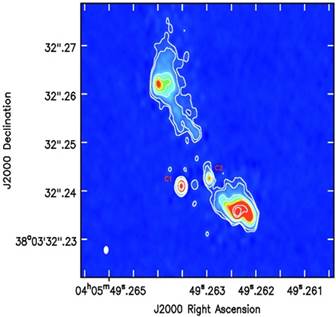
Bengaluru: In a groundbreaking development, astronomers have detected iron emission lines in X-ray spectra from a binary black hole system in the radio galaxy 4C+37.11, located approximately 750 million light years from Earth. This marks the first time such lines have been identified in a binary black hole system, offering a new avenue to study the properties and interactions of these enigmatic cosmic entities.
The discovery, led by researchers from the Indian Institute of Astrophysics (IIA), utilized data from NASA’s Chandra Space Telescope. The Fe K spectral lines, attributed to ionized iron atoms, were found to originate from both the accretion disk and the collisionally ionized plasma surrounding the supermassive black holes (SMBHs) in 4C+37.11.
“This system is one of the few confirmed binary active galactic nuclei, with two SMBHs separated by just 23 light years,” explained Dr. Santanu Mondal, a Ramanujan Fellow at IIA and the study’s lead author. “The proximity of these black holes makes 4C+37.11 a rare and valuable case for understanding dynamics in extreme gravitational environments.”
Supermassive black holes, with masses ranging from millions to billions of times that of the Sun, are known to inhabit the centers of galaxies. Studying the gas in their gravitational fields has long been a challenge. However, X-ray observations, such as the detection of Fe K lines, provide critical insights into the physical conditions surrounding these black holes, including temperature, density, and ionization states.
“This is the first time Fe K emission lines have been detected in a binary SMBH system,” said Dr. Mousumi Das, co-author of the study. “These lines are crucial for understanding the merging processes of SMBHs, which are known to produce gravitational waves during their final moments.”
The team determined the total mass of the binary SMBHs in 4C+37.11 to be about 15 billion times that of the Sun, with a moderate or low spin of less than 0.8. These findings, combined with the Fe K line emissions, are expected to advance the understanding of matter-radiation interactions in extreme conditions and provide a deeper look into the evolution of SMBHs.
The study, co-authored by researchers from India, Norway, and the United States, has been published in the prestigious Astronomy & Astrophysics journal.
“This discovery underscores the importance of detecting Fe K line emissions in binary SMBHs,” said Dr. Mondal. “They offer a unique tool for estimating black hole masses and spins, and for exploring the intricate dynamics of matter in such extreme astrophysical systems.”
The findings not only enhance our knowledge of binary black hole systems but also set the stage for further investigations into the merging processes of supermassive black holes and their role in shaping the universe.
Bhubaneswar: In view of the increased passenger rush during the festive season, the East Coast…
Bhubaneswar: Odisha has proposed setting up 290 additional public electric vehicle (EV) charging stations across…
Cuttack: Dipak Samantrai, former Director of the National Academy of Broadcasting and Multimedia (NABM), noted…
Bhubaneswar: The Odisha Government has assured full support for the development of National Waterway-5 (NW-5),…
Bhubaneswar: The Odisha Government has deployed four IAS officers as Additional Special Relief Commissioners (Additional…
Bhubaneswar: More than 200 community kitchens serving flood-affected families in Ganjam district have received uninterrupted…