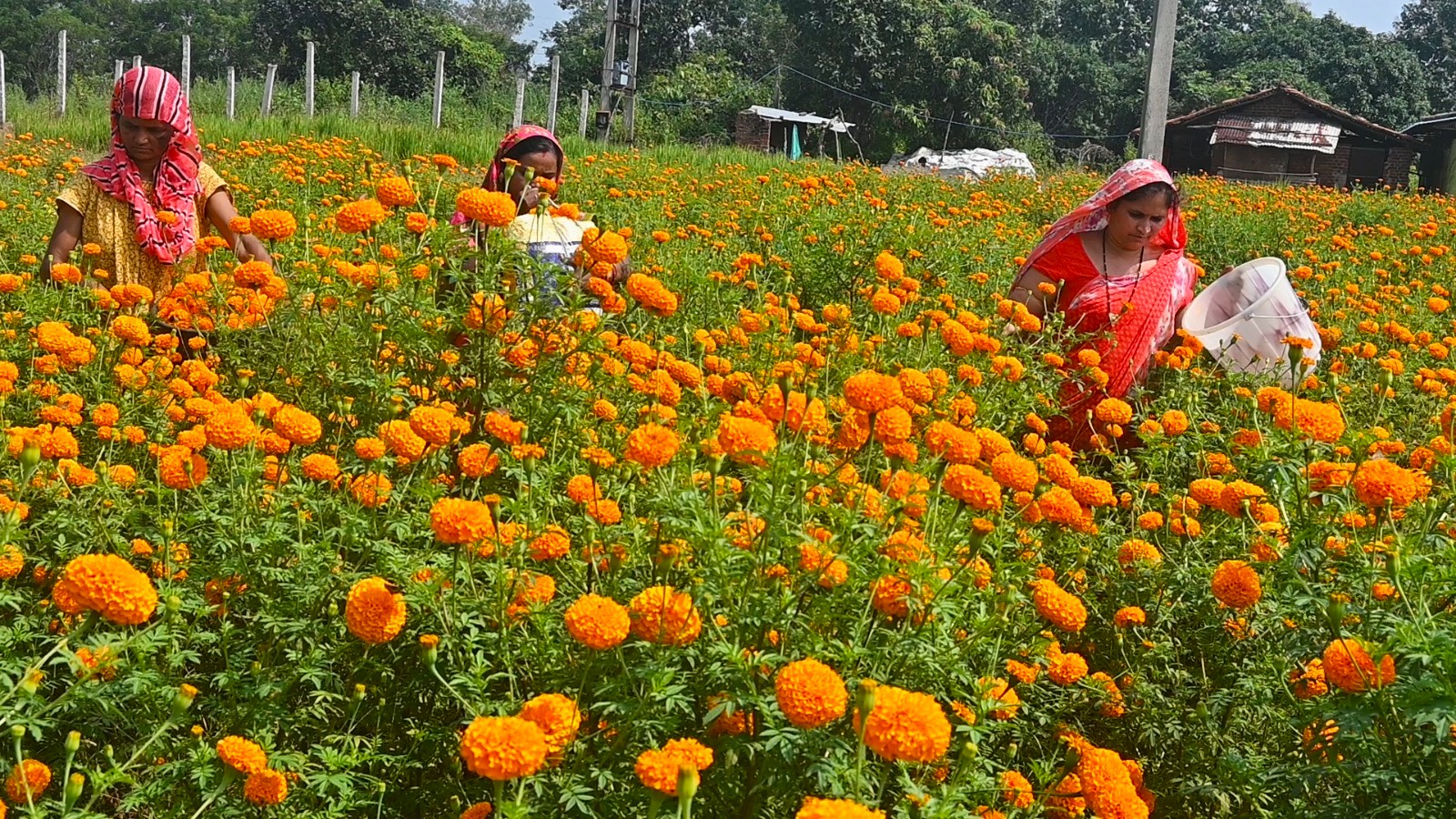
Bhubaneswar: Sanatanpali, a quiet village under Jujumara block in Odisha’s Sambalpur district, today wears a vibrant new identity. Fields that once bore paddy, green gram and black gram now bloom with marigold, gerbera, roses and exotic varieties like Mexican eustoma. Over the last two decades, flower cultivation has reshaped the economic and social landscape of this village, bringing dignity, income security and fresh hope—especially for women, landless and marginal farmers.
For 40-year-old Shankhjini, the transformation is deeply personal. With no land to her name, she once depended on daily wage labour to survive. “I worked in others’ fields for years,” she recalls. “Income was uncertain, and life was difficult.”
Today, she leases land, cultivates flowers and earns a steady income. More importantly, she says, flower farming has given her dignity and recognition as a farmer. “Now people know me for my work. I feel confident and independent,” she says, smiling.
Her journey mirrors that of many in Sanatanpali. Fifty-four-year-old Lingraj Sahu began cultivating flowers on two acres. Encouraged by consistent profits and growing market demand, he now plans to cultivate flowers thrice a year and expand beyond marigold to include gerbera and roses. “Traditional crops never gave such returns,” he says. “Flowers have changed our thinking.”
The village’s floriculture journey began modestly in 2003, when a handful of farmers experimented with flower cultivation. For years, progress was slow. The turning point came in 2020 with the formation of Sabuj Sanatanpali Farmer Producer Company Limited (FPO) — Odisha’s first flower-based FPO.
At the time, flowers were grown on just five acres. Today, cultivation spans over 100 acres, involving more than 1,500 farmers, of whom around 150 are active flower growers. Notably, 70–80 of them are women.
“Women farmers have gained the most,” says Managing Director of the FPO, Manabodh Barik. “Many were earlier confined to household work or wage labour. Now, they earn independently, save money, and command social respect.”
A major leap occurred in April 2024, when the FPO signed an MoU with CSIR–National Botanical Research Institute (NBRI), Lucknow. This partnership introduced scientific farming techniques, high-quality saplings and continuous technical guidance—often delivered through WhatsApp groups connecting farmers directly with scientists.
The result has been remarkable. Farmers shifted from local marigold varieties, which dried quickly and fetched poor prices, to the Thailand “tennis ball” marigold. The new variety stays fresh for 5–7 days, looks more attractive, and sells for ₹150–₹200 per kilogram.
Earlier cultivated only once a year, marigold is now grown three times annually, generating a net profit of nearly ₹2.4 lakh per acre—a staggering eight to ten times more than traditional paddy farming.
Union Education Minister Dharmendra Pradhan has lauded the FPO’s efforts, encouraging farmers to further expand flower cultivation.
Sanatanpali’s fields now host an unlikely guest: eustoma, a flower native to Mexico. Introduced by CSIR–NBRI on a pilot basis in a polyhouse, the flower has adapted well to local conditions. With a freshness span of up to eight days and high market demand, eustoma offers farmers an income of up to ₹2 lakh per acre.
Dr. Ajit Kumar Shasany, Director of CSIR–NBRI, says eustoma can be cultivated twice a year at temperatures between 16°C and 28°C. Encouraged by early success, plans are underway to scale up production.
During the recent New Year season, farmers sold eustoma at ₹60–₹100 per stem, turning scepticism into enthusiasm. “Now our fields look like colourful carpets,” says farmer Pramod Barik. “It’s hard to believe this was once dry farmland.”
Currently, Odisha grows flowers on around 10,000 hectares, producing nearly 60,000 metric tonnes of loose flowers and 463 million sticks of cut flowers annually. Yet, only 40% of demand is met locally, with the rest sourced from other states and abroad.
To bridge this gap, the Odisha government launched the Flower Mission in 2023. Under the scheme, women self-help groups receive up to 80% subsidy, significantly higher than the 50% for others. The mission aims to boost local production, reduce imports, and create sustainable rural livelihoods.
To ensure better price realisation, a Horticultural Terminal Market Complex is being planned at Neeldunguri in Sambalpur. Once operational, it will serve farmers from 10 districts of western and northern Odisha, facilitating auction marketing and access to national and international markets.
“This will be a game-changer,” says horticulturist Dr. Abhilash Padhan. “It will revolutionise how flowers, fruits and vegetables are marketed in Odisha.”
Despite growing demand, nearly 50% of flowers go to waste during the off-season. To address this, NBRI experts have trained women farmers to create incense sticks, vermilion, perfumes, rakhis, greeting cards and handicrafts from leftover flowers.
For Shankhjini, this innovation offers yet another source of income. “Now, even wasted flowers earn money,” she says. “Nothing goes to waste.”
From fragile livelihoods to flourishing enterprises, Sanatanpali’s journey is a testament to how science, collective action and women’s leadership can transform rural economies. Today, the village stands as a symbol of Odisha’s floral revolution—where every bloom tells a story of resilience, dignity and hope.
Bhubaneswar: In a major step towards strengthening women’s safety and confidence, Deputy Chief Minister Pravati…
Bhubaneswar: The Odisha government has intensified efforts to strengthen irrigation infrastructure, with a high-level review…
Bhubaneswar: The Under-14 boys’ and girls’ competitions of the 69th National School Games Federation of…
Bhubaneswar: In a major push to industrialisation, Chief Minister Mohan Charan Majhi on Wednesday inaugurated…
Bhubaneswar: In a push to upgrade primary education infrastructure, Chief Minister Mohan Charan Majhi on…
Bhubaneswar: Strengthening development in Kandhamal district, Odisha Chief Secretary Anu Garg reviewed key projects across…



