
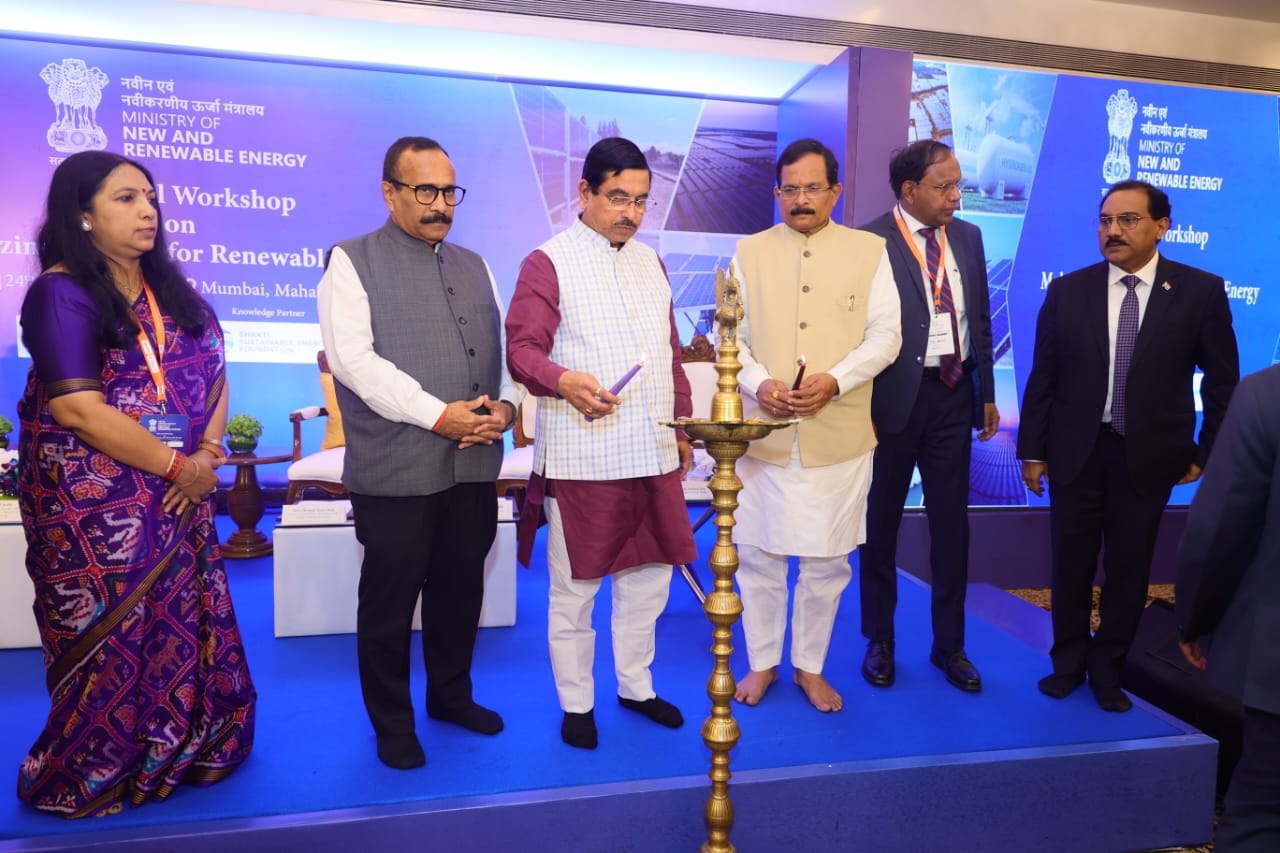
Mumbai: Union Minister for New & Renewable Energy, Pralhad Joshi, underscored the crucial role of financing in achieving India’s ambitious target of 500 GW renewable energy capacity by 2030. Speaking at the National Workshop on Mobilizing Finance for Renewable Energy in Mumbai, he called for collective efforts from financial institutions and policymakers to ensure accessible funding for the renewable energy sector.
Union Minister of State for Power and New & Renewable Energy, Shripad Naik, also addressed a press conference alongside Joshi, reinforcing the government’s commitment to accelerating investments in clean energy infrastructure.
Joshi revealed that the idea for the workshop originated from a high-level review meeting chaired by Prime Minister Narendra Modi, where discussions focused on accelerating flagship schemes such as PM Surya Ghar and PM-KUSUM. He emphasized that as India moves toward becoming the world’s third-largest economy, its energy demand is set to double, requiring renewable energy to match thermal power generation to ensure energy security.
Highlighting India’s commitment to achieving Net Zero emissions by 2070, he noted that the country has already made significant progress, with renewable energy capacity reaching 222 GW. Shri Joshi pointed out that solar tariffs have dropped dramatically, with the latest bid in Madhya Pradesh touching ₹2.15 per unit, compared to ₹11 per unit earlier. However, he stressed the urgent need for battery storage solutions to support the large-scale deployment of renewables.
Addressing the role of financial institutions, Joshi urged banks to simplify lending processes for rooftop solar projects and establish a Renewable Energy Financing Obligation, similar to the Renewable Purchase Obligations (RPOs) for power distribution companies.
He highlighted the transformational impact of decentralized energy initiatives, particularly PM-KUSUM and PM Surya Ghar, which empower farmers as “Urjadata” (energy providers) while also reducing transmission losses.
Joshi also outlined India’s leadership in green hydrogen (GH2), revealing that India has already received major export orders and is ahead of several developed nations in this emerging sector. He noted that global investors view India as a prime destination for manufacturing and clean energy investments, recognizing its young workforce and strong industrial capacity.
Union Minister Shripad Naik emphasized that achieving the 500 GW renewable energy goal by 2030 will require an investment of approximately ₹30 lakh crore. He urged stakeholders to adopt innovative financing models, offer flexible lending terms, and prioritize green investments to accelerate India’s clean energy transition.
Secretary of the Ministry of New & Renewable Energy, Nidhi Khare, also stressed the critical role of green bonds, affordable finance, and innovative funding models in driving India’s renewable energy transformation.
The National Workshop on Mobilizing Finance for Renewable Energy featured discussions on financing challenges and strategies across four key areas:
-
Financing Utility-Scale Renewable Energy Projects
- Addressed challenges in securing funding for large-scale projects.
- Discussed interest rates, perceived risks, and financial solutions.
-
Financing New & Emerging Renewable Technologies
- Focused on offshore wind, floating solar, and green hydrogen.
- Explored capital allocation, policy interventions, and risk mitigation.
-
Financing Distributed Renewable Energy (DRE) & Innovative RE Applications
- Covered rooftop solar, canal-top PV, and Agri-PV solutions.
- Examined financing constraints for startups and policy support.
-
Regulatory & Capacity-Building for Banks & NBFCs
- Discussed RBI guidelines and sector-specific lending policies.
- Highlighted the need for stronger regulatory frameworks and risk-sharing mechanisms.
The workshop saw participation from senior officials of major public and private sector banks, including SBI, HDFC Bank, ICICI Bank, Bank of India, Axis Bank, Punjab National Bank, and IDFC Bank, among others.
Key takeaways from the discussions included the need for lower-cost financing, increased access to global climate funds, and strengthening public-private partnerships to support India’s clean energy transition.
Joshi concluded by urging financial institutions to streamline lending processes, reduce compliance burdens, and actively support renewable energy projects. He emphasized that PM Surya Ghar is not just a scheme—it is a national movement.
The workshop reaffirmed the government’s commitment to ensuring financial constraints do not hinder India’s renewable energy ambitions, reinforcing India’s position as a global leader in the clean energy revolution.