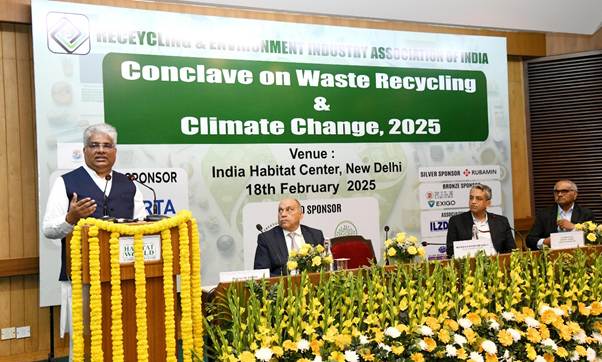
New Delhi: Union Minister for Environment, Forest and Climate Change, Bhupender Yadav, today inaugurated a day-long conclave on ‘Waste Recycling & Climate Change 2025’, organized by the Recycling and Environment Industry Association of India (REIAI). The event brought together over 200 delegates, including environmental scientists, waste management professionals, and policymakers, to discuss the urgent need for waste recycling and the future of the circular economy in India.
In his inaugural address, Yadav highlighted that India generates around 62 million tonnes of waste annually, with plastic, electronic, and hazardous waste growing at an alarming rate. He stressed that the traditional linear economic model—take, make, and dispose—was no longer sustainable. “The increasing pressure on landfills, depletion of natural resources, and environmental damage from unchecked waste disposal require urgent action,” he stated. He emphasized that the circular economy, which focuses on reducing, reusing, and recycling, is not just an alternative but a necessity for a sustainable future.
Yadav outlined how a well-functioning circular economy conserves natural resources, fosters industrial innovation, enhances economic competitiveness, and creates job opportunities. He reiterated that waste should be treated as a resource, and adopting sustainable practices is crucial for achieving economic resilience, environmental sustainability, and social security in the long run.
The Union Minister further stated that by 2050, India’s circular economy is expected to have a market value of $2 trillion and create 10 million jobs. He called this a massive opportunity for start-ups and new product developers in the recycling industry, urging the industry to align its growth with environmental sustainability. Drawing inspiration from nature’s efficient recycling systems, Yadav emphasized, “Nobody recycles like Nature.”
Yadav urged the recycling industry to adopt newer, innovative technologies to reduce dependence on natural resources and cut down on imports of critical minerals necessary for economic growth. He stressed that the shift towards circular economy principles would bring tremendous economic benefits and align with the national vision of Atmanirbhar Bharat, enhancing the competitiveness of Indian industries on the global stage.
The Minister also informed the audience that the Ministry of Environment, Forest and Climate Change has been instrumental in formulating policies and regulations, including Extended Producer Responsibility (EPR) frameworks, which incentivize recyclers and integrate the informal sector into formal recycling systems. These initiatives aim to streamline waste management and promote eco-friendly production across industries.
Yadav outlined four key strategies to drive the circular economy in India:
Dr. Amandeep Garg, Additional Secretary, Ministry of Environment, Forest and Climate Change, and Chairman, Central Pollution Control Board (CPCB), emphasized the need for the recycling industry to address the significant gap in the country’s waste recycling system. He called for corporate houses to lead the transition to a circular economy by incorporating recyclable designs, promoting sustainability in operations, and enhancing consumer awareness.
The event was also attended by Dr. Ashok Kumar, President of Recycling and Environment Industry Association of India, and subject experts from the recycling industry. The conclave underscored the need for collaborative efforts between the government, industry, and consumers to create a sustainable and efficient recycling ecosystem in India.
Cuttack: A letter advising a young man to meet freedom fighter Nabakrushna Chaudhury, nearly 50…
Bhubaneswar: Odisha has stepped up its disaster preparedness as a weather system over the region…
Bhubaneswar: Odisha has intensified its efforts to tackle drug abuse in six identified narcotics hotspots,…
Bhubaneswar: Bamboo artisans, entrepreneurs and self-help groups in Odisha now have a dedicated marketplace to…
Gurgaon: Shunya Agritech has launched FodrPulse, a free mobile application designed to help hydroponic fodder…
Bhubaneswar: The Bhubaneswar Development Authority (BDA) has opened the online application process for allotment of…
