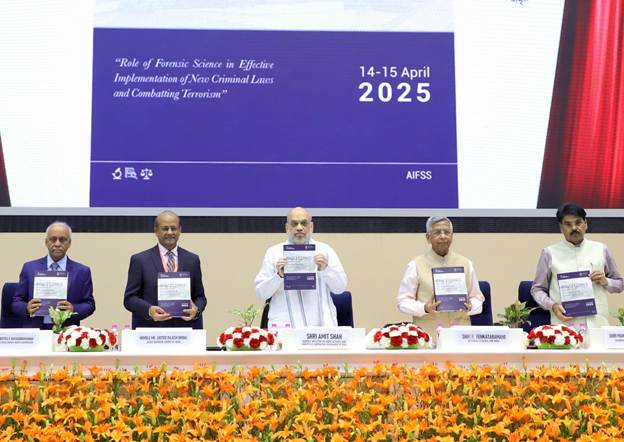
New Delhi: Union Home Minister and Minister of Cooperation Amit Shah addressed the All India Forensic Science Summit 2025 in New Delhi today, emphasizing the transformative role of forensic science in India’s evolving criminal justice system. The summit, hosted by the National Forensic Sciences University (NFSU), centered on the theme “Role of Forensic Science in Effective Implementation of New Criminal Laws and Combating Terrorism.”
The event saw participation from several dignitaries including Justice V. Ramasubramanian, Chairperson of the National Human Rights Commission, Attorney General R. Venkataramani, Rajya Sabha MP and Chairman of the Bar Council of India Manan Kumar Mishra, Union Home Secretary Govind Mohan, and NFSU Vice Chancellor Dr. J. M. Vyas.
Beginning his address by paying tribute to Dr. B. R. Ambedkar on his birth anniversary, Shah highlighted the Constitution’s role in safeguarding the life, property, and dignity of citizens, and emphasized how forensic science today serves as a vital tool in reinforcing this system of justice.
He underlined that under Prime Minister Narendra Modi’s leadership, India is making its justice system both people-centric and scientific, with efforts focused on ensuring timely justice. “Our aim is to build a safe, capable, and competent India,” Shah said, pointing to the recently enacted Bharatiya Nyaya Sanhita (BNS), Bharatiya Nagarik Suraksha Sanhita (BNSS), and Bharatiya Sakshya Adhiniyam (BSA) as landmark reforms that have laid the foundation for a technologically robust justice system.
Speaking on the significance of forensic science, the Home Minister noted that India has a long-standing tradition of scientific crime investigation, citing ancient texts like the Charak Samhita, Sushruta Samhita, and Kautilya’s Arthashastra. He remarked that the nature of crime has drastically changed, becoming increasingly borderless and technologically sophisticated, thereby elevating the importance of forensic investigation in solving modern crimes.
Recalling the establishment of the Gujarat Forensic Sciences University in 2009, Shah said it was Prime Minister Modi’s visionary leadership that laid the groundwork for what has now evolved into the National Forensic Sciences University — the first of its kind globally. Since its inception in 2020, NFSU has expanded rapidly, emerging as a hub for forensic education, research, and innovation. The university now offers degree, diploma, PhD, and research programmes and has developed indigenous toolkits to aid police forces across India.
Highlighting the government’s commitment to technological integration, Shah said forensic investigation is now mandatory in all crimes with punishments exceeding seven years. E-documents and e-summons have been legally defined, and digital evidence such as audio, video, and forensic videography have been given legal recognition. These reforms, he asserted, will significantly improve conviction rates, which currently stand at 54 percent.
He cited examples where, thanks to forensic evidence and swift legal procedures, convictions in serious crimes like rape and triple murder have been secured in record time — in some cases, within just 23 days.
The Home Minister shared key statistics from the Crime and Criminal Tracking Network and System (CCTNS), which has now computerized 100 percent of police stations across the country. Over 14 crore FIRs and associated documents are now available online. Courts, prisons, and prosecution departments have also been digitized, with extensive data available through platforms like e-courts, e-prison, e-prosecution, and e-forensics. He added that 1.53 crore fingerprint records are currently stored in the National Automated Fingerprint Identification System (NAFIS), accessible to every police station in the country.
Shah revealed that the Ministry of Home Affairs is preparing to integrate all existing digital databases using Artificial Intelligence, enabling more proactive and data-driven crime prevention strategies. He also announced that NFSU will soon have campuses in every state, with 7 already operational, 9 more to be established within the next six months, and plans underway for 10 additional campuses. Each campus will specialize in one domain, with dedicated support for research and innovation.
Looking ahead, Shah said India will need around 30,000 trained forensic professionals annually to respond to high-stakes crime scenes. NFSU, he said, is poised to meet this demand, producing over 36,000 skilled graduates each year who will serve in both public and private forensic labs.
He also highlighted the university’s international outreach, with 240 foreign students currently enrolled and new global partnerships being explored. New areas of study include drone forensics, marine forensics, corporate forensics, and smart city forensics.
Shah emphasized the need to categorize offenders and offer psychological counseling to help reform individuals, thus integrating forensic science into prison rehabilitation programs. He announced the establishment of the Modus Operandi Bureau to study criminal behavior patterns, adding that this would further strengthen crime control efforts.
In his closing remarks, the Home Minister urged for deeper collaboration between NFSU and the Ministry of Home Affairs to create a scientifically empowered, crime-free society. The summit also recognized the achievements of young innovators in hackathons and their contributions to promoting Hindi in scientific discourse.
Bhubaneswar: Odisha is set to strengthen its environmental monitoring framework with greater use of technology,…
New Delhi/Bhubaneswar: Odisha Deputy Chief Minister Pravati Parida on Thursday met Union Women and Child…
Bhubaneswar: Odisha has received national recognition for its efforts to promote renewable energy, winning the…
Bhubaneswar: Odisha is gearing up to host two major national-level urban development events, with preparations…
Bhubaneswar: Air connectivity between Odisha and Maharashtra is set to receive a boost with IndiGo…
Bhubaneswar: In a bid to accommodate the expected surge in passenger traffic during the upcoming…
