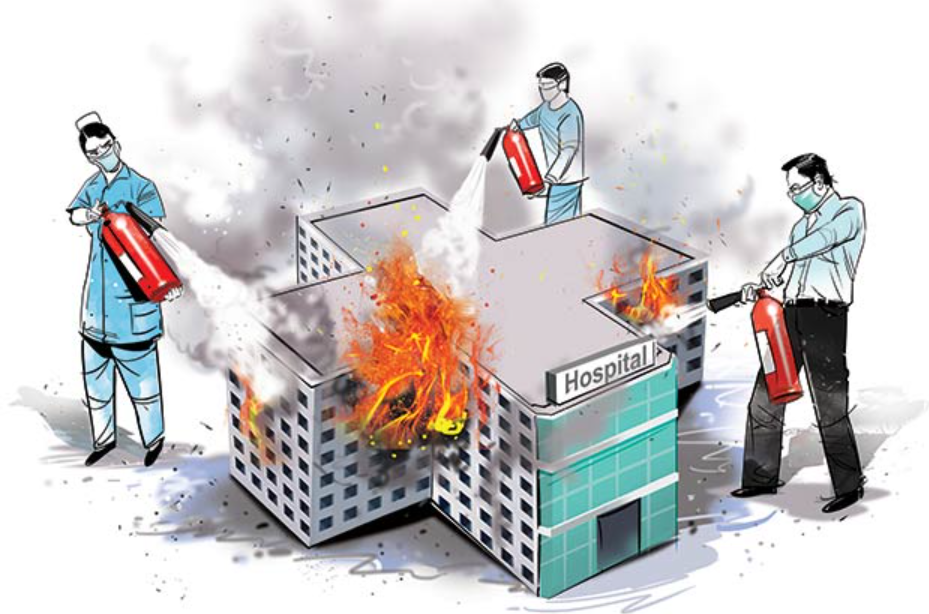
New Delhi: With the summer months bringing escalated temperatures, the threat of hospital fires looms large. In a bid to prevent such catastrophic incidents, the Union Health Ministry and the National Disaster Management Authority (NDMA) have jointly issued an advisory to all States/UTs, emphasizing the urgent need for proactive measures.
The directive urges State Health Departments and State Disaster Management Authorities to collaborate closely to ensure that all accredited hospitals undertake immediate action on the following fronts:
Thorough Inspections: Hospitals are directed to conduct comprehensive fire safety audits and on-site inspections to assess compliance with fire safety regulations. This includes ensuring the functionality of fire-fighting systems such as alarms, smoke detectors, extinguishers, hydrants, and fire lifts.
Electrical Load Audits: Addressing the issue of inadequate electrical load capacity, hospitals are instructed to conduct regular audits, particularly when adding new equipment or converting spaces into ICUs. Any identified discrepancies must be promptly rectified.
Fire NOC Compliance: Hospitals must adhere strictly to regulatory requirements and obtain valid fire No-Objection Certificates (NOCs) from their respective state fire departments. Special emphasis is placed on recalibrating electrical loads in older buildings constructed before the adoption of fire safety norms.
Detailed instructions outlining specific steps and measures for hospitals to ensure fire safety compliance have been provided to Chief Secretaries of all States and UTs, with a recommendation to disseminate the information among all accredited hospitals.
The advisory outlines the following instructions to prevent fire incidents in hospitals and other healthcare facilities:
Functional Fire-Fighting Systems: Regular inspection of fire-fighting equipment such as extinguishers, hydrants, and alarms, ensuring their operational efficacy.
Regular Maintenance and Testing: Establishing maintenance schedules for fire safety equipment, including monthly checks of extinguishers and quarterly tests of alarms and hydrants.
Regular Electrical Load Audits: Conducting bi-annual electrical audits to evaluate power consumption and prevent overloading, as per the National Electrical Code of India-2023.
Oxygen Safety: Implementing strict no-smoking policies in areas with oxygen tanks or piped oxygen and controlling heat sources.
Installation of Smoke Detectors and Fire Alarms: Ensuring the installation and regular testing of fire smoke detectors and alarms in all hospital areas.
Combustible Material Control: Auditing materials used in hospital construction and furnishings to replace combustible materials with non-combustible or fire-resistant alternatives.
Non-Combustible Material for Electrical Ducts: Inspecting electrical ducts and sealing them with fire-resistant materials to prevent the spread of fire.
Avoiding Overloading Power Sources: Using power management systems to monitor electrical loads and prevent overloading.
Installation of Water Sprinklers and Hosepipes: Fitting critical areas with automatic sprinkler systems and accessible hosepipes linked to the fire alarm system.
Strict Adherence to the National Building Code: Reviewing and updating hospital infrastructure to comply with fire safety standards outlined in the National Building Code 2016.
Obtaining Fire Safety NOC: Annually renewing the Fire Safety No-Objection Certificate as per State Fire Safety Rules from the local fire department.
Staff Training and Drills: Implementing continuous training programs for staff on fire prevention and conducting bi-annual fire drills, including evacuation drills.
Evacuation Plans: Developing comprehensive evacuation plans with clear escape routes, emergency exits, and designated safe assembly areas.
Each hospital is required to formulate a Standard Operating Procedure (SOP) to be followed in case of a fire incident, ensuring preparedness and effective response protocols are in place.
Bhubaneswar: Odisha has taken a significant lead in India’s clean energy transition by becoming the…
Bhubaneswar: In a major step towards planned urban expansion, the Bhubaneswar Development Authority on Tuesday…
Bhubaneswar: The “Bamboo Forward Summit — From Ground to Growth” was successfully organised, bringing together…
Bhubaneswar: ParibhaAsha HeritEdge Lab has launched Ekamra Anubhav 2.0, a reimagined edition of its heritage…
Bhubaneswar: Responding to mounting criticism and political consensus, the Odisha government has begun the process…
Bhubaneswar: The inaugural edition of the National Indoor Athletics Championships concluded on a high note…