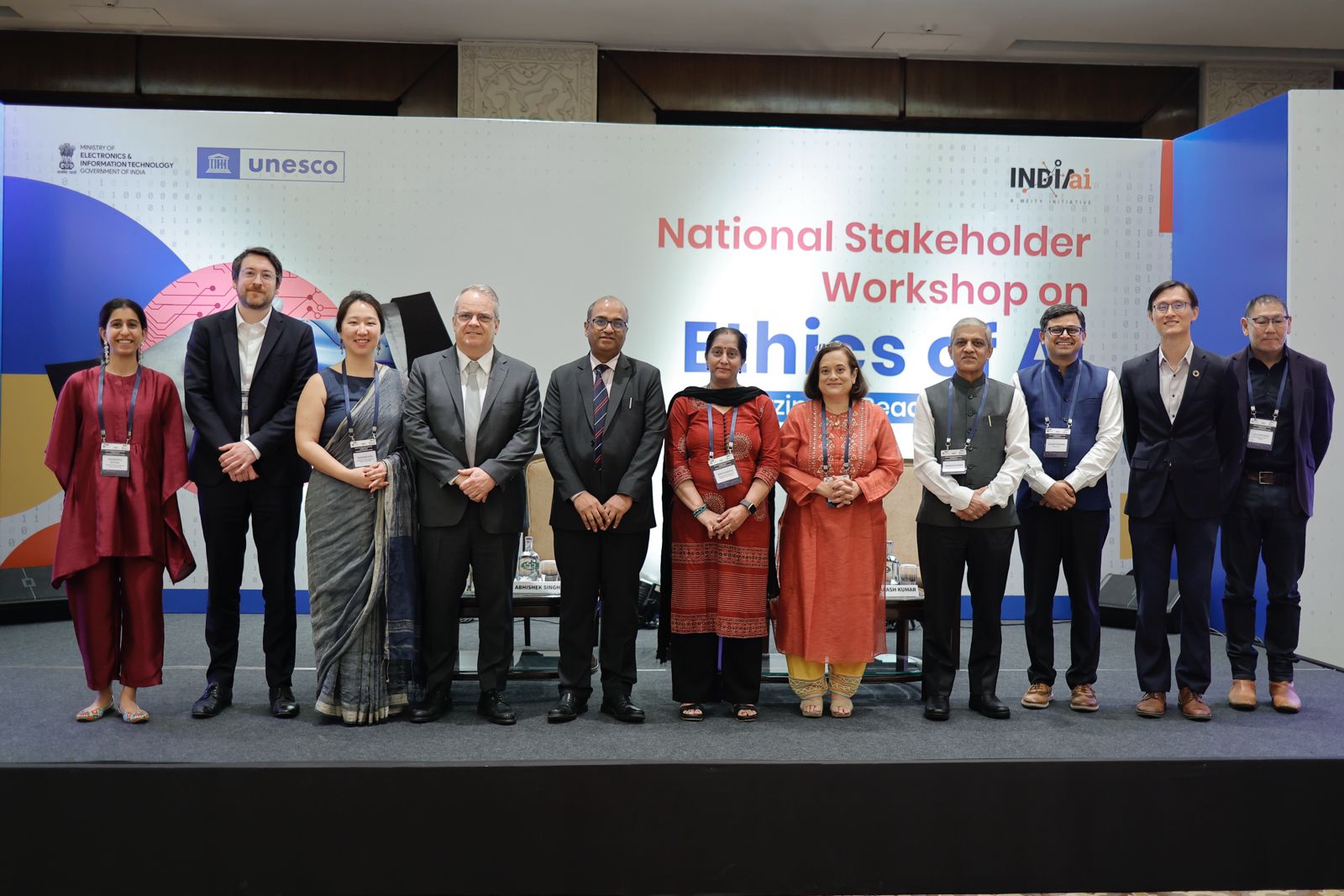
New Delhi: The United Nations Education, Scientific and Cultural Organization (UNESCO) South Asia Regional Office, in collaboration with the Ministry of Electronics and Information Technology (MeitY), Government of India, hosted the National Stakeholder Workshop on Safe, Trusted, and Ethical AI at the Taj Palace Hotel. This event follows the Government of India’s recent approval of the IndiaAI Mission, which has been allocated over Rs 10,000 crore, marking a significant step towards strengthening India’s AI ecosystem.
The workshop provided a platform for critical discussions on integrating safe, trusted, and ethical AI considerations into national and state-level AI strategies. The aim is to ensure the deployment of AI technologies aligns with public welfare and adheres to international norms and standards.
Broad Representation and Critical Dialogues
The workshop featured participation from senior officials from various Central Line Ministries, State Governments, NITI Aayog, and industry partners such as NASSCOM. Extensive dialogues on safe and trusted AI, its ethical implications, and the societal impact of AI technologies were conducted through panel discussions and breakout group sessions.
Eminent Dignitaries and Their Perspectives
The inaugural session was graced by Prof Ajay Kumar Sood, Principal Scientific Adviser to the Government of India; Abhishek Singh, Additional Secretary, MeitY; Tim Curtis, Director, UNESCO South Asia Regional Office; and Gabriela Ramos, UNESCO Assistant Director General for Social and Human Sciences.
Prof Ajay Kumar Sood emphasized the need for a balanced approach to AI, stating, “As AI raises concerns on ethics and its societal implications, India aims to adopt a balanced approach. The IndiaAI mission will foster the development and adoption of AI, with UNESCO playing a commendable role in promoting ethics of AI worldwide.”
Abhishek Singh highlighted the importance of building a safe and trusted AI framework, explaining, “Ethics in AI should prevent user harm, promote innovation, and mitigate risks associated with AI.”
Significant Economic Impact and Technological Self-Reliance
AI is expected to add nearly $500 billion to India’s GDP by 2025, driven by advancements in healthcare, financial services, and telecommunications. MeitY is leading the IndiaAI Mission, which includes key components such as IndiaAI Compute Capacity, IndiaAI Innovation Centre (IAIC), IndiaAI Datasets Platform, IndiaAI Application Development Initiative, IndiaAI FutureSkills, IndiaAI Startup Financing, and Safe & Trusted AI.
Comprehensive Agenda and Ethical AI Standards
The workshop’s comprehensive agenda included sessions on AI fundamentals, ethical dimensions of AI, UNESCO’s role in AI ethics, and the current AI policy landscape in India. The goal was to establish a foundation for informed policy development that promotes equitable and sustainable AI adoption nationwide.
Tim Curtis, UNESCO Representative to India, emphasized the importance of ethical AI, stating, “AI has immense potential to contribute to achieving the Sustainable Development Goals (SDGs), but it poses significant ethical and practical risks if deployed without proper frameworks. UNESCO aims to support the Indian government in integrating ethical considerations into national and state-level AI strategies, ensuring alignment with international norms and standards.”
NASSCOM’s Insight on Ethical AI
During a panel discussion, NASSCOM President Debjani Ghosh remarked, “Ethics is about equity and inclusion. First, humans need to adhere to ethical standards, and then extend those principles to AI. We cannot afford a closed system where only a few companies control AI.”
Global Standards and National Implementation
The ‘Recommendation on the Ethics of Artificial Intelligence,’ adopted unanimously in November 2021 by all 193 UNESCO Member States, serves as the first international standard-setting instrument on AI ethics. The protection of human rights and dignity is its cornerstone, emphasizing transparency, fairness, and human oversight in AI systems.
UNESCO is working with MeitY to ensure that the core values and principles of this global recommendation are translated into concrete policy actions across various spheres, including data governance, environmental sustainability, gender equity, education, research, and health.