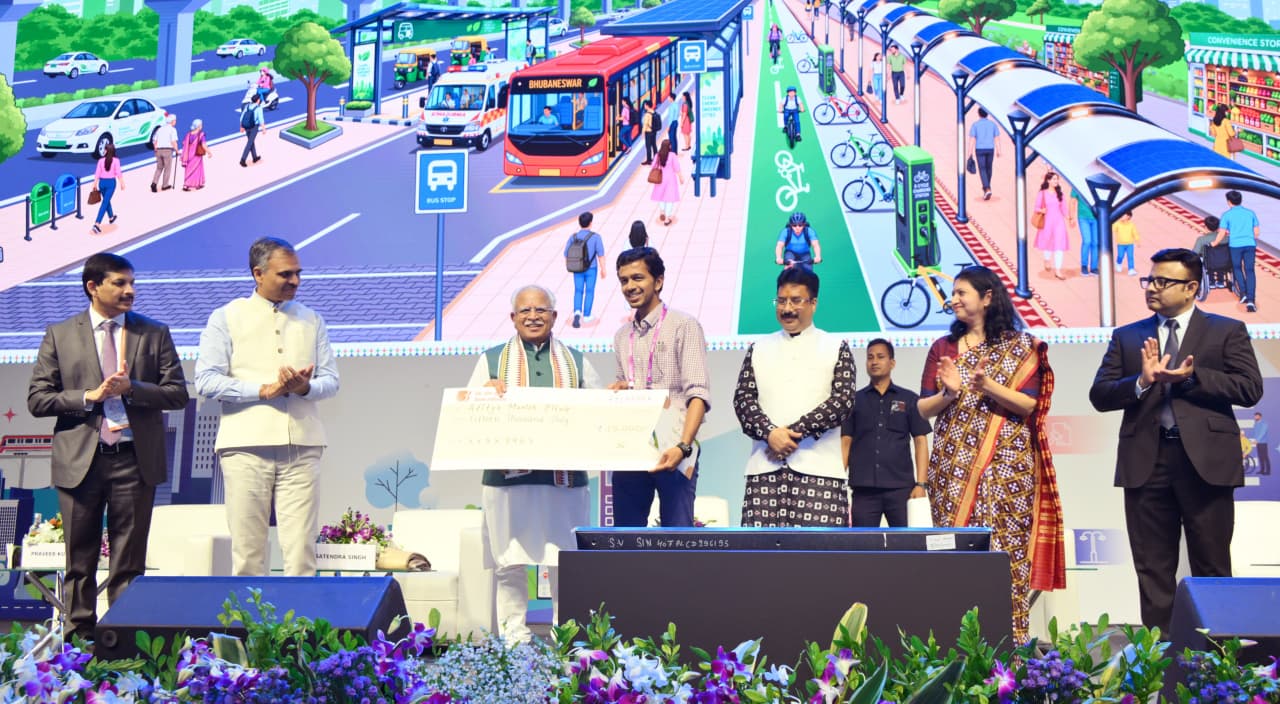
Bhubaneswar: The 19th Urban Mobility India (UMI) Conference and Exhibition 2026 concluded in Bhubaneswar on Saturday, with Union Minister for Housing and Urban Affairs and Power Manohar Lal calling for integrated, inclusive and technology-driven transport systems to make Indian cities more accessible and liveable.
Held on October 23 and 24 under the theme ‘Urban Accessibility and Liveability in Digital Age’, the two-day conference was organised by the Ministry of Housing and Urban Affairs (MoHUA) through the Institute of Urban Transport (India), with the support of the Government of Odisha. It brought together around 1,500 delegates and experts from India and abroad to discuss sustainable urban transport, emerging technologies and people-centric city planning.
Addressing the valedictory session, Manohar Lal said urban mobility must be integrated into city planning from the outset, as transport infrastructure has become a foundation for economic growth and urban development. He stressed the need to ensure convenient access to workplaces, schools, hospitals and other essential services.
The Minister outlined three guiding principles for future urban mobility: Integration, Inclusiveness and Intelligence. Integration, he said, requires seamless connectivity among metro, bus, rail and other transport services, supported by effective first- and last-mile connectivity. Inclusiveness means making transport safe and accessible for women, senior citizens, persons with disabilities and all sections of society. Intelligence involves using artificial intelligence and real-time data to improve traffic management, passenger safety and public transport efficiency.
Highlighting the expansion of urban transport infrastructure, the Minister said nine metro projects covering approximately 174 kilometres, involving an investment of more than ₹59,000 crore, had been approved since December 2025. An additional 102 kilometres of metro network had become operational during the same period, taking India’s operational metro network to 1,185 kilometres across 26 cities.
He also highlighted progress under the PM e-Bus Sewa Scheme, stating that 1,100 electric buses had begun operations in 28 cities, carrying an average of around 2.5 lakh passengers daily. Referring to Delhi’s Transit-Oriented Development (TOD) Policy 2026, approved in April, he said it would support planned development and affordable housing along metro, Regional Rapid Transit System (RRTS) and railway corridors across approximately 207 square kilometres.
The Minister said the conference featured 14 sessions and 28 exhibitors showcasing urban transport innovations and solutions. Discussions also explored the use of data from telecommunications networks, mobile applications and digital platforms to support evidence-based planning for metro, bus and other transport services. He urged States, cities and transport organisations to translate the conference recommendations into concrete action plans.
Odisha Housing and Urban Development Minister Krushna Chandra Mahapatra said the success of a conference depended on translating ideas into meaningful action on the ground. He noted that the event had provided a platform for policymakers, urban experts, industry partners and other stakeholders to exchange experiences and best practices.
He emphasised that the lessons from the conference should be converted into practical solutions suited to the needs of individual cities, with a focus on safer, more accessible, inclusive and liveable urban spaces.
Additional Chief Secretary of the Housing and Urban Development Department Usha Padhee said hosting the UMI Conference and the National Urban Conclave 2026 had provided Odisha with an opportunity to engage with ideas and perspectives on sustainable urban development and people-centric mobility.
She said the State had sought to extend a warm welcome to delegates and expressed hope that the discussions and collaborations would lead to meaningful action towards building inclusive, accessible and sustainable cities.
The valedictory session also recognised cities, States and transport organisations for excellence and best practices in urban transport. Manohar Lal and Krushna Chandra Mahapatra presented the awards.
Bhubaneswar’s Comprehensive Region Urban Transport (CRUT) received the award for the City with the Best Green Transport Initiative. Chennai’s Greater Chennai Corporation was recognised for the best non-motorised transport system, while Delhi Transport Corporation and Delhi Metro Rail Corporation received the award for excellence in innovation and smart mobility solutions.
Delhi Transport Corporation was also recognised for the best public transport system and the best use of big data analytics for operations and evidence-based transport planning. Kochi Metro Rail Ltd. received the award for the metro station with the best multi-modal integration. Chennai Metro Rail Ltd. and the National Capital Region Transport Corporation were recognised for passenger services and satisfaction.
Noida Metro Rail Corporation Ltd. received a special award for optimising civil structural design.
In the commendation awards, Odisha’s CRUT was recognised in the category of State/UT with the Best Urban Transport Reforms and Implementations. Other recipients included Bhavnagar’s Transport Department and Municipal Corporation for green transport, Kakatiya Urban Development Authority in Warangal for non-motorised transport, Kochi Metro Rail for smart mobility solutions and Bengaluru Traffic Police for the use of big data analytics.
The second day featured technical sessions, round-table discussions and a plenary session on sustainable and integrated mobility. Discussions on land use and transport beyond city limits examined transit-oriented development, compact urban growth, mixed-use development and connectivity between suburban areas and major transport networks.
A round-table on people-centric streets highlighted the need for continuous footpaths, protected cycling networks, safe crossings and traffic-calming measures. Another session examined ways to encourage people to shift from private vehicles to public transport through public communication, community participation, incentives and digital applications.
Participants also discussed the use of artificial intelligence, real-time data and connected infrastructure to improve transport safety and efficiency. The plenary session on rail-led integrated urban development explored the role of metro and other mass rapid transit systems in supporting sustainable urban growth, multimodal integration and effective first- and last-mile connectivity.
The conference exhibition featured 28 organisations from the Government of Odisha, metro rail companies, public sector organisations and private entities. A research symposium also provided a platform for scholars and PhD students, featuring 46 selected research papers, including 20 oral presentations and 26 poster presentations.
The conference concluded with an emphasis on integrated planning, evidence-based decision-making, technological innovation and inclusive public transport as key elements in improving accessibility and quality of life in India’s cities.
Bhubaneswar: Odisha has stepped up its cyclone preparedness, with the India Meteorological Department (IMD) forecasting…
Bhubaneswar: The Odisha Rural Development and Marketing Society (ORMAS) has won the BIRC Global Excellence…
Bhubaneswar: Odisha has earmarked ₹1,615 crore over five years under its PMAY-Urban BANDHU initiative to…
Bhubaneswar: The Odisha Energy Department has stepped up preparations to deal with the possible impact…
Bhubaneswar: Integrated transport networks connecting cities with their surrounding regions are essential for improving daily…
Bhubaneswar, October 24: The Odisha Agriculture Department has stepped up preparedness to protect crops and…