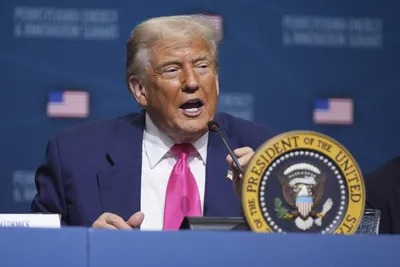
Washington: Donald Trump has reignited debate over foreign hiring by sharply criticizing leading US tech firms for employing Indian professionals and outsourcing work overseas. The former US President, speaking at a national Artificial Intelligence (AI) summit, accused companies like Google, Microsoft, and Apple of undermining domestic employment and compromising national technological leadership.
Addressing a packed audience, Trump accused American tech giants of exploiting the country’s freedoms while investing and hiring abroad. He specifically cited operations in China, India, and Ireland, stating: “Many of our largest tech companies have reaped the blessings of American freedom while building their factories in China, hiring workers in India, and stashing profits in Ireland. Under President Trump, those days are over.”
Although no new restrictions were formally announced, Trump’s comments are being seen as a clear signal to reorient national AI policy in favor of American workers. His remarks could influence corporate hiring strategies, especially for firms engaged in government-backed AI programs.
Trump also used the platform to unveil three new executive orders aimed at consolidating US dominance in artificial intelligence. The first focuses on fast-tracking domestic infrastructure for AI, easing regulatory barriers to expand data centers and computing hubs across the country. The second mandates that AI systems developed using federal funding remain free from ideological bias, with Trump declaring that “woke” technology would no longer be funded. He criticized earlier diversity-driven programs as obstacles to true innovation. The third order promotes the global export of US-made AI systems and aims to reduce dependence on foreign suppliers.
These measures come at a time when American companies are deeply intertwined with India’s tech talent pool. Over the years, cities like Bengaluru and Hyderabad have emerged as strategic engineering bases for US firms, with Indian developers contributing significantly to software, cloud, and AI projects. Indian nationals also make up a substantial share of the US tech workforce, accounting for nearly 74 percent of all new H-1B visas approved in 2024, according to official data.
While Trump stopped short of announcing changes to H-1B policies or outsourcing laws, the emphasis on reshoring talent is likely to shape future decisions in Washington. His stance has already caused unease among Indian professionals working in the US and those planning to move there, as well as within India’s IT sector, which includes giants like Infosys, Wipro, and TCS.
The industry, however, warns that limiting access to global talent could harm American innovation. A Brookings Institution report noted that more than half of the leading AI researchers in the US were born overseas, with many coming from India and China. Analysts suggest that Trump’s push to prioritize American hires may win political support but risks weakening the very ecosystem that has propelled the US to the forefront of global technology.
Trump’s comments, while politically charged, signal a broader policy direction that prioritizes technological sovereignty and domestic employment over globalization. As election season intensifies, his AI-focused message is likely to resonate with voters but raise concerns within the tech sector at home and abroad.
Bhubaneswar: The Odisha Lalit Kala Akademi celebrated its 66th Foundation Day at the Kalinga Art…
Berhampur: Thousands of Olive Ridley sea turtles arrived at the Rushikulya river mouth early Sunday…
Bhubaneswar: The third Foundation Day of Odisha Women in Media (OWM) was celebrated in Bhubaneswar…
Bhubaneswar: The Blue Economy is set to become a major pillar of Odisha’s future economic…
Bhubaneswar: Odisha Police in collaboration with UNICEF organised the JUVENTICA – Digital Rights & Safety…
Bhubaneswar: The Global Summit on Blue Economy 2026 began on Thursday at the Convention Centre,…
