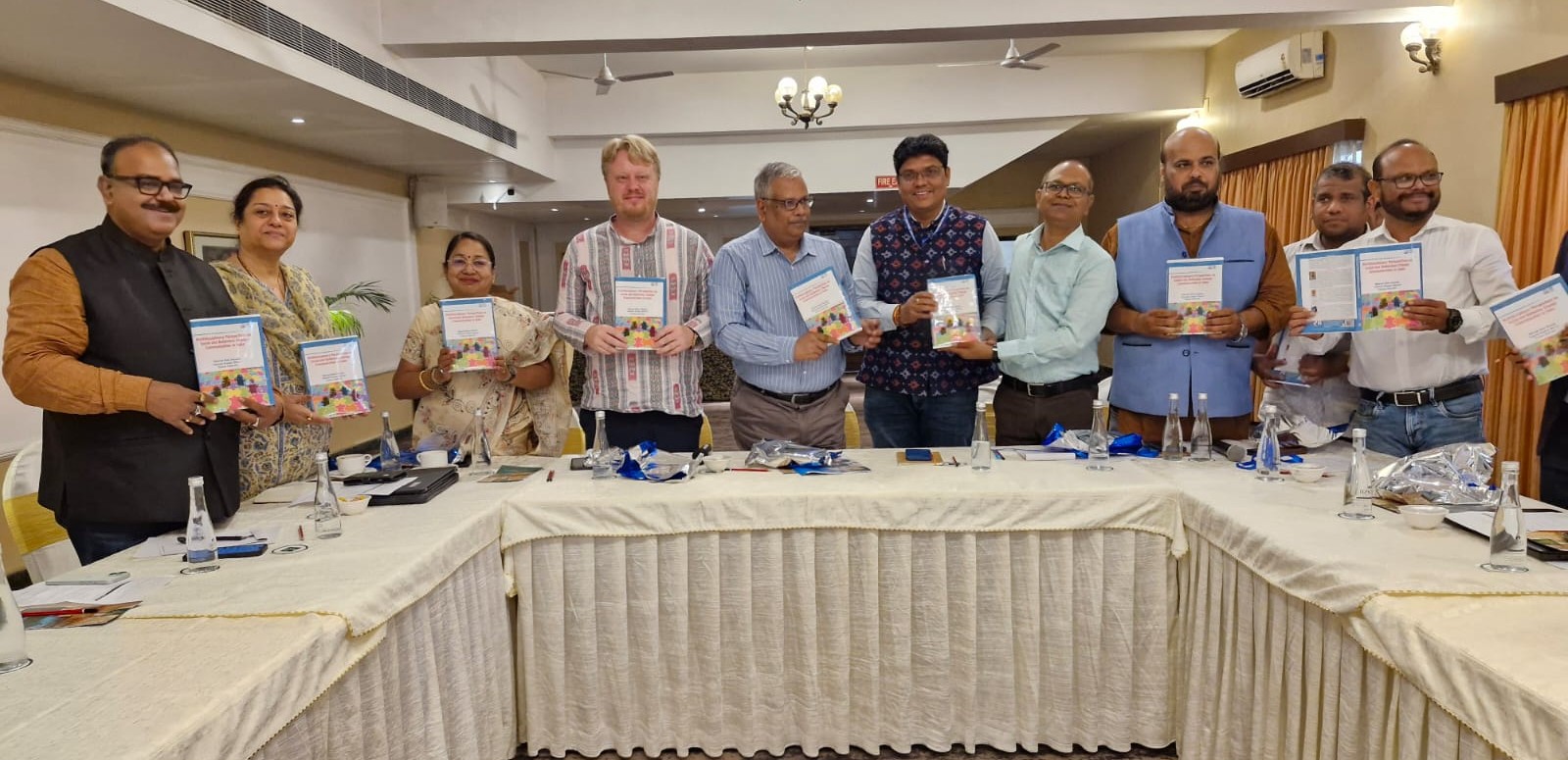
Bhubaneswar: A State-Level Workshop on “Role of Academic Institutions in Strengthening Social Behavioural Change Landscape for Women, Children and Adolescents in Odisha” was organised today in Bhubaneswar. Jointly organised by Fakir Mohan University, Balasore, with UNICEF Odisha, the workshop brought together academicians, researchers, development practitioners, and policy experts to deliberate on how higher educational institutions can play a stronger role in advancing Social and Behavioural Change (SBC) initiatives across Odisha, particularly for improving the well-being of women, children, and adolescents.
Prof. Bharati Bala Patnaik, Head of the Department of Journalism and Mass Communication, Fakir Mohan University, delivered the welcome address and highlighted the importance of academic engagement in behavioural research and communication.
Prasanta Kumar Dash, Chief of Field Office, UNICEF Odisha, in his address emphasised the need to mainstream Social and Behavioural Change across universities. He stated that behavioural science must be understood and practiced at the academic level to address social challenges effectively.
“Social and Behavioural Change (SBC) must reach all universities so that behavioural sciences are understood and practiced at the academic level. Many challenges, such as stunting that begins in the womb, are driven by behaviours deeply ingrained in our culture and resistant to change even as people grow or become educated. We must focus on strong behavioural insights to understand why people reject beneficial ideas, moving beyond simple awareness to achieve scientific behavioural change that truly impacts society,” he said.
Dennis Christian Larsen, Social and Behavioural Change Chief at UNICEF India, spoke on the importance of scientific approaches in designing effective behaviour-change policies. He noted, “Odisha is a leading state in Social and Behavioural Change, and by creating a community of practice here, we can develop models that serve other states and countries. While services and infrastructure are important, the behaviours of the population are crucial to reaching the Sustainable Development Goals.”
He further added, “The ‘last mile’ of the population is the most difficult to reach, requiring a scientific approach to understand attitudes and feelings so that policymakers can rely on evidence-based strategies.”
The session was facilitated by Sugata Roy, SBC Specialist, UNICEF, who called upon universities to play a greater role in generating evidence and guiding policy and programme actions. “We are looking at you not just as the powerhouse of knowledge, but also as a powerhouse for giving us direction through generating evidence and translating that evidence into action,” he remarked.
Lopamudra Tripathy, Social and Behaviour Change Specialist, UNICEF India, wrapped up the session by stating, “We need to think about how we can together take this initiative one step ahead and make a meaningful difference at the community level.”
The event also witnessed the launch of the book titled “Multidisciplinary Perspectives on Social and Behaviour Change in India”, highlighting the importance of interdisciplinary approaches in understanding and addressing behaviour change challenges.
Bhubaneswar: In a significant ruling concerning government land near the UNESCO-listed Konark Sun Temple, the…
Bhubaneswar: Odisha has set an ambitious target of becoming a $500 billion economy by 2036…
Bhubaneswar: The 19th Urban Mobility India (UMI) Conference and Exhibition 2026 opened in Bhubaneswar on…
Bhubaneswar: The Odisha Water Resources Department has stepped up its preparedness for potential cyclone-related situations,…
Bhubaneswar: East Coast Railway (ECoR) has achieved its October 2026 scrap sale target of ₹17…
New Delhi: Odisha is showcasing its rich rice heritage at the Bharat International Rice Conference…