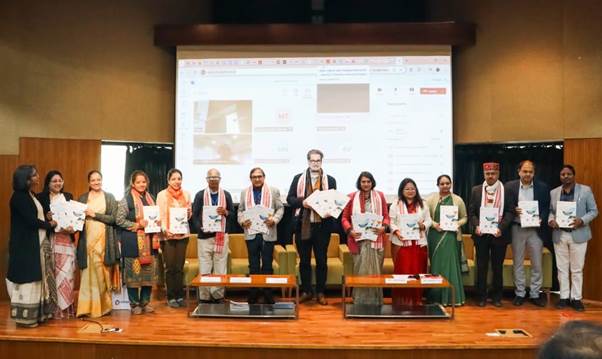
New Delhi: The report titled ‘District-level Climate Risk Assessment for India: Mapping Flood and Drought Risks Using the IPCC Framework’ was released today at the Indian Institute of Technology Delhi. Developed by the Indian Institute of Technology Mandi, Indian Institute of Technology Guwahati, and CSTEP Bengaluru, with support from the Department of Science and Technology (DST) in collaboration with the Swiss Agency for Development and Cooperation (SDC), the report provides a comprehensive analysis of flood and drought risks across 698 districts in India.
The detailed report includes district-level flood and drought hazard, exposure, and vulnerability maps, which have been generated to provide actionable insights for risk assessment and adaptation planning. Alongside the report, a User Manual has been released to guide stakeholders in utilizing the data effectively.
Dr. Anita Gupta, Head of the CEST Division at the Department of Science and Technology (DST), spearheaded the initiative, emphasizing that DST is committed to addressing climate change through the development of two national missions—National Mission on Sustainable Himalayan Ecosystems (NMSHE) and National Mission on Strategic Knowledge for Climate Change (NMSKCC). She stated that the report will aid in identifying high-risk states and provide tailored adaptation strategies. Additionally, a series of awareness campaigns is planned to empower vulnerable communities and build sustainable frameworks to combat climate change impacts.
Pierre-Yves Pitteloud, Senior Regional Advisor on Disaster Risk Reduction (DRR), Climate Change Adaptation (CCA) & Rapid Response (RR) at the Swiss Agency for Development and Cooperation, highlighted the importance of risk mapping at the district level. He noted that this facilitates dialogue between policymakers, communities, and local bodies to identify vulnerabilities and hazards, fostering better climate resilience.
The flood risk assessment within the report revealed that 51 districts fall into the ‘Very High’ flood risk category, and 118 districts fall into the ‘High’ flood risk category. The states most affected include Assam, Bihar, Uttar Pradesh, West Bengal, Gujarat, Odisha, and Jammu and Kashmir, with over 85% of districts falling into these categories.
In terms of drought risk, the report indicated that 91 districts fall into the ‘Very High’ drought risk category, and 188 districts fall into the ‘High’ drought risk category. Bihar, Assam, Jharkhand, Odisha, Uttar Pradesh, Maharashtra, West Bengal, Karnataka, Tamil Nadu, Chhattisgarh, Kerala, Uttarakhand, and Haryana have the highest concentrations of districts in these risk categories, with over 85% of these districts affected.
The dual risk of flood and drought was another critical area explored, revealing that 11 districts are at a ‘Very High’ risk for both hazards. These districts include Patna in Bihar; Alappuzha in Kerala; Charaideo, Dibrugarh, Sibsagar, South Salmara Mankachar, and Golaghat in Assam; Kendrapara in Odisha; and Murshidabad, Nadia, and Uttar Dinajpur in West Bengal.
The report’s findings were presented by Prof. Laxmidhar Behera, Director of IIT Mandi; Prof. Devendra Jalihal, Director of IIT Guwahati; and Professor N H Ravindranath from IISc Bengaluru. Additionally, the event saw the participation of Dr. Kalachand Sain, Former Director of Wadia Institute of Himalayan Geology; Dr. Shyamasree Dasgupta and Dr. Indu K Murthy from CSTEP Bangalore; Dr. Susheela Negi from DST; along with officials from the Ministry of Environment, Forest and Climate Change, state climate cells, and other key stakeholders.
Bhubaneswar: The Odisha government on Monday released ₹99.26 crore in interest subvention to 1,79,809 Self-Help…
Bhubaneswar: Odisha has entered into strategic partnerships with 15 organisations and institutions to strengthen skill…
Bhubaneswar: Odisha's technology-enabled mobility platform Odisha Yatri is set to showcase its expanding mobility network…
Bhubaneswar: East Coast Railway (ECoR) has stepped up its renewable energy push, with solar installations…
Bhubaneswar: Odisha's hockey stars Amit Rohidas and Shilanand Lakra received a warm welcome at Kalinga…
Bhubaneswar: With thousands of migratory birds set to make Chilika their winter home, the wildlife…