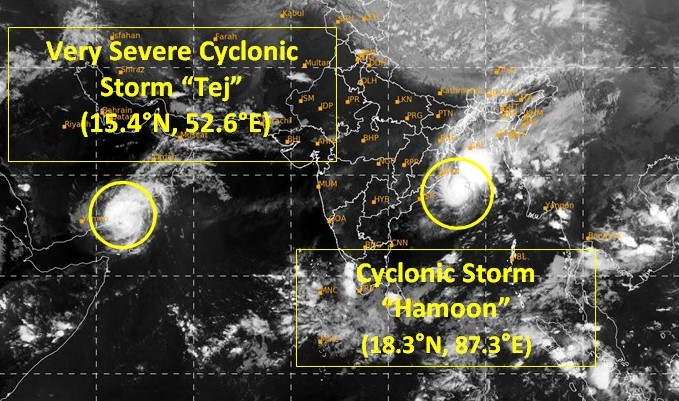
Bhubaneswar: Unprecedented weather patterns have led to a remarkable and rare occurrence as two powerful cyclonic storms, named “Tej” and “Hamoon,” have emerged simultaneously over the Arabian Sea and the Bay of Bengal, respectively. The Indian Meteorological Department (IMD) has flagged this extraordinary phenomenon as a highly unusual and infrequent event, marking a significant point in the study of meteorological occurrences.
The formation of the extremely severe cyclonic storm “Tej” over the southwest Arabian Sea on October 20, 2023, closely followed by the development of “Hamoon” as a cyclonic storm over the Bay of Bengal on October 21, 2023, has garnered considerable attention from meteorological experts. The rare simultaneous genesis of these cyclones in separate ocean basins has set a distinct milestone in the contemporary understanding of atmospheric dynamics and natural weather occurrences.
According to the historical data provided by the IMD, such a convergence of cyclonic activities over the Arabian Sea and the Bay of Bengal has been recorded only a handful of times in the past, making this current occurrence an exceptional and noteworthy meteorological event.
The last known instance of such simultaneous activity dates back to 2018, when the Very Severe Cyclonic Storm “Luban” formed over the Arabian Sea and subsequently crossed Yemen and Oman’s coastal regions on October 14, 2018. This was followed by the development of another Very Severe Cyclonic Storm, “Titli,” which crossed the coasts of northern Andhra Pradesh and southern Odisha on October 11, 2018.
Further, a comparable occurrence was observed in 1977 when two Very Severe Cyclonic Storms simultaneously emerged in November. The Bay of Bengal Super Cyclonic Storm, which prevailed from November 14 to November 20, 1977, made landfall near Chirala on November 19. Simultaneously, the Bay of Bengal Very Severe Cyclonic Storm, active from November 9 to November 23, 1977, crossed the Tamil Nadu coast south of Nagapattinam on November 12. This system then traversed the Arabian Sea, followed a looping trajectory, and weakened before crossing the Karnataka coast north of Mangalore on November 29 as a depression.
As the global community continues to grapple with the implications of climate change and extreme weather events, the simultaneous occurrence of “Tej” and “Hamoon” serves as a significant case for heightened awareness and understanding of the complex interplay of environmental factors influencing such extraordinary meteorological phenomena.
Bhubaneswar: Odisha has stepped up its cyclone preparedness, with the India Meteorological Department (IMD) forecasting…
Bhubaneswar: The Odisha Rural Development and Marketing Society (ORMAS) has won the BIRC Global Excellence…
Bhubaneswar: Odisha has earmarked ₹1,615 crore over five years under its PMAY-Urban BANDHU initiative to…
Bhubaneswar: The Odisha Energy Department has stepped up preparations to deal with the possible impact…
Bhubaneswar: Integrated transport networks connecting cities with their surrounding regions are essential for improving daily…
Bhubaneswar: The 19th Urban Mobility India (UMI) Conference and Exhibition 2026 concluded in Bhubaneswar on…