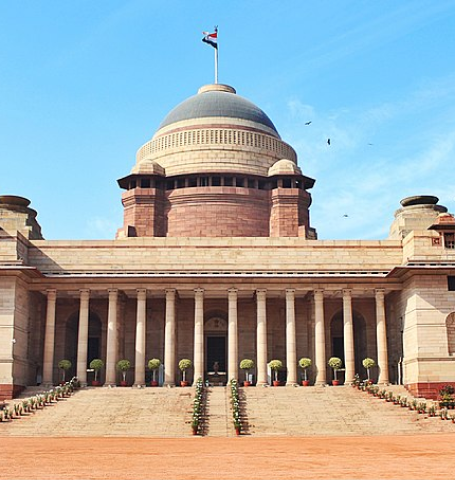
President Murmu Renames Historic Halls at Rashtrapati Bhavan to Reflect Indian Cultural Values
New Delhi: To enhance the cultural resonance of Rashtrapati Bhavan, President Droupadi Murmu has announced the renaming of two iconic halls within the Presidential complex. The historic ‘Durbar Hall’ and ‘Ashok Hall’ have been rechristened as ‘Ganatantra Mandap’ and ‘Ashok Mandap’, respectively. This change aims to better reflect the deep-seated Indian cultural values and ethos in these symbolic spaces.
The newly named ‘Ganatantra Mandap’, formerly known as ‘Durbar Hall’, is a prominent venue for important national ceremonies, including the presentation of National Awards. The term ‘Durbar’ traditionally refers to the courts and assemblies of Indian rulers and the British colonial era. However, as India transitioned to a Republic, the relevance of the term diminished. The new name, ‘Ganatantra Mandap’, resonates with the concept of ‘Ganatantra’, or Republic, which has been a core aspect of Indian society since ancient times. The change symbolizes a shift towards a nomenclature that celebrates India’s democratic and republican ideals.
‘Ashok Hall’, originally a ballroom, has been renamed ‘Ashok Mandap’. The name ‘Ashok’ signifies a state of being free from suffering or sorrow and is also associated with Emperor Ashoka, a historical figure who symbolizes unity and peaceful coexistence. The National Emblem of India, featuring the lion capital from Ashoka’s pillar at Sarnath, underscores the historical and cultural significance of the name. Additionally, the Ashok tree holds a special place in Indian religious traditions and arts. The renaming to ‘Ashok Mandap’ not only brings linguistic uniformity but also seeks to eliminate the remnants of anglicization, while upholding the values associated with the name ‘Ashok’.
Rashtrapati Bhavan, the official residence and office of the President of India, stands as a symbol of the nation’s heritage. The renaming of these halls is part of ongoing efforts to make Rashtrapati Bhavan more accessible to the public and to align its ambience with India’s rich cultural heritage.
These changes reflect a broader initiative to ensure that the symbols and spaces within Rashtrapati Bhavan resonate with the values and ethos of the Indian people, marking a step towards decolonizing the cultural symbols of India’s most prestigious residence.
Bhubaneswar: Odisha has stepped up its disaster preparedness as a weather system over the region…
Bhubaneswar: Odisha has intensified its efforts to tackle drug abuse in six identified narcotics hotspots,…
Bhubaneswar: Bamboo artisans, entrepreneurs and self-help groups in Odisha now have a dedicated marketplace to…
Bhubaneswar: The Bhubaneswar Development Authority (BDA) has opened the online application process for allotment of…
Bhubaneswar: Odisha is looking to make irrigation projects more closely linked with farm production and…
Bhubaneswar: Odisha is set to use drones and artificial intelligence more extensively in environmental monitoring,…