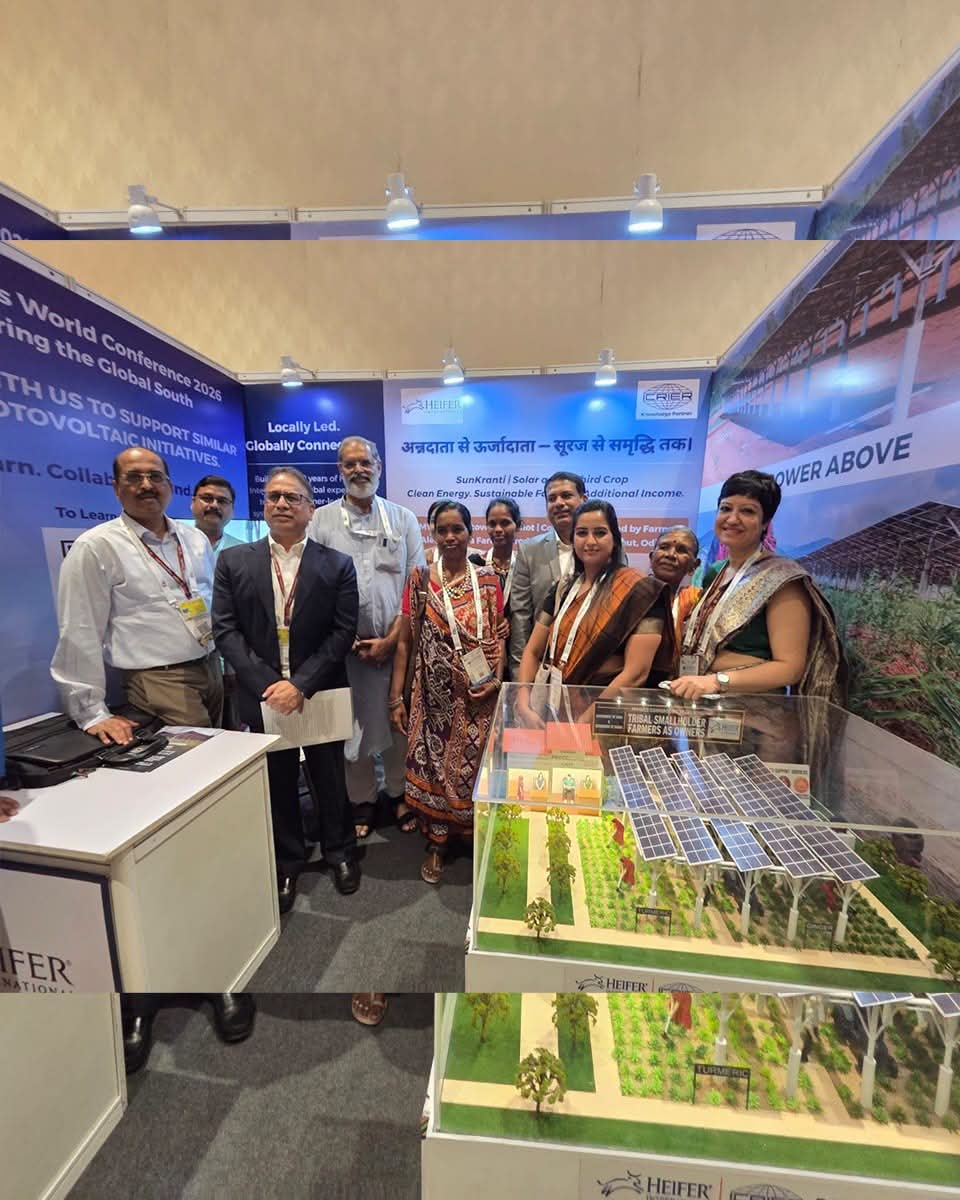
Bhubaneswar/New Delhi: Odisha is finalising a dedicated Agri-PV Policy 2026 to enable farmers to grow crops and generate solar power on the same land, with a target of developing 1 GW of agrivoltaic capacity by 2030.
Deputy Chief Minister and Agriculture and Farmers’ Empowerment and Energy Minister Kanak Vardhan Singh Deo announced the proposed policy while addressing the ministerial session of the 7th Agrivoltaics World Conference 2026 at Bharat Mandapam in New Delhi on Wednesday. He said Odisha aims to become the first state in India to introduce a dedicated policy for agrivoltaics.
The proposed framework is based on the concept of “One Field, Two Harvests”, allowing farmers to continue agricultural activities while earning additional income through solar power generation. Singh Deo stressed that farmers’ interests would remain the priority, with solar installations designed around agricultural needs rather than the other way around.
A key provision of the proposed policy is that at least 90 per cent of every Agri-PV project site must remain under active cultivation. The land would retain its agricultural classification and eligibility for crop insurance, according to the policy framework outlined by the Deputy Chief Minister.
The model would offer farmers two options: owning the systems themselves to earn from both crop sales and electricity generation, or partnering with solar developers in return for assured long-term lease rentals.
To attract investors and provide greater certainty for projects, the proposed framework includes 25-year power purchase agreements with GRIDCO, guaranteed power offtake, grid connectivity and open-access rights.
The policy is also expected to simplify farmer enrolment and link Agri-PV incentives with support for drip irrigation, cold storage, solar pumps and agro-processing facilities.
Highlighting the challenges posed by rising temperatures and erratic rainfall, Singh Deo said agrivoltaics could help farmers adapt to changing climatic conditions.
Raised solar panels can create cooler microclimates, conserve soil moisture and provide some protection to crops and agricultural workers from direct sunlight. These benefits could be particularly important for small and marginal farmers facing increasing climate-related risks.
“We want to make our farmers empowered with Annadata se Urjadata tak,” the Deputy Chief Minister said, referring to the transition of farmers from food providers to both food and energy providers.
The proposed policy aims to combine renewable energy generation with continued agricultural production, offering farmers an additional income stream without requiring them to give up cultivation.
Odisha’s Agri-PV initiative builds on the state’s Renewable Energy Policy 2022 and the RE Investor Conclave held in February 2026, which secured clean energy investment commitments worth Rs 67,000 crore across 6.8 GW of capacity, according to the information shared at the conference.
Ground-level implementation has begun with a 1 MW Agri-PV project. The state is also pursuing a pilot collaboration with Nanyang Technological University, Singapore, to test advanced agrivoltaic technologies under local agricultural conditions.
The initiative is intended to explore the potential of the technology across Odisha’s estimated 40.7 lakh acres of suitable cropland and 47.7 lakh acres of fallow land, as cited in the presentation.
Addressing international delegates, scientists, policymakers and investors, Singh Deo invited research institutions, private investors and other states to collaborate with Odisha in developing farmer-focused agrivoltaic solutions.
The ministerial session was co-organised with the Ministry of New and Renewable Energy, the International Institute for Sustainable Development (IISD) and the Council on Energy, Environment and Water (CEEW).
Vishal Kumar Dev, Additional Chief Secretary, Energy Department, Sachin Ramchandra Jadhav, Commissioner-cum-Secretary, Agriculture and Farmers’ Empowerment Department, and other senior Odisha government officials also participated in the conference.
The proposed Agri-PV Policy 2026 is intended to position Odisha at the intersection of agriculture and renewable energy, with its success depending on protecting farmland, ensuring reliable payments to farmers and making solar installations compatible with everyday farming operations.
Bhubaneswar: Bhubaneswar will host two major national-level events on urban development and mobility this week,…
Bhubaneswar: Odisha has developed a comprehensive protocol for managing pregnancies affected by sickle cell disease,…
New Delhi: President Droupadi Murmu on Wednesday attended the award ceremony of the 65th National…
New Delhi: Union Agriculture and Farmers’ Welfare Minister Shivraj Singh Chouhan has called for developing…
Bhubaneswar: Odisha Chief Secretary Anu Garg has called for expanding livelihood opportunities for rural families…
Bhubaneswar: Odisha Chief Secretary Anu Garg has directed all concerned departments and District Collectors to…