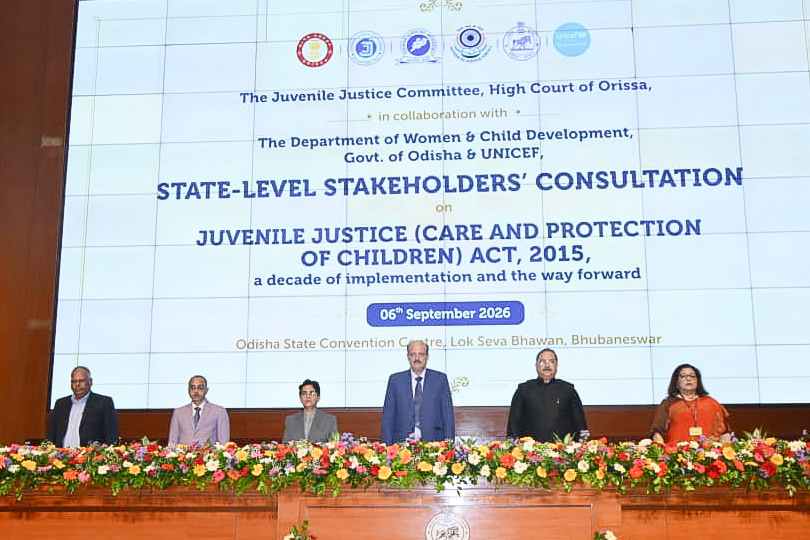
Bhubaneswar: A decade after the Juvenile Justice (Care and Protection of Children) Act, 2015 came into force, stakeholders in Odisha have called for a stronger focus on prevention, family-based care and grassroots interventions to keep children away from institutional care and conflict with law.
The issue came into focus at a State-Level Stakeholders’ Consultation on “Juvenile Justice (Care and Protection of Children) Act, 2015: A Decade of Implementation and the Way Forward” held in Bhubaneswar on Saturday.
Chief Justice of the High Court of Orissa Justice Harish Tandon, Juvenile Justice Committee Chairperson Justice Savitri Ratho, Women and Child Development Commissioner-cum-Secretary Dr Mrinalini Darswal and UNICEF Odisha Chief of Field Office Prasanta Dash attended the consultation along with judicial officers, government officials, police personnel, child rights experts and civil society representatives.
Addressing the gathering, Justice Tandon stressed that prevention should form the core of the juvenile justice system. “Prevention must be at the heart of juvenile justice. We must address vulnerabilities at the grassroots so that children do not come into conflict with law or enter institutional care,” he said.
The consultation was jointly organised by the Juvenile Justice Committee of the High Court of Orissa and the Department of Women and Child Development in association with UNICEF Odisha. It brought together representatives from the judiciary, police, Women and Child Development, School and Mass Education, State Commission for Persons with Disabilities, child protection institutions, legal services authorities, academia and civil society organisations.
Justice Savitri Ratho, Dr Darswal and Prasanta Dash provided an overview of the implementation of the JJ Act in Odisha and reflected on the lessons of the past decade, including the need to strengthen preventive approaches.
The technical sessions were divided into four thematic panels covering children in conflict with law, children in need of care and protection, family-based care and adoption, and offences against children.
The first panel examined the rights of children in conflict with law, including preliminary assessment in heinous offences, pre- and post-production processes and rehabilitation. The second focused on children in need of care and protection, discussing vulnerability mapping, prevention, the functioning of Child Welfare Committees, case management and rehabilitation of children with special needs through inter-departmental convergence.
The third panel deliberated on family strengthening, prevention of family separation, adoption, foster care, sponsorship and aftercare. The fourth examined offences against children, with emphasis on prevention, child-friendly procedures by police and courts, and legal aid and support for survivors.
Participants noted that the JJ Act has significantly reshaped India’s child protection and juvenile justice framework by providing mechanisms for children in conflict with law and those in need of care and protection. Over the past decade, reforms have also sought to strengthen Juvenile Justice Boards and Child Welfare Committees, improve adoption processes, enhance district-level accountability and bring child protection services under Mission Vatsalya.
The consultation also drew attention to emerging risks faced by children, including cybercrime and online exploitation, trafficking, substance abuse, migration and other forms of vulnerability. Stakeholders stressed the need for stronger infrastructure, continuous capacity building of frontline personnel, effective institutional mechanisms and closer coordination among departments.
The discussions underscored the need to move beyond a response-based approach and strengthen preventive systems at the family and community levels so that vulnerable children can access support before they enter the formal child protection or juvenile justice system.
Justice M.S. Raman, Judge of the High Court of Orissa and member of the Juvenile Justice Committee, proposed the vote of thanks and acknowledged the support and participation of the dignitaries, stakeholders and participants in making the consultation successful.
Bhubaneswar: A four-district economic corridor covering 19 urban areas is taking shape in Odisha with…
Bhubaneswar: A regular train journey turned into a celebration of books and literature on Sunday…
Bhubaneswar: The Odisha government has stepped up implementation of its decision to change the English…
Bhubaneswar: The Odisha government has decided to carry forward its rural bridge-building programme for another…
Bhubaneswar: Seven education officials from Odisha have earned national recognition for innovative initiatives aimed at…
Bhubaneswar: The Odisha government has called upon banks to expand credit support to agriculture, MSMEs…