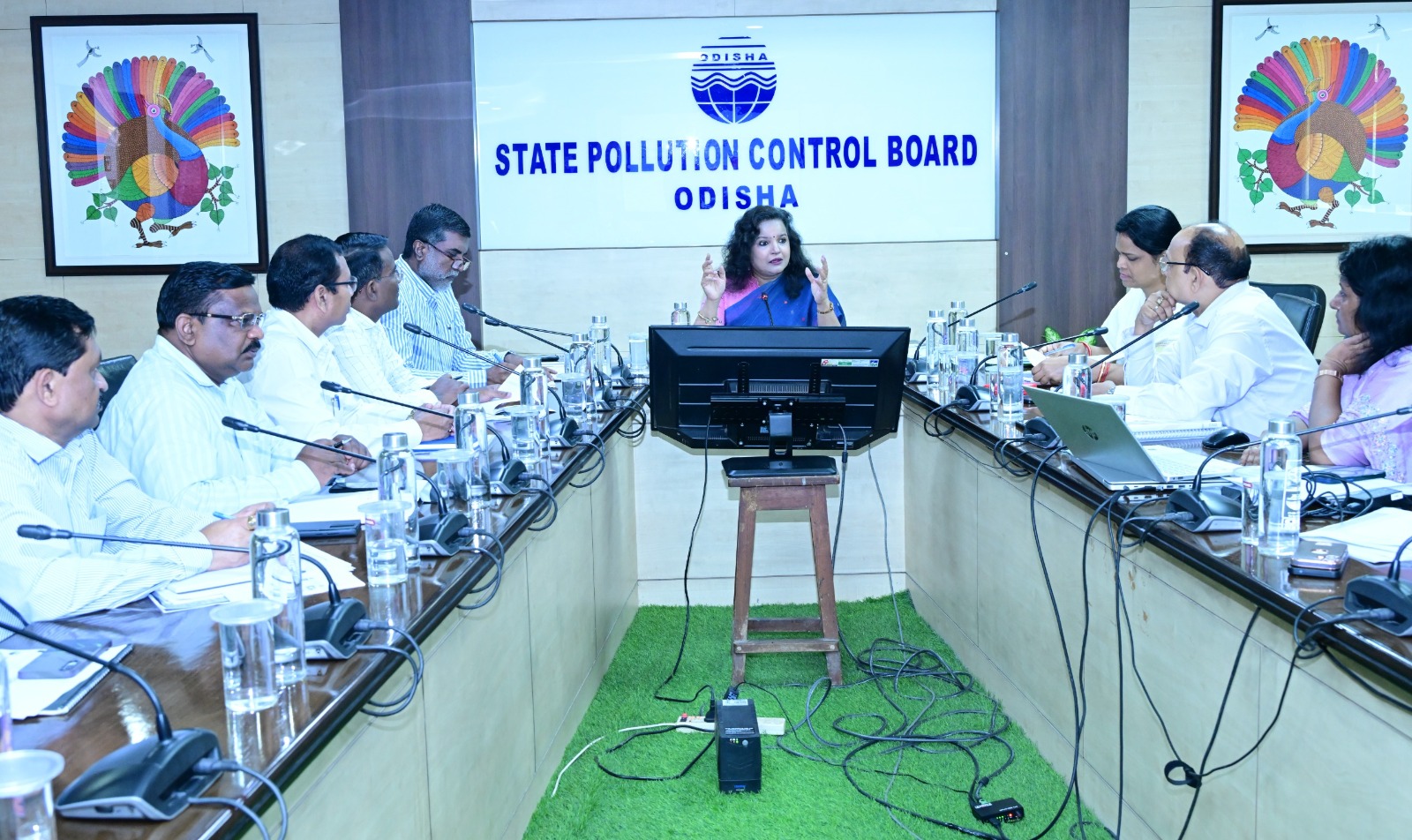
Bhubaneswar: Odisha is looking to make environmental regulation more efficient and investment-friendly while ensuring that rapid industrialisation does not come at the cost of ecological protection. Chief Secretary and Odisha State Pollution Control Board (OSPCB) Chairman Anu Garg stressed this need during a review meeting at the Board’s office on Monday.
Garg called for a shift in the functioning of the OSPCB towards a technology-driven, transparent and data-based environmental management system, rather than limiting its role to issuing approvals and checking compliance.
The review assumes significance as Odisha continues to witness expansion in major industrial sectors, including steel, aluminium, power, mining and petrochemicals. Garg said environmental safeguards and industrial development must progress together to create a conducive environment for investment in the state.
She directed the Board to make environmental approvals and compliance mechanisms simpler, predictable, transparent and time-bound, in line with the state’s Ease of Doing Business initiatives.
According to the Chief Secretary, such reforms would allow industries to meet environmental standards while reducing procedural hurdles for new projects and businesses.
The meeting focused on strengthening online monitoring, automated data collection and digital tracking of industrial compliance. Garg called for greater use of technology and data in pollution control and environmental decision-making.
The Board also discussed plans to modernise its Central Laboratory, Coastal Environment Monitoring Centre and regional laboratories, besides expanding research activities.
Greater collaboration with national research organisations, technical institutions and specialised agencies was also emphasised to improve the state’s environmental monitoring and technical capabilities.
A major focus of the review was the need to move towards a circular economy, with Garg stressing that waste should be treated as a potential economic resource rather than something meant only for disposal.
She called for scientific systems covering the segregation, collection, processing, recycling and recovery of municipal, industrial, plastic, e-waste, construction and demolition and hazardous waste.
The Chief Secretary also advocated the promotion of the ‘Waste to Wealth’ or ‘Waste to Economy’ approach, under which waste from one industry can become a raw material for another.
This, she said, could simultaneously reduce waste, encourage new businesses and generate employment and income.
The meeting also examined ways to increase the utilisation of industrial by-products such as fly ash, slag, red mud and phosphogypsum.
Officials discussed developing mechanisms to use these materials in construction, highway projects and other infrastructure works instead of relying primarily on disposal.
Garg also called for greater public access to environmental information, including real-time air and water quality data.
The Board was advised to make wider use of social media and public awareness campaigns to communicate environmental issues and promote responsible practices among citizens.
Officials also discussed expanding awareness programmes in schools and colleges and observing major environmental occasions such as World Environment Day, World Ozone Day, International Day of Clean Air for Blue Skies and National Pollution Prevention Day.
The Chief Secretary reviewed steps being taken to simplify industrial approvals through the single-window online system.
Online certificate verification and paperless procedures are among the measures being implemented to make the approval process more efficient.
Human resource requirements of the OSPCB were also examined, including vacant posts, promotions and future manpower planning. Garg stressed the need to strengthen the Board’s regional offices, laboratories, legal wing and IT wing.
Garg also pointed out that Odisha’s future economic growth should not rely solely on its mineral resources.
Tourism, she said, would be an important driver of the state’s economy, making environmental protection particularly important for the sustainable development of tourism and infrastructure.
She called for the OSPCB to play a wider role in supporting development while ensuring that ecological safeguards remain firmly in place.
OSPCB Member Secretary Dr Manoj V. Nair made a presentation on the Board’s existing challenges, regulatory framework and future roadmap during the meeting.
Garg directed that future initiatives of the pollution control body should remain aligned with the state’s ‘Viksit Odisha 2036’ vision and the national ‘Viksit Bharat 2047’ goal.
The review ultimately called for a stronger balance between environmental protection, responsible industrialisation, investment, circular economy initiatives and employment generation as Odisha seeks to build a cleaner and more sustainable economy.
Bhubaneswar: East Coast Railway (ECoR) has announced the cancellation of 14 express and passenger train…
Bhubaneswar: Cyclonic Storm Arnab is likely to cross the Andhra Pradesh coast near Yanam by…
Bhubaneswar: The Department of Mission Shakti has launched a state-level capacity-building programme to strengthen women-led…
Bhubaneswar: Odisha is planning to modernise its land and property registration system through the National…
Bhubaneswar: Odisha has stepped up its cyclone preparedness, with the India Meteorological Department (IMD) forecasting…
Bhubaneswar: Odisha has received three national honours for its urban transport initiatives at the 19th…