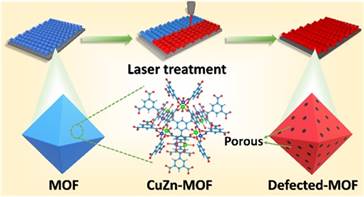
Mohali: Researchers at the Institute of Nano Science and Technology (INST), Mohali, have developed a novel laser-based method to introduce controlled defects in Metal Organic Framework (MOF)-based supercapacitors, significantly boosting their performance. This breakthrough could pave the way for advancements in energy storage technologies, offering a more efficient and environmentally friendly solution.
Traditional techniques for introducing defects in MOF materials, such as thermal annealing, chemical exposure, and high-energy ball milling, often lacked precision and control over the extent of defects. This new laser irradiation approach, developed by Prof. Vivek Bagchi and his team, allows for precise tuning of defects and porosity in pristine CuZn-BTC MOF without altering its crystal structure or transforming it into a composite material.
The key innovation of this method lies in its ability to preserve the crystallinity of the MOF while enhancing its activity. By adjusting laser power, the team was able to systematically create pores in the material, increasing the electrode’s surface area and improving ion diffusion pathways. These changes enhance the stability and accessibility of the MOF, making it more effective for energy storage applications.
“Upon exposure to laser radiation, some bonds in the CuZn-MOF break, but the crystal structure remains largely intact, leading to a three-dimensional porous network,” explained Prof. Bagchi. “This network provides microchannels for ion diffusion, improving the material’s overall performance in supercapacitors.”
In addition to its effectiveness, the laser-based process is faster and more environmentally friendly than traditional methods, as it doesn’t require chemical solvents or extra materials. The technique’s precision also allows for each step of the synthesis to be carefully controlled, making it a cleaner and safer alternative.
Published in the prestigious journal ACS Materials Letters, this breakthrough opens up new opportunities for further research. The method could be applied to other MOFs, potentially leading to significant technological advancements in energy storage systems where MOF materials are used.
Bhubaneswar: Chief Minister Mohan Charan Majhi on Sunday inaugurated two affordable housing projects in Bhubaneswar,…
Bhubaneswar: Odisha has received the prestigious ‘Wind India 2026: Leadership in Wind Energy De-risking’ award…
Bhubaneswar: The Police Commissionerate, Bhubaneswar-Cuttack, has announced traffic restrictions across Bhubaneswar from October 16 to…
Bhubaneswar: To manage the expected rise in passenger traffic during the upcoming Durga Puja and…
Greater Noida: Odisha’s traditional handlooms and handicrafts are attracting buyers and visitors from India and…
Bhubaneswar: Food vendors at this year's Bali Jatra in Cuttack will be encouraged to use…