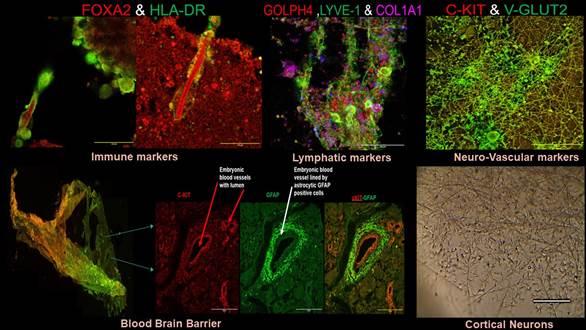
Chandigarh: In a groundbreaking development, researchers at the Post Graduate Institute of Medical Education & Research (PGIMER), Chandigarh, have unveiled a novel model for generating mass neurovascular tissues or neurovascular organoids/embryoids (NVOEs) exclusively from autologous blood. This innovative approach opens up new avenues for investigating impaired brain functioning and development, analyzing preclinical neuroimaging scans, and correlating findings with altered blood supply.
Neural organoids have been at the forefront of scientific research, holding promise for improved insights into brain development, disease modeling, drug discovery, and transplantation sources. However, existing models have limitations, such as the lack of vascularization and the labor-intensive nature of co-culturing blood vessel organoids with cerebral organoids.
Addressing these challenges, the researchers at PGIMER have developed a prototype for establishing and characterizing self-organizing neurovascular organoids/embryoids entirely from autologous blood, without resorting to genetic manipulation or morphogen supplementation. Funded by the Anusandhan National Research Foundation (ANRF, erstwhile SERB), this research breakthrough allows the production of functional vascularized embryoids that require no guided patterning, making it a cost-efficient method utilizing only autologous plasma and blood cells.
Verification of the functional vasculature in neurovascular embryoids was achieved by detecting signals of both hemoglobin (Hb) and deoxyhemoglobin (HbO2) using the Blood-Oxygen-Level-Dependent (BOLD) signal concept.
The implications of this innovative approach are vast, offering opportunities to study neurological disease pathways, neuroregeneration, preclinical neuroimaging, endogenous gene editing, and autologous immunotherapies for tumors and autoimmune diseases.
The researchers are in the process of filing a patent for this groundbreaking model at the Punjab State Council for Science and Technology, Chandigarh. They are applying these models to understand the genetic basis of neurosensory hearing loss and auditory comprehension challenges in children with congenital Sensorineural Hearing Loss (SNHL), along with comorbid features or neurodevelopmental defects.
This prototype holds promise for developing patient-specific embryoid models for a range of congenital neurosensory, neurodevelopmental, and neurodegenerative diseases, paving the way for precision medicine applications, drug testing, neural circuit deciphering, and identification of novel biomarkers for early neurological diseases.
Bhubaneswar: Responding to mounting criticism and political consensus, the Odisha government has begun the process…
Bhubaneswar: The inaugural edition of the National Indoor Athletics Championships concluded on a high note…
Bhubaneswar: The Higher Education Department, Government of Odisha has announced that the Common PG Entrance…
Bhubaneswar: The Government of Odisha has nearly concluded paddy procurement for the 2025–26 Kharif season,…
Bhubaneswar: Strengthening its efforts to stabilise farm incomes and streamline agricultural marketing, the Odisha Rural…
Bhubaneswar: With a growing focus on sustainable agriculture and income diversification, the Agricultural Promotion and…