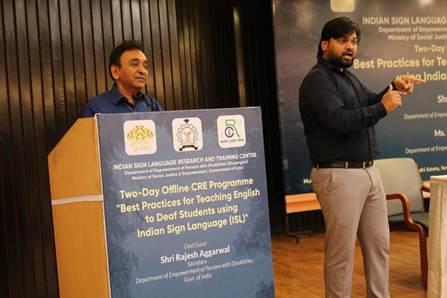
New Delhi: A two-day offline national workshop on ‘Best Practices for Teaching English to Deaf Students Using Indian Sign Language (ISL)’ was held in New Delhi from July 10 to 11, 2025. The event was organized by the Indian Sign Language Research and Training Centre (ISLRTC), an autonomous body under the Department of Empowerment of Persons with Disabilities (DEPwD), Ministry of Social Justice and Empowerment, Government of India.
The workshop was inaugurated by Rajesh Aggarwal, Secretary, DEPwD. In his inaugural address, Aggarwal emphasized the critical role of Indian Sign Language as the primary language for the Deaf community, essential for their cognitive development and academic success. He also underlined the importance of building English language proficiency among deaf individuals to enhance their employment prospects and ensure their full integration into mainstream society. Highlighting the potential of technology in advancing literacy among the Deaf, he called for its greater use in classrooms and training environments.
Over the two days, the workshop featured presentations and interactive sessions led by some of the country’s most experienced professionals in deaf education and English literacy. These included Dr. Sibaji Panda, founder of Happy Hands School for the Deaf; Sunil Sahasrabudhe, a senior consultant and expert in bilingual education; Rajesh Ketkar, associated with MBM News and Orjet Foundation; Hari Hara Kumar from Deaf Enabled India, Hyderabad; Sharayu Kadam of TEACH, Mumbai; and Chithra Prasad from NISH, Kerala. An international perspective was brought in by Abbas Ali Behamanesh, an English and ASL educator at Gallaudet University, who addressed the participants virtually.
The sessions delved into effective bilingual approaches, culturally sensitive teaching strategies, and innovative classroom techniques for promoting English literacy through ISL. Special educators, ISL instructors, and teachers from deaf schools participated in group discussions, sharing insights and identifying actionable practices to enhance learning outcomes for deaf students across India.
The workshop concluded with a valedictory address by Manmeet Kaur Nanda, Additional Secretary, DEPwD. She commended the participants for their commitment and emphasized the government’s continued support in promoting inclusive education.
The event saw the enthusiastic participation of 180 delegates from across the country, including educators from special and inclusive schools, Master Trainers from National Institutes and Composite Regional Centres, and representatives from NCERT and NIOS. The workshop marks a significant step forward in building a more inclusive and effective educational framework for deaf learners in India.
Bhubaneswar: East Coast Railway (ECoR) is expanding its technology-driven security network, with plans to increase…
Bhubaneswar: Odisha’s traditional handloom and handicraft heritage took centre stage at Bhubaneswar Times Fashion Week…
Bhubaneswar: With physical tests for the recruitment of Foresters, Forest Guards and Excise Constables set…
Bhubaneswar: Adapting government communication to the rapidly evolving digital and artificial intelligence (AI) landscape while…
Bhubaneswar: Olympian hockey player and East Coast Railway (ECoR) Sports Officer Amit Rohidas was felicitated…
Bhubaneswar: In a major push to expand egg production and attract investment in the poultry…