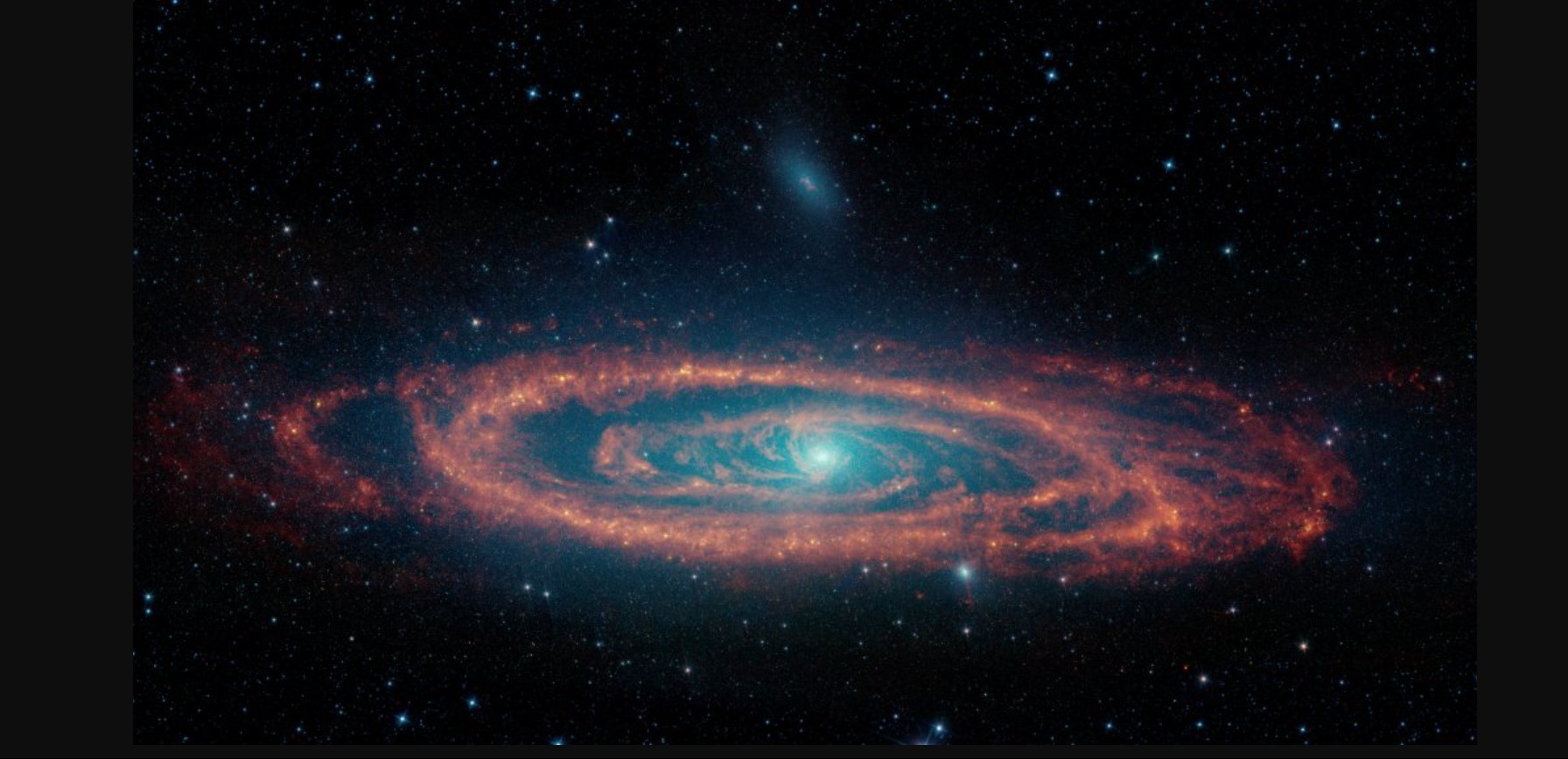
New discoveries from NASA’s retired Spitzer Space Telescope are shedding light on the feeding habits of supermassive black holes, offering scientists fresh insights into their enigmatic behavior.
In images captured by the Spitzer Space Telescope, streams of dust stretching thousands of light-years are observed flowing towards the supermassive black hole residing at the core of the Andromeda galaxy. These streams play a crucial role in understanding how black holes, with masses billions of times that of the Sun, consume matter while maintaining relatively subdued brightness levels.
As supermassive black holes consume gas and dust, the material heats up before it is devoured, producing luminous displays brighter than entire galaxies. However, black holes at the hearts of galaxies like the Milky Way and Andromeda exhibit a more subdued brightness, suggesting they consume a steady flow of matter rather than irregular clumps.
A recent study applied this hypothesis to the Andromeda galaxy, simulating the behavior of gas and dust around its supermassive black hole over time. The simulation revealed the formation of a small disk of hot gas near the black hole, continuously fueling it. This steady flow of matter replenishes the disk, preventing irregular clumps from forming and causing fluctuations in brightness.
Comparing these findings to Spitzer and Hubble Space Telescope data, researchers identified spirals of dust previously unnoticed, which align with the constraints of their simulations. These spirals are believed to be feeding Andromeda’s supermassive black hole, providing crucial evidence to support the theory of steady black hole feeding.
“This is a remarkable example of scientists leveraging archival data to uncover new insights about galaxy dynamics,” said Almudena Prieto, co-author of the study. “We’re discovering new details about galaxy behavior from data collected over two decades ago.”
Launched in 2003, the Spitzer Space Telescope observed the universe in infrared light, revealing unseen features of galaxies like Andromeda. By analyzing different wavelengths, astronomers can identify regions where gas has cooled and dust has formed, providing insights into star formation.
Spitzer’s comprehensive view of Andromeda unveiled surprising features, including a large dust ring dominating the galaxy’s structure. Despite its spiral nature, Andromeda is uniquely characterized by this ring and a secondary hole caused by a dwarf galaxy’s passage.
While the Spitzer Space Telescope concluded its mission in January 2020, its legacy lives on through groundbreaking discoveries that continue to reshape our understanding of the cosmos.
Bhubaneswar: Bhubaneswar police have banned DJ music during Dussehra idol immersion processions in the city,…
Bhubaneswar: Several trains to and from Puri will be temporarily short-terminated or short-originated from October…
Dhenkanal: The martial heritage of Odisha’s Paikas came alive at Kandabindha village in Dhenkanal district…
Bhubaneswar: Braj Mohan Ram on Sunday took oath as the new Governor of Odisha at…
Bhubaneswar: Recognising their gold medal-winning performances at the 2026 Asian Games in Japan, Odisha Chief…
Bhubaneswar: Two school-going sisters from Odisha have used a multiplication table to deliver a social…