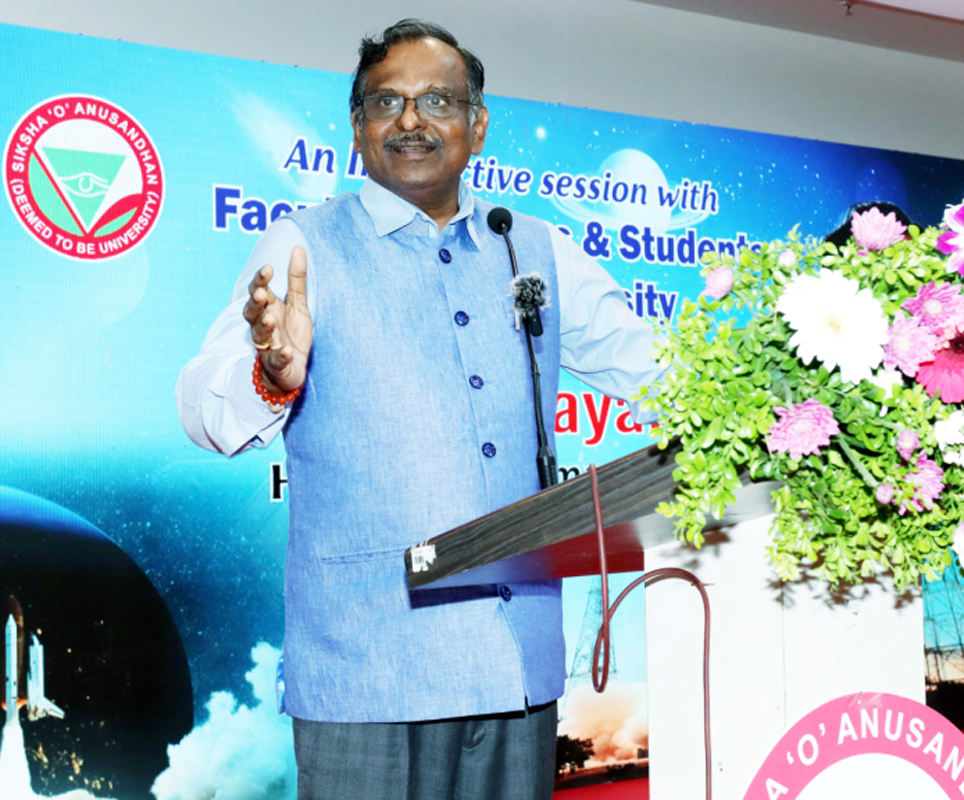
Bhubaneswar: In a significant revelation about India’s future in space exploration, Chairman of the Indian Space Research Organisation (ISRO) and Secretary of the Department of Space, Dr. V. Narayanan, announced on Wednesday that India plans to launch its own modular space station, the Bharatiya Antariksh Station (BAS), by the year 2035.
Addressing students, researchers, and faculty at Siksha ‘O’ Anusandhan (SOA) Deemed to be University in Bhubaneswar, Dr. Narayanan said the BAS would enhance India’s space presence and catalyze further advancements in space technology. The initiative is part of India’s broader vision to emerge as a global space power by 2047, he added.
Dr. Narayanan also spoke about India’s first human space flight mission, ‘Gaganyaan,’ which is expected to be launched in March 2027. Four test pilots are currently undergoing astronaut training for the mission. Ahead of the crewed flight, a series of uncrewed missions will be conducted to rigorously test onboard systems and technologies.
Highlighting ISRO’s long journey, Dr. Narayanan noted that although India’s space program began in 1962, it has made impressive strides despite starting much later than other spacefaring nations. He recalled that ISRO, founded in 1969, successfully launched its first satellite in 1980 and has since developed six generations of launch vehicles.
He pointed out several milestones that underscore ISRO’s achievements:
The successful development of cryogenic engines, two of which are fully indigenous, despite past global restrictions.
The historic Chandrayaan-3 mission, which made India the first country to soft-land on the Moon’s south pole and discover water molecules on the lunar surface.
The Mars Orbiter Mission (Mangalyaan), which placed India in the record books as the only nation to reach Mars’ orbit on its first attempt.
A world record launch, deploying over 100 satellites in a single mission.
Dr. Narayanan also highlighted recent technological achievements, including the first-ever satellite docking experiment carried out by ISRO on January 16, 2025. The operation was completed with remarkable precision while the satellites traveled at speeds of 28,400 km/h, followed by a successful undocking in orbit.
Looking ahead, ISRO plans to launch Chandrayaan-4, a more complex mission aimed at returning lunar samples to Earth, followed by Chandrayaan-5, which is expected to be a collaborative mission with Japan.
Bhubaneswar: Braj Mohan Ram on Sunday took oath as the new Governor of Odisha at…
Bhubaneswar: Recognising their gold medal-winning performances at the 2026 Asian Games in Japan, Odisha Chief…
Bhubaneswar: Two school-going sisters from Odisha have used a multiplication table to deliver a social…
Bhubaneswar: The Satwalipi Committee on Mahaprabhu Lingaraj Temple has submitted its third interim report to…
Bhubaneswar: Odisha will organise a state-level summit to finalise priorities and accelerate the implementation of…
Bhubaneswar: The Housing and Urban Development Department has asked Urban Local Bodies (ULBs) across Odisha…